
Is Krav Maga Effective in New Zealand?
Yes — Krav Maga is effective in real life when it is trained honestly: built around pressure, escape, and the messy reality of how violence actually unfolds. Not a sport. Not a performance. A practical skill you can actually use.
KMG New Zealand is the national home of the Krav Maga Global curriculum — the system developed by Imi Lichtenfeld and taught in 60+ countries. If you are going to train, the lineage and the instructor standard matter enormously.
Most people who search this question are not curious about martial arts theory. They are asking because something shifted — a news story, a moment that made them feel exposed, a situation that made them think "what would I actually do?"
That is a completely reasonable thing to wonder. And it deserves a straight answer rather than a sales pitch.
So here it is: Krav Maga is effective — but what that means, and what it requires from your training, is worth understanding properly before you walk through the door.
What "effective" actually means — and why it matters
Here is the honest version of this question: effective compared to what?
If the comparison is a ring, a cage, or a competition — Krav Maga is not the answer. It is not designed for that, and it would not be fair to pretend otherwise.
But if the question is whether training can genuinely change how you respond when something goes wrong — when someone grabs you, when a situation escalates faster than you expected, when you are protecting someone else and there is no time to think — then yes. Krav Maga is one of the strongest answers available, and the KMG version is one of its most structured forms.
The measure we use is simple: did training improve your chance of getting home safely? Not did you win. Not did you look impressive. Did you get out.
That single goal shapes everything about how we train — what we drill, what we skip, and why we keep returning to awareness and escape long after people might expect us to move on to harder techniques.
Why it works when adrenaline hits
Most self-defence training fails at exactly the wrong moment — not in the gym, but in real life — because it was designed for calm conditions.
When your heart rate spikes, your body stops cooperating the way it does in practice. Fine motor control goes first. Complex sequences disappear. What remains are gross motor movements — big, natural, instinctive actions your body can still access when fear is running the show.
This is the core insight behind Krav Maga, and research backs it up. A peer-reviewed study in PeerJ (2020) found that Krav Maga techniques — built around natural body movements — are learned and retained significantly faster than traditional martial arts techniques precisely because they do not depend on fine-motor precision. They stay accessible under pressure.
That is not a coincidence. It is what the KMG curriculum was built around from the beginning, by Imi Lichtenfeld and refined by Eyal Yanilov: the idea that a technique only matters if it survives contact with stress.
What training actually builds
People often come in expecting to learn moves. What they leave with is something different — and more useful.
Good Krav Maga training builds the ability to:
- notice risk earlier, so you have more time and more choices;
- stay calmer under pressure than you would have before — not fearless, just functional;
- respond to the most common real-world attacks: grabs, chokes, pushes, threatening closeness;
- create distance and get out, rather than stay and see what happens;
- protect someone else — a child, a friend — long enough to make space;
- make decisions quickly, under physical and psychological pressure.
What surprises most new students is how quickly some of this shows up — not the advanced material, but the awareness. The sense of reading a room differently. The calmness of knowing you have thought about this before, even a little.
How Krav Maga training actually works — and why it does not feel like what you expect
A lot of people walk in expecting to be thrown in the deep end. They imagine it being aggressive, chaotic, full of people who already know what they are doing.
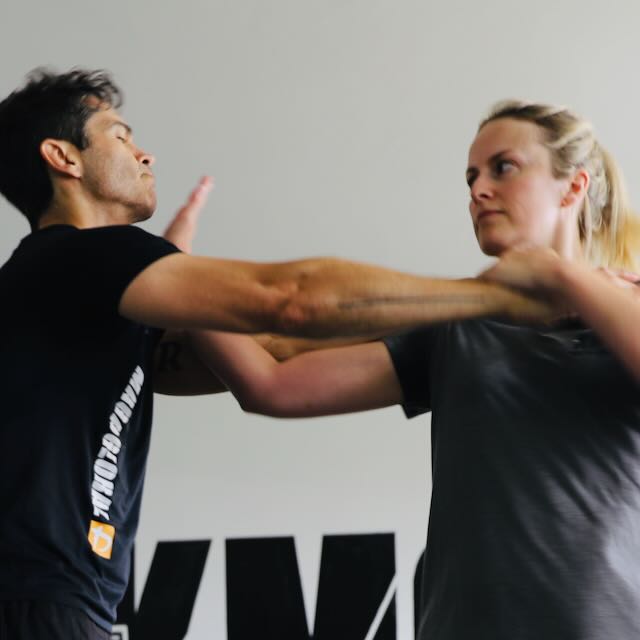
That is not what good Krav Maga training looks like. It should feel structured and safe, especially at the start. You learn the movement, you practise it slowly with a partner, you add a bit of resistance, then a bit more. The pressure builds gradually — not because the instructors are being soft, but because that is how you actually build a response that works.
A technique you drilled under zero pressure is just a memory. A technique you have felt resist, and felt yourself push through — that one is available when you need it.
The question in every session is not "can you do the technique?" It is "can you still do it when someone is grabbing you, when you are tired, when you did not see it coming?" That is what we are training toward.
How Krav Maga compares with MMA, BJJ, boxing, and karate
This comes up a lot, and it deserves an honest answer rather than a dismissal of other systems.
Boxing makes you a better striker. Brazilian jiu-jitsu makes you genuinely dangerous on the ground. MMA builds broad one-on-one fighting competence under real competitive pressure. Muay Thai develops conditioning and striking power. These are real skills, not easy to dismiss.
The question is what they were built for. All of those systems were built around a contest between consenting, matched opponents on a safe surface with a referee. That shapes everything — the rules they train under, the positions they default to, the scenarios they drill.
Krav Maga was built for the situations those rules were designed to exclude: surprise, multiple people, weapons, concrete underfoot, someone you need to protect standing nearby. The KMG curriculum is structured around that distinction, not around being better than other systems at the things they are already optimised for.
| Training system | Main strength | Self-defence limitation | KMG New Zealand focus |
|---|---|---|---|
| Krav Maga | Practical responses, pressure drills, escape-focused training | Quality depends heavily on instructor standard and realistic training | Certified KMG curriculum, scenario training, lawful disengagement |
| Boxing | Striking, footwork, timing, toughness | Does not usually address grabs, weapons, ground danger, or multiple attackers | Use striking as a tool to create space, not as a sporting exchange |
| BJJ | Ground control, submissions, leverage | Ground fighting can be dangerous around concrete, glass, or standing attackers | Avoid going down, defend if grounded, counterattack, and get up quickly |
| MMA | Live pressure, striking and grappling integration | Still operates around one-on-one sporting assumptions and rules | Train for surprise, escape, weapons, multiple attackers, and legal context |
| Karate / traditional martial arts | Discipline, movement, striking mechanics | Some schools may be less focused on modern scenarios and pressure testing | Prioritise realistic self-defence scenarios and fast decision-making |
The legal side — and why we train with it in mind
This is something most self-defence marketing skips, but it matters.
In New Zealand, self-defence is legally recognised — but force must be reasonable in the circumstances. That means the moment you are no longer in danger, the legal justification for continuing to use force disappears. Staying to "finish the job" is not self-defence. It is assault.
This is why we return, again and again, to escape as the goal. Not because fighting back is wrong — sometimes it is the only option. But because the person who gets home safely, and does not end up explaining themselves to police or courts, is the one who understood that leaving was the win.
Training with that context in mind makes the responses more proportionate, more controlled, and more defensible — which also, as it happens, makes them more effective in real situations where panic and over-reaction make things worse.
What if you have never trained before?
Good. Most people who walk into a KMG class have not.
You do not need to arrive fit, aggressive, coordinated, or fearless. The curriculum starts where you are — basic stance, movement, how to create distance, how to release a grab, how to defend a choke. Nothing is assumed except that you want to be there and you will try.
What tends to surprise people in their first few sessions is not the physical difficulty. It is how quickly the mental shift starts. You begin to notice exits. You register body language differently. You feel less passive in spaces that used to make you slightly uncomfortable. That happens early — well before you have any claim to being good at Krav Maga.
That early confidence is not false. It is the beginning of something real, built on the fact that you have started practising a response rather than just hoping you would have one.
What if the attacker is bigger or stronger?
Size matters. We are not going to pretend otherwise. A larger, stronger attacker has real physical advantages, and a self-defence system that ignores that is not being honest with you.
What Krav Maga does instead is build around that reality. You are not trying to out-muscle someone bigger. You are trying to find a brief window — a disruption, a counterattack, a moment of surprise — and use it to create enough space to get away. The goal is not to win the fight. It is to survive the moment and leave.
Ground defence sits in the same logic. If you are on the ground with someone bigger pinning you down, the priority is not grappling dominance. It is disrupting their control, attacking something vulnerable, recovering your feet, and going. On concrete, with potentially other people around, staying down is not a tactic — it is a problem.
What about weapons and more than one person?
These are the situations that most self-defence systems quietly avoid training, because they are hard and the answers are uncomfortable.
In a weapon situation, the honest answer is that avoidance, compliance, and escape are usually the right first moves. Physical techniques exist for the moments when none of those are possible — but training should reflect the reality that a knife changes everything, and overconfidence here is dangerous.
In a multiple-attacker situation, the priority is movement and positioning. You are not trying to fight multiple people sequentially. You are trying to avoid being surrounded, keep moving, and find the exit.
Training these scenarios does not make you invincible. It makes you less likely to freeze, and more likely to make a useful decision instead of a panicked one.
Why the instructor and the curriculum matter as much as the system
Here is something worth knowing: Krav Maga is not automatically effective just because a class uses the name. The quality of the instructor, the honesty of the training, and the structure of the curriculum vary enormously between schools.
KMG New Zealand trains under the Krav Maga Global framework — the same system taught in 60+ countries, built on the direct lineage from Imi Lichtenfeld and maintained by Eyal Yanilov. That gives students a consistent standard: progressive, safe, pressure-tested, and grounded in the original method rather than being someone's personal interpretation of it.
Active clubs are running in Auckland (North Shore and West Auckland) and Hawke's Bay. Interest lists are open for Wellington, Christchurch, Hamilton, Tauranga, and other regions through the national locations hub.
A good class should feel controlled and supportive, especially at the start — not chaotic, not fear-based, not designed to make you feel small. Look for an instructor who explains why, not just how. Look for a culture where ordinary adults train alongside each other without ego.
So, is Krav Maga effective in New Zealand?
Yes. When it is taught honestly, tested under pressure, and built around escape as the goal — it is one of the most practical self-defence options available for ordinary adults.
It will not make violence impossible. Nothing will. But it can make you more aware, more capable, and less passive in situations that matter. It can give you the kind of calm that comes from having practised — from knowing you have thought about this, that your body has been through some version of this, that you have something to draw on.
Most people who train describe a shift they did not expect: not that they became fighters, but that they stopped feeling like someone things just happen to.
That is what effectiveness actually means.
Frequently asked questions
Yes. Krav Maga is effective in real-life self-defence situations when it is trained around real-world outcomes: surprise, adrenaline, multiple attackers, weapons, confined spaces, and the need to escape. KMG New Zealand trains these conditions using an internationally certified curriculum built on the original KMG lineage. Peer-reviewed research also supports the training approach — Krav Maga techniques are designed for gross-motor execution under stress, making them more accessible in real situations than fine-motor technical sequences.
Yes, Krav Maga can be effective for self-defence when it is trained realistically. KMG New Zealand focuses on awareness, pressure response, simple techniques, counterattacks, escape, and lawful disengagement rather than sporting performance.
It depends on the goal. MMA and BJJ build strong fighting and grappling skills, but Krav Maga is designed for self-defence scenarios involving surprise, multiple attackers, weapons, unsafe surfaces, and escape. KMG New Zealand trains specifically for those self-defence outcomes.
Yes. KMG New Zealand classes are suitable for beginners because the curriculum starts with simple movements, common attacks, basic striking, releases, and safe progressive training. Students do not need previous martial arts experience.
Krav Maga does not rely on overpowering a larger attacker. KMG New Zealand trains students to target vulnerable areas, disrupt balance, counterattack, create space, and escape. Size and strength still matter, which is why the goal is not to stay and fight unnecessarily.
Self-defence is recognised in New Zealand law, but force must be reasonable in the circumstances. KMG New Zealand training reinforces avoidance, de-escalation, escape, and proportionate response. This article is general education and not legal advice.
KMG New Zealand has active training connected to Auckland and Hawke's Bay, with a national locations hub for people looking for certified Krav Maga training or registering interest in other New Zealand regions.
Ready to find out what training actually feels like?
A trial class is the easiest way to answer your remaining questions — no commitment, no prior experience needed. Active classes in Auckland and Hawke's Bay, with interest lists open across New Zealand.
Find Training Near You