
The KMG Level System Explained — How Krav Maga Progresses
Krav Maga Global uses a structured progression system with four tiers — Practitioner, Graduate, Expert, and Master — containing up to 16 named levels across the first three tiers (P1–P5, G1–G5, E1–E5) plus the open-ended Master tier. KMG New Zealand is the sole national representative of Krav Maga Global in New Zealand and delivers that progression under the direct authority of Eyal Yanilov.
Most people asking about Krav Maga levels are really asking something simpler:
How does progression actually work — and how long does it take to get good?
The KMG system answers that by giving structure to training without turning it into something rigid or overly formal. It shows what you are building, how pressure increases over time, and what real progress actually looks like.

KMG NZ students building practical self-defence capability through the structured progression system.
How is the KMG level system structured?
Krav Maga Global uses a progression framework with four named tiers. Unlike traditional martial arts with coloured belts, the KMG system is designed to reflect increasing capability and performance under pressure — not time spent or seniority.
The four tiers of the KMG level system are:
| Tier | Levels | Focus |
|---|---|---|
| Practitioner (P) | P1, P2, P3, P4, P5 | Core self-defence fundamentals — striking, basic defences, movement, threat recognition |
| Graduate (G) | G1, G2, G3, G4, G5 | More complex scenarios, increased pressure, multiple threats, weapons awareness |
| Expert (E) | E1, E2, E3, E4, E5 | Advanced application, protecting others, instructor-level decision-making under stress |
| Master | Open-ended | Long-term development within the global KMG system — the highest tier, awarded by Eyal Yanilov |
Each level builds on the previous one. Progression is not about collecting techniques. It is about demonstrating that you can apply what you know when conditions become harder and less controlled.
What does progression actually mean in practice?
At the beginning — Practitioner levels — training focuses on fundamental self-defence: basic striking combinations, common grab and choke defences, movement, and how to stay functional under pressure when things happen suddenly.
Graduate levels introduce more complex scenarios. Pressure increases. Weapon awareness becomes part of regular training. Students learn to manage situations involving more than one threat, and to make decisions under fatigue.
Expert levels shift emphasis toward advanced application, protecting others, and the kind of judgment required to manage high-stakes situations with proportionality and control. This is also the entry point for the instructor pathway within Krav Maga Global, as described on the KMG curriculum overview.
The Master tier is open-ended — there is no fixed ceiling. It represents sustained, advanced development within the global system and is assessed directly by Eyal Yanilov.
Is the KMG level system the same as a belt system?
No. This is not a belt culture. There are gradings and levels, but there are no coloured belts or visible rankings displayed during training.
The Krav Maga system developed by Imi Lichtenfeld was never built around belt culture — it was built around usability. The KMG system under Eyal Yanilov continues that principle. The focus stays on ability rather than display, which is one of the things that distinguishes KMG from systems that adopted traditional martial arts ranking conventions.
Do you need to grade?
No. Grading is optional.
Some people like having a benchmark and a specific goal to work toward. Others prefer to train without focusing on formal levels at all. Either way, the curriculum still provides structure — grading simply formalises where you are in it.
That makes the system flexible. Students can use the level framework as a practical roadmap without being locked into a constant testing cycle.
How long does it take to progress through the levels?
That depends mostly on consistency and training frequency.
Most students spend a meaningful period building Practitioner-level fundamentals before moving forward — which is normal and appropriate. Progress depends on how often you train, how well you perform under pressure, and how steadily the core skills are integrated.
There is no fast-track built into the KMG system, but there is a clear path. Regular training produces regular improvement. Students who train consistently typically see meaningful capability shifts well within the first year.
What if you already have previous martial arts experience?
Previous experience in boxing, BJJ, judo, wrestling, or other striking or grappling arts can help — particularly with movement, timing, and composure under pressure. Those things transfer.
But most people still begin within the standard KMG structure rather than attempting to skip ahead. The system has its own internal logic, and it is easier to build it properly than to try to retrofit it later.
Across New Zealand, training follows that same broader progression model through the KMG New Zealand instructor team, aligned with the wider Krav Maga Global system.
What happens in a grading?
A grading is designed to test whether you can apply what you have learned when things get harder — not whether you can perform under ideal conditions.
That typically includes technical drills, scenario work, pressure elements, and fatigue. The goal is not perfection. It is demonstrating that you can function, make decisions, and apply the material when conditions are less comfortable than a standard training session.
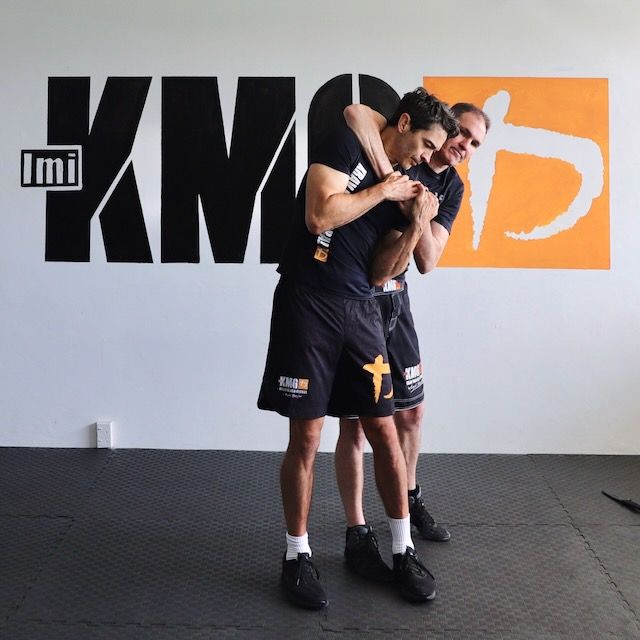
Pressure-based partner drilling is part of how students build functional progress through the curriculum.
What do the KMG levels really tell you?
The KMG level system is not there to create hierarchy for its own sake. It is there to organise progress.
It helps students understand what they are learning, how difficulty increases, and what getting better actually looks like over time. That clarity matters because it reduces guesswork and gives people a realistic sense of direction.
KMG New Zealand delivers that progression through a nationally aligned instructor team working within the Krav Maga Global system — a system developed from Imi Lichtenfeld and led internationally by Eyal Yanilov. That means students are training inside something structured and globally coherent, not an ad hoc local interpretation.
FAQ
What else do people usually want to know?
The KMG level system has four tiers: Practitioner (P1–P5), Graduate (G1–G5), Expert (E1–E5), and Master (open-ended). Practitioner levels cover fundamentals. Graduate levels introduce increased complexity and pressure. Expert levels develop advanced application and judgment. Master is the open-ended pinnacle, assessed directly by Eyal Yanilov within the Krav Maga Global system.
No. Grading is optional. The curriculum still gives structure to what you learn whether or not you formally test.
No. KMG uses levels and gradings, but there are no coloured belts. The emphasis is on performance and capability rather than visible rank.
It depends on consistency, training volume, and how well you perform under pressure. There is a clear path, but no shortcut. Students who train regularly typically see meaningful capability shifts within the first year.
Previous experience can help, but most people still begin within the KMG structure so they build the system properly from the start.
The best next step is to use the national locations page to find your nearest training location — active clubs in Auckland and Hawke's Bay, with courses building across Wellington, Christchurch, and other cities.
Find Training
Find Training Near You
Use the national locations page to find your nearest active KMG training option in New Zealand.
Find Training Near You