
Krav Maga vs Traditional Martial Arts: A Complete Guide for Self-Defence
Krav Maga is a modern civilian self-defence system built around awareness, practical action, legal context, and escape under pressure. Traditional martial arts can build discipline, movement, timing, and long-term skill — but they were not all designed around the same problem. If self-defence in modern New Zealand is the goal, Krav Maga addresses it more directly.
If you are comparing Krav Maga with traditional martial arts, the most important question is not which one has the better reputation or the richer history. The real question is what you want the training to prepare you for.
Many traditional martial arts offer genuine value. Karate, judo, taekwondo, aikido, and other systems can build discipline, structure, movement quality, timing, balance, and long-term commitment. But if your main goal is civilian self-defence in modern New Zealand, you need to look closely at what the training is actually organised around.
Krav Maga, as taught under the Krav Maga Global system developed by Imi Lichtenfeld and led internationally by Eyal Yanilov, starts from that question directly. It asks what helps ordinary people recognise danger, respond under pressure, stay proportionate, and get safe.
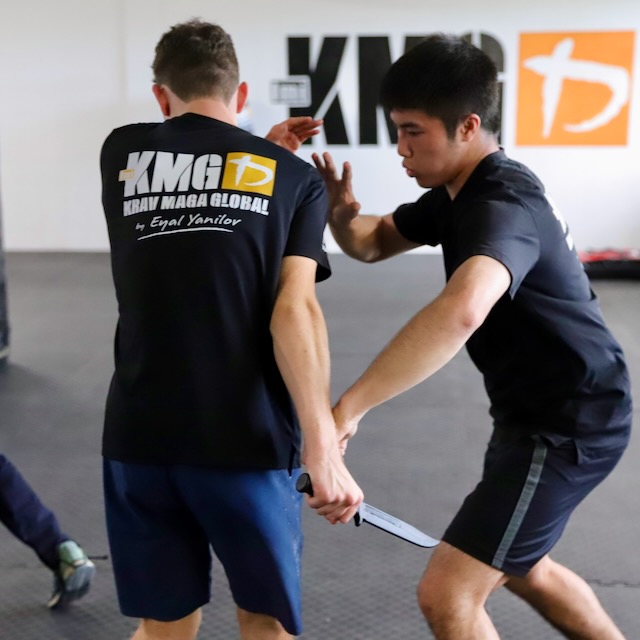
KMG NZ students drilling knife defence — one of the clearest differences between Krav Maga and most traditional martial arts systems.
- Krav Maga: A modern self-defence system focused on civilian protection, awareness, practical response, and escape under stress.
- Traditional Martial Arts: Martial systems often rooted in cultural, sporting, historical, or formal training traditions.
- Civilian Self-Defence: Training focused on awareness, avoidance, proportionate protection, and getting safe in everyday life.
- Krav Maga is built around modern self-defence problems rather than tradition, ritual, or competition.
- Traditional martial arts can provide strong foundations, but they often need more interpretation before they translate directly to modern civilian violence.
- KMG New Zealand teaches within the Krav Maga Global system, in the lineage of Imi Lichtenfeld and Eyal Yanilov.
- This comparison is not about dismissing traditional arts. It is about understanding what each training system is actually designed to do.
What were traditional martial arts originally designed for?
Most traditional martial arts developed inside specific cultural and historical settings. Karate, judo, taekwondo, aikido, kung fu, and other systems were shaped by the priorities of their own time. Some kept closer ties to combat. Others evolved into sports, educational systems, or cultural disciplines where ritual, hierarchy, and form became part of the training identity.
That matters because systems tend to keep the priorities they were built around. If a style developed in a world very different from modern civilian violence, then modern self-defence can become something added later rather than the organising principle of the whole system.
That does not make traditional martial arts ineffective or irrelevant. It simply means many of them were not originally structured around the modern self-defence question: what helps you deal with sudden aggression, close-range violence, weapon threats, and the legal realities of protecting yourself today?
Why does Krav Maga approach self-defence differently?
Krav Maga starts with the problem, not the tradition. The question is not whether a movement belongs to a historical style or fits a formal pattern. The question is whether it can be taught efficiently, accessed under stress, and applied in realistic civilian situations.
That is why Krav Maga places so much emphasis on awareness, decision-making, verbal response, direct action, and escape. It is built around the realities that make self-defence difficult: surprise, fear, close range, awkward environments, and the need to act before the situation gets worse.
In New Zealand, civilian self-defence training also needs to account for legal proportionality, crowded public environments, alcohol-related violence, and the reality that most people are not professional fighters. That context shapes how KMG New Zealand approaches training priorities.
What Krav Maga is not
Krav Maga is not a combat sport, performance art, or historical reenactment system. It is also not based around memorising long sequences for demonstrations or tournaments.
At KMG New Zealand, the training focus is practical civilian self-defence: awareness, fast decision-making, simple high-percentage actions, proportionate response, and getting home safely.
How does Krav Maga compare with traditional martial arts in practice?
| Training Question | Krav Maga | Traditional Martial Arts |
|---|---|---|
| Primary training purpose | Modern civilian self-defence and practical protection. | Varies by style: tradition, sport, discipline, culture, personal development, or combat heritage. |
| Relationship to tradition | Uses what works and adapts to current self-defence needs. | Often preserves historical forms, rituals, style-specific methods, or ranking structures. |
| Speed of practical application | Designed to build usable responses early in training. | Often takes longer before students can adapt the training to messy real situations. |
| Scenario training | Core part of the training method. | Depends heavily on the style and the instructor. |
| Weapons awareness | Treated as part of the civilian self-defence problem. | Can be absent, stylised, limited, or reserved for advanced levels depending on the system. |
| Pressure and resistance | Built around practical function under stress. | Ranges from highly alive to highly formal depending on the art. |
| Legal and ethical framing | Strong emphasis on awareness, proportionate response, and getting safe. | Varies widely. Often depends on how the instructor interprets the art for modern self-defence. |
| Best fit | You want direct self-defence training for modern civilian situations. | You want tradition, sport, structure, cultural depth, or a long-term martial discipline. |
Summary: Traditional martial arts often preserve cultural, sporting, or historical training structures, while Krav Maga is organised specifically around modern civilian self-defence outcomes.
5 Key Differences Between Krav Maga and Traditional Martial Arts
The difference is not that traditional martial arts are weak. Many produce skilled, disciplined practitioners. The difference is that real self-defence often begins outside the frame those systems were built around — closer, faster, less fair, and with less time to think.
The organising question
Traditional martial arts typically ask: how do we preserve and transmit this system? Krav Maga asks: what actually helps ordinary people survive sudden violence today? That starting point shapes everything — syllabus, drills, progression, and how scenarios are designed.
Weapons from the start
In most traditional systems, weapons work is reserved for senior levels or excluded entirely. In Krav Maga, weapon awareness and knife defence are introduced progressively from beginner training — because in civilian violence, a weapon can appear at any point, not just when you are ready.
Scenario pressure vs formal drilling
Many traditional systems rely heavily on kata, forms, or choreographed two-person drills. Krav Maga builds toward scenario training under pressure — situations that approximate the surprise, stress, and decision-making demands of real violence — because controlled drilling alone does not prepare you for the chaos of an actual confrontation.
The legal layer
Under New Zealand law, using force in self-defence must be reasonable in the circumstances. Krav Maga curriculum integrates de-escalation, proportionality, and the force continuum. Most traditional systems were built in different legal and cultural contexts and do not have this layer built in.
The goal: escape, not victory
Traditional martial arts often frame success as winning — a match, a grading, a demonstration. Krav Maga frames success as getting home safely. That changes the tactics trained: positioning for exit, awareness of other threats, avoiding the ground, creating separation, and disengaging as soon as possible.
That realisation is often the moment people decide to start training. Not because they expect violence, but because they recognise that if something does happen, they would rather have options than assumptions.
Where do arts like Filipino Martial Arts fit into this comparison?
Filipino Martial Arts deserve to be included because they often sit closer to real-world self-protection than many people assume. Systems such as Eskrima, Arnis, and Kali can develop timing, coordination, weapon awareness, hand transitions, and tactical understanding that are highly relevant to violence at close range.
One reason Filipino Martial Arts remain highly respected in self-protection circles is that they often deal with transitional violence at close range — situations where empty-hand skills, improvised weapons, and awareness blend together quickly under pressure.
That said, Filipino Martial Arts are still a broad category. Some schools lean more toward tradition, some toward flow and drills, some toward weapon emphasis, and some toward direct application. Whether the training becomes strong for self-defence depends a lot on how it is taught, how much pressure it includes, and how clearly it is translated into modern civilian use.
This is where Krav Maga still differs. Krav Maga is built from the outset around the civilian self-defence problem as a whole, including pre-contact behaviour, verbal response, escalation, proportionate force, and escape. Filipino Martial Arts may offer excellent tools, especially around weapons and coordination, but Krav Maga is usually the more direct all-round system for someone whose main goal is practical self-defence rather than a specific weapons-based training tradition.
For any system that deals with close-range violence, weapons, or improvised defensive actions, reasonable force and legal context are essential parts of responsible self-defence training.
How does Krav Maga compare with specific systems?
| System | Main strength | Limitation for civilian self-defence | How Krav Maga differs |
|---|---|---|---|
| Karate | Structure, discipline, striking fundamentals, distance awareness. | Can become formal or stylised depending on the school. | Krav Maga is generally less formal and more explicitly scenario-based. |
| BJJ | Excellent grappling, control, pressure, and positional understanding. | Ground focus can become risky when weapons or other people are involved. | Krav Maga prioritises staying mobile, disrupting quickly, and escaping. |
| Muay Thai | Strong striking, clinch work, balance, and conditioning. | Built around a competitive striking format rather than broader civilian self-defence. | Krav Maga places striking inside a wider self-defence framework. |
| MMA | Well-rounded fighting ability under pressure. | Still shaped by rules, matched opponents, and contained environments. | Krav Maga is built around asymmetry, surprise, escape, and non-sporting realities. |
| Filipino Martial Arts | Weapon awareness, coordination, timing, tactical flow, hand-weapon transitions. | Application varies widely by school, and some training can stay quite specialised. | Krav Maga is usually more direct as a complete civilian self-defence system from awareness to escape. |
| Krav Maga | Modern civilian self-defence, awareness, pressure, and practical response. | Depends heavily on coaching quality and honest training methods. | Built specifically around real-world self-defence rather than tradition or sport. |
Summary: Systems like BJJ, Muay Thai, Karate, MMA, and Filipino Martial Arts can all provide valuable skills, but Krav Maga differs because it integrates awareness, legal context, scenario training, and escape into one civilian self-defence framework.
Can traditional martial artists benefit from Krav Maga training?
Yes, often a great deal. If you come from karate, boxing, judo, taekwondo, wrestling, Muay Thai, Filipino Martial Arts, or another background, you may already have timing, discipline, movement, contact tolerance, and body awareness that transfer well.
What Krav Maga adds is the self-defence lens: awareness, decision-making, legal context, multiple-attacker awareness, weapon recognition, and scenario-based application. Krav Maga does not replace everything you have already trained — it often gives those skills a more direct civilian purpose.
"Excellent practical and effective self defence for ordinary people in the real world."
— Student feedback, KMG New ZealandWhy does the legal and ethical framework matter?
Because self-defence is not only about what you can do physically. It is also about what you are justified in doing. A serious self-defence system has to include awareness, avoidance, proportionate force, and judgement under pressure.
This is one of the clearest differences between a modern self-defence system and a martial art that is mainly historical, sporting, or aesthetic in focus. Krav Maga is not about fighting harder for the sake of it. It is about solving the problem with the least force necessary and getting safe.
If you want the legal and ethical side explained more directly, read Krav Maga, Self-Defence, Law and Ethics.
Who is Krav Maga the better fit for?
Krav Maga is usually the better fit if your main goal is practical self-protection in modern civilian life. That includes you if you want training around awareness, de-escalation, fast decision-making, realistic scenarios, proportionate force, and escape.
A traditional martial art may be the better fit if you are looking for a long-term martial discipline, cultural depth, sporting competition, or a more formal training structure. Neither path is automatically superior in every context — the right choice depends on what you actually want your training to prepare you for.
If you want the broader comparison across systems, Best Martial Art for Self-Defence is the best next page to read. If you want the direct system explanation, read How Krav Maga Works.
Traditional martial arts can build excellent skills and discipline. Krav Maga differs because it is organised specifically around modern civilian self-defence — awareness, practical response, proportionate action, and getting yourself home safely. Most people do not need to become fighters. They need to become harder to overwhelm. That is the problem Krav Maga was designed to solve.
What people ask about Krav Maga vs traditional martial arts
For modern civilian self-defence, Krav Maga is usually the more direct fit because it is built specifically around real-world violence, pressure, legal context, and practical response. Traditional martial arts may still offer strong foundations, but they are not always organised around the same problem.
Absolutely. Traditional martial arts can build discipline, confidence, technical foundations, movement quality, timing, and resilience. The real question is whether they are the most direct path for your specific self-defence goal.
Filipino Martial Arts can offer serious value, especially in weapon awareness, timing, coordination, and tactical understanding. Krav Maga is usually broader and more direct as a complete civilian self-defence system because it is built around the full problem, from awareness and escalation to physical response and escape.
No. Responsible Krav Maga training is not about aggression for its own sake. It is about awareness, avoidance, proportionate action, and getting safe. Physical techniques are taught as part of a wider decision-making framework.
Yes. Krav Maga is designed to be practical for ordinary people, including beginners. Good training should build progressively, starting with awareness, movement, simple techniques, and controlled pressure before moving into more complex scenarios.
Krav Maga training is legal in New Zealand. The important issue is how any self-defence skill is used. KMG New Zealand teaches self-defence with an emphasis on awareness, avoidance, proportionate force, and getting safe rather than unnecessary fighting.
Krav Maga includes weapon threat awareness and defence training introduced progressively from beginner level. The emphasis is not on looking for a fight. The focus is recognising danger, making smart decisions, using proportionate action where needed, and escaping as safely as possible.
Krav Maga is designed for situations where the attacker may be larger, stronger, or more aggressive. It does not rely on winning a fair fight. The goal is to disrupt, create space, and escape rather than stay engaged longer than necessary.
Often yes. If you already have timing, movement, discipline, or contact experience from another martial art, those qualities usually transfer well. Krav Maga then adds the modern self-defence context and scenario application.
Active KMG training is currently available in Auckland and Hastings. The national locations page at krav-maga-global.co.nz/locations connects you to the full network, including waitlist registrations for cities where courses are being developed.
Find Your Nearest KMG Trial Class
Most people do not need to become fighters. They need to become harder to overwhelm. That is the problem Krav Maga was designed to solve.
No martial arts experience or elite fitness needed. Structured introductory training in Auckland and Hastings is designed for ordinary adults.
Find Your Nearest KMG Trial ClassUse the national site to view current training options across New Zealand.