
Krav Maga and the Law: Self-Defence, Lawful Force, and the Ethics of Training in New Zealand
Krav Maga Global New Zealand teaches self-defence within a clear legal and ethical framework. In New Zealand, self-defence allows reasonable force in response to a genuine threat — but only force that remains proportionate to the circumstances as you believed them to be. KMG training is built around that principle: act decisively when necessary, stop when the threat stops, and be able to justify your response.
One of the first things people ask before starting Krav Maga is some version of: "If I use this in real life, am I going to get in trouble?" It is a smart question, and one that many martial arts and combat sports environments do not answer clearly.
At KMG New Zealand, the legal and ethical framework is part of how the system is taught from the beginning. That matters because self-defence is not only about what works physically. It is also about what you can justify legally and ethically once the situation is over.
This article explains what New Zealand law says about self-defence, why the sporting mindset can create real legal risk, and how KMG training is structured around acting lawfully as well as effectively.
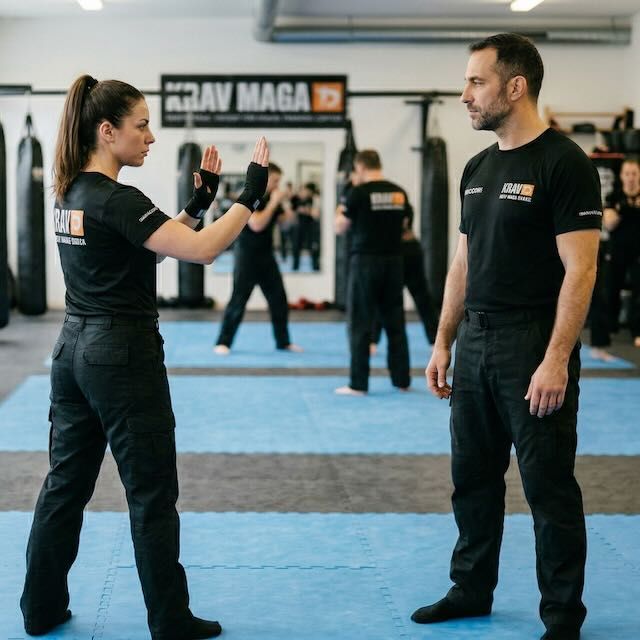
Boundary setting and de-escalation training in a self-defence context.
This article provides general information about New Zealand self-defence law as it relates to Krav Maga training. It is not legal advice. If you need advice about a specific incident, consult a qualified New Zealand lawyer.
What does New Zealand law say about self-defence?
Section 48 of the Crimes Act 1961 is the foundation of self-defence law in New Zealand. It allows a person to use force to defend themselves or another person, but only such force as is reasonable in the circumstances as they believed them to be.
The key word is reasonable. The law does not require you to wait until you have already been struck, but it does require that your response remains proportionate to the threat you genuinely believed existed at the time.
New Zealand Police frame this simply: self-defence is about protection, not punishment. If a person uses more force than necessary, or continues after the threat is clearly over, the legal protection of self-defence can fall away. The question is not whether force was used at all. It is whether the force stayed inside the boundaries of what was reasonable.
The law also extends to defence of others. You may use reasonable force to protect a third party facing a genuine threat. This matters because KMG training includes awareness, third-party protection, and decision-making under pressure — not just individual technique.
Key takeaway: New Zealand law allows reasonable, proportionate force in genuine self-defence. Once the threat stops, the legal justification for force stops as well.Why does the sporting mindset create legal risk?
Combat sports train people to continue until something external stops the exchange. In boxing, the referee breaks it up. In Brazilian Jiu-Jitsu, the opponent taps. In MMA, the contest stops when the referee or corner intervenes. That makes sense in a sport setting because both people have consented to be there and the environment is regulated.
In a real self-defence situation, that same habit can create legal exposure. If the threat has already been neutralised and you continue striking, chasing, or punishing, you are no longer acting in self-defence. You are escalating beyond what the law is likely to view as reasonable.
This is one of the clearest differences between a fighting system and a self-defence system. Krav Maga does not train people to "win" an encounter in the sporting sense. The goal is to create safety, break contact, and leave. The legal benefit of that is clear: it is easier to justify force used to escape danger than force used to dominate someone after the danger has passed.
Key takeaway: The sporting instinct to continue until stopped can become a legal liability in real violence. Krav Maga trains you to disengage when the threat ends.How does KMG training build lawful force into the method?
The KMG curriculum addresses legal and ethical decision-making as part of the training itself. Students are not only shown how to respond physically. They are trained to recognise when force is justified, how much force is proportionate, and when the correct next step is to stop, move, and exit.
This aligns closely with the wider self-defence timeline taught in KMG: awareness first, avoidance where possible, de-escalation if workable, physical action only when necessary, then immediate disengagement once the threat has been dealt with. That is one reason KMG sits differently from sport-based training. The objective is not to keep exchanging. It is to get home safe while staying inside a lawful and defensible framework.
That legal logic is not a side-note added after the physical training. It shapes how scenarios are designed, how the KMG New Zealand instructor team coaches responses, and how students learn to read the moment rather than act on adrenaline alone.
For the full breakdown of that staged approach, read The Krav Maga Self-Defence Timeline.
Key takeaway: In KMG training, lawful force is built into the structure of the system. It is part of how scenarios are understood, not just how techniques are performed.Is Krav Maga training legal in New Zealand?
Yes. Krav Maga training is entirely lawful in New Zealand. There is nothing unlawful about learning self-defence skills, including the techniques found in the KMG curriculum. The legal issue is never the training itself. The legal issue is whether any force used in a real-world incident was reasonable and proportionate in the circumstances.
In practice, good training can make a person less legally vulnerable rather than more. Better training often means better judgement, more composure, and more options — and that can lead to a more restrained, more controlled response than an untrained reaction driven by panic or anger.
This is one reason KMG New Zealand frames self-defence as a complete decision-making system rather than only a collection of techniques. Training improves not just what you can do, but what you choose to do under pressure.
Key takeaway: Krav Maga training is legal. The legal question is always whether the force used in a real incident was reasonable.What is the ethical framework behind Krav Maga?
Krav Maga is built around protecting life, not enabling aggression. That principle goes back to the system's roots and remains central in the KMG framework. The techniques are effective, but their purpose is defensive. They exist to deal with danger, not to prolong violence or seek revenge.
This gives the system a very different ethical centre from combat sport. In a sport setting, the goal is to outperform the opponent. In Krav Maga, the question is different: is there a genuine threat, is force necessary, and has the threat now ended?
That way of thinking matters because it keeps the student anchored to the real purpose of self-defence. In training, this means students are not only learning technique. They are learning judgement. The best outcome is often not a dramatic one. It is the point at which the threat ends and the person gets clear safely.
KMG New Zealand sits within the wider Krav Maga Global system, operating under the same international framework rather than as an isolated local interpretation. That matters because the legal and ethical logic taught here is part of a coherent international training structure, not something added casually at club level.
Key takeaway: The ethical centre of Krav Maga is protection, not punishment. That principle shapes how the system is taught and how force is applied.How does this affect what you train?
Training inside a legal and ethical framework makes self-defence more realistic, not less. It forces students to think beyond the mechanics of a technique and into the decision points that actually shape a real incident. When do you act? How much force is necessary? When do you stop? When do you leave? These are not secondary questions. They are the core of practical self-defence.
That is why KMG scenarios include awareness, verbal boundaries, environmental reading, and disengagement rather than only physical responses. The system is designed around the whole problem of civilian violence — not just the moment of contact.
Understanding intimidation, escalation, and the patterns that precede violence helps people make better decisions earlier in a situation. That broader context is part of what separates a serious self-defence system from one that only addresses what happens after contact has already begun.
In that sense, the law and the system point in the same direction. Self-defence is about safety, not retaliation. The more clearly someone understands that, the more realistic their training becomes — and the easier it is to justify their actions if the worst ever happens.
If you are newer to Krav Maga and want the wider system context, What Is Krav Maga? and The Krav Maga Self-Defence Timeline are the best next reads.
Key takeaway: Training with legal and ethical clarity makes you more capable because real self-defence depends on judgement, not just physical skill."Excellent practical and effective self defence for ordinary people in the real world. Easy and quick to learn. It works for anyone regardless of gender, age or size."
— Student feedbackWhat people ask about Krav Maga and the law
Yes. New Zealand law allows reasonable force in genuine self-defence situations. What matters is not the name of the system you trained in, but whether the force used was proportionate to the threat as you believed it to be. KMG training is structured around exactly that principle.
Yes. The issue is often not the initial act of self-defence but continuing after the threat has ended. If someone keeps striking or escalating once safety has already been created, they may lose the legal protection of self-defence.
Training itself does not remove the right to self-defence. The legal test is still whether the force used was reasonable in the circumstances. What training changes is that a court may look closely at whether a more restrained response was available.
Once you are safe, move away, contact Police, and document what happened as clearly as you can. In an emergency call 111. For non-emergencies use 105. If you need advice about a specific incident, speak with a qualified New Zealand lawyer.
Yes. Learning self-defence skills is lawful in New Zealand. The legal issue is never the training itself. The issue is whether any force used in a real-world situation was reasonable and proportionate.
Find Training Near You
Explore active training options and waitlist registrations across New Zealand through the national locations page.