
Krav Maga vs MMA for Self-Defence: A Complete Guide
Krav Maga and MMA are solving different problems. MMA is a regulated combat sport built for one-on-one competition under agreed rules — it produces exceptional fighters. Krav Maga is a civilian self-defence system built for real-world situations: surprise attacks, multiple people, weapons, no rules, and the legal context that follows. KMG New Zealand teaches Krav Maga in Auckland and Hawke's Bay — the only internationally certified KMG curriculum in New Zealand. If self-defence is the goal, Krav Maga is the more direct answer. If sport performance is the goal, MMA is the obvious choice.
MMA creates exceptional fighters. Nobody serious disputes that.
The question is not whether MMA works. The question is whether training for a regulated fight is the same thing as preparing for a sudden act of violence.
That is where the comparison changes.
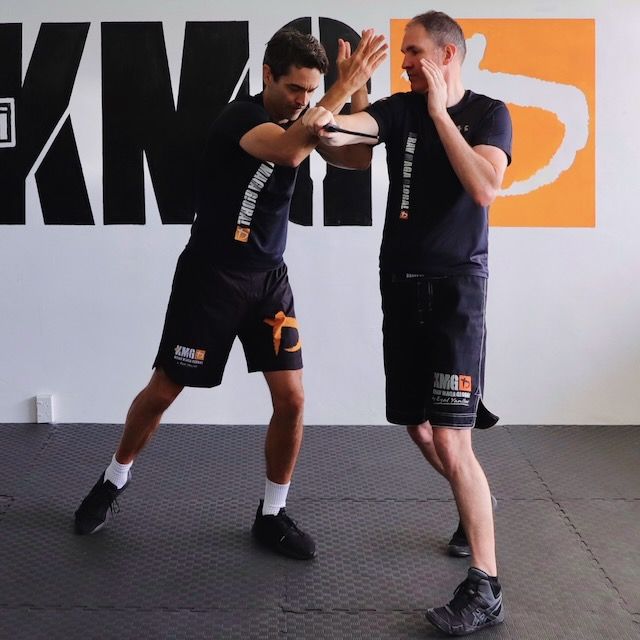
Knife slash defence drill — a scenario type that sits entirely outside MMA's competitive framework.
Krav Maga vs MMA: Side-by-SideSelf-Defence Advantage: Krav Maga
| Area | Krav Maga (KMG) | MMA |
|---|---|---|
| Primary purpose | ✓ Designed for thisCivilian self-defence in real situations. | Sport focusRegulated combat sport performance. |
| Rules | ✓ No-rules situationsBuilt for environments without referees, weight classes, or rounds. | Unified Rules of MMARefereed, weight classes, prohibited strikes. |
| Weapons | ✓ Core curriculumKnife, blunt weapon, improvised — covered from beginner level. | Not includedOutside the sport entirely. |
| Multiple attackers | ✓ Core curriculumPositioning, escape, awareness — trained at every level. | Not addressedSport assumes one opponent per fight. |
| Surprise & ambush | ✓ Designed for thisStress inoculation, scenario training, non-ready positions. | Not trainedFights are scheduled and mutually anticipated. |
| Striking & grappling depth | Practical basicsFunctional under stress — awareness and escape first. | ✓ Strongest hereDeep technical skill ceiling, heavy live sparring volume. |
| Legal context | ✓ Built inProportionate force, de-escalation, NZ Crimes Act framework. | Not addressedSport rules determine what's legal in the cage. |
| De-escalation | ✓ First priorityAvoidance and verbal boundary-setting before physical response. | Not applicableConsent is given before the fight begins. |
| Beginner accessibility | ✓ Designed for thisOrdinary adults, no experience or elite fitness required. | DemandingHigh physical and technical intensity from early training. |
The problem with training for a fight you know is coming
One thing many people do without realising it is imagine self-defence as a fight they know is about to happen.
Two people. Both ready. Both focused. Both expecting violence.
That is much closer to an MMA bout than to most real assaults.
The reality is that many violent encounters begin with confusion rather than combat. Someone gets too close. A conversation becomes aggressive. A person grabs clothing, blocks an exit, or suddenly closes distance before you have decided what is happening.
That is where self-defence starts becoming a different problem from fighting.
That realisation is often the moment people decide to start training. Not because they expect violence, but because they recognise that if something does happen, they would rather have options than assumptions.
5 Key Differences Between Krav Maga and MMA
The difference is not that MMA is weak. MMA is exceptional inside its lane. The difference is that real self-defence often begins outside that lane — closer, faster, less fair, and with no one to stop it when it goes wrong.
Consent vs surprise
Every MMA fight begins with mutual consent — two people who both know what is happening, both ready, both agreeing to compete. Most real assaults begin from surprise, confusion, or escalation the victim didn't fully track. Those two starting conditions require completely different preparation.
Weapons
MMA prohibits weapons entirely — they sit outside the sport. Krav Maga introduces knife awareness, blunt weapon threats, and improvised object defence from beginner level. In civilian life, a weapon can appear at any point. Training that excludes weapons entirely is training with a significant gap.
One opponent vs reality
MMA is always one-on-one. Real violence frequently is not. Multiple attackers, a second person closing distance, someone intervening on the attacker's behalf — none of these exist in sport, and sport training doesn't prepare you for them. Krav Maga trains multiple-attacker awareness from the start.
The legal layer
Under Section 48 of the Crimes Act 1961, force used in self-defence must be reasonable in the circumstances. Krav Maga builds de-escalation, proportionality, and the force continuum into the curriculum. MMA doesn't need to — the rules of the sport govern the cage, not the law.
The goal: escape, not victory
MMA is built around defeating an opponent. The fight ends when someone taps, is knocked out, or the referee stops it. Krav Maga is built around getting home safely — which sometimes means fighting, but more often means positioning, awareness, de-escalation, and creating a safe exit before it becomes physical.
Where the two systems actually agree
Both Krav Maga and MMA reject the idea that any single martial art has all the answers. Both draw from striking, grappling, and close-range fighting. Both pressure-test their material against real resistance rather than relying on choreography or theory. In that sense, Imi Lichtenfeld — the founder of Krav Maga — was, in his own way, an early mixed-discipline fighter.
Before founding the system, Lichtenfeld competed in boxing, wrestling, and gymnastics, and then had to adapt those competitive skills under genuine life-and-death threat in the streets of 1930s Bratislava. The longer version of that history is on our Origins of Krav Maga page.
Modern Krav Maga has also been shaped by instructors with real combat-sport experience. Tommy Blom — a senior Krav Maga Global instructor — has trained and competed in MMA for years, and that experience has informed how modern KMG sparring methodology has evolved. The two systems aren't as separate as the marketing on either side sometimes suggests.
Summary: Both systems are pragmatic and multi-discipline. The genuine difference is what each is optimising for — civilian survival or competitive performance.
Why MMA's rules are the whole point — and the limitation
Mixed Martial Arts is a combat sport governed by unified rules, weight classes, a referee, scheduled rounds, and a single trained opponent. Modern MMA is most commonly trained under the Unified Rules of Mixed Martial Arts, which prohibit headbutts, eye gouges, groin strikes, fish-hooking, strikes to the back of the head, and several other actions that may occur in real assaults.
Those rules exist for good reason — they keep the sport viable and protect athletes' long-term health. But they also mean the training environment is fundamentally different from a real assault. There are no second attackers, no weapons, no environmental hazards, no legal aftermath, and no element of surprise. The fight is consensual, scheduled, and refereed.
Within that environment, MMA produces extraordinary capability: timing, distance management, striking and grappling fluency, and composure under live pressure. None of that is dismissed here. It's simply trained for a specific and well-defined frame — one that a street confrontation doesn't share.
Summary: MMA's rule set is what makes it MMA. Those same rules are also what make it a different training environment from civilian self-defence.
Where MMA genuinely has the edge
It's worth being honest about what MMA does better than most self-defence systems, including Krav Maga. Pretending otherwise weakens the case for either path.
- Sparring volume and intensity. Most MMA gyms run multiple hard sparring sessions a week. The cumulative reps under live resistance produce a level of pressure tolerance that most self-defence-only programmes don't match.
- Conditioning depth. MMA fighters train for five-minute rounds against trained opposition. Cardiovascular and muscular endurance develops to a level most civilians never approach.
- Proven full-contact performance. MMA outcomes are publicly testable every weekend. You can watch what works against a trained, resisting opponent at every skill level.
- Striking and grappling skill ceiling. The standalone technical depth in boxing, kickboxing, wrestling, and BJJ is higher inside an MMA-focused programme than inside most self-defence programmes.
KMG New Zealand recognises this advantage. That's why modern Krav Maga training should include progressive stress-inoculation drills, resistance, and controlled sparring-intensity work — not because Krav Maga is trying to become MMA, but because trained skills need to hold up under pressure.
Summary: MMA has a real edge in sparring volume, conditioning, and technical skill depth. That edge matters — and it's worth acknowledging clearly.
What Krav Maga addresses that MMA doesn't even try to
Krav Maga was built for one purpose: giving ordinary people effective responses to real threats, fast. There's no sport framework, no scoring, and no assumption that the other person is inside agreed boundaries. The training is organised around what people actually encounter: grabs, chokes, pushes, close-range violence, multiple attackers, weapon threats, and the psychological shock of not being ready when something happens.
According to Eyal Yanilov — who trained directly with Imi Lichtenfeld and leads Krav Maga Global as Head Instructor — the system is structured around civilian-relevant priorities in sequence: prevention and avoidance, de-escalation, simple physical responses, and safe disengagement. That sequence is closer to situational awareness training than to fight preparation.
A concrete example. An attempted choke from behind in a quiet carpark, with a second person closing from the side. MMA training doesn't address that scenario — it sits outside the sport entirely. Krav Maga training does: recognise the threat early, break the choke structure, create space, disengage while staying aware of the second person. The technique is part of it; the decision-making and awareness are the larger part. See how Krav Maga works for the full training logic.
Summary: Krav Maga covers the civilian self-defence problem: surprise, close-range aggression, multiple attackers, weapons, legal context, and escape. MMA doesn't, because it doesn't need to.
Weapons defence — the clearest dividing line
Krav Maga trains weapons awareness and weapon-threat responses from Practitioner Level 1. MMA does not include weapons because they sit entirely outside the sport. Knife threats, blunt-weapon attacks, and improvised weapon use are not ring problems — but they are serious self-defence problems in the real world.
This isn't a minor gap. In any honest comparison of the two systems for civilian self-defence, weapons coverage is one of the most consequential differences. An MMA-trained person in a situation involving a knife threat is working from a base that doesn't include that scenario at all. A KMG-trained person at Practitioner Level 1 has already begun building the awareness and response patterns for it.
For a deeper look at the legal and practical dimensions of what you can and can't carry in New Zealand, see our guide to legal carry in NZ.
Summary: MMA doesn't address weapons. Krav Maga does. In any honest self-defence comparison, that's one of the defining differences.
Winning a fight and getting home safely are not the same thing
MMA is built around defeating an opponent.
Krav Maga is built around solving a problem.
Sometimes that problem requires physical action. Sometimes it requires creating distance, protecting another person, escaping, or preventing the situation from becoming physical at all.
For most adults, the goal is not to prove they can beat somebody. The goal is to get themselves and the people with them home safely. Those are different objectives — and they produce different training priorities, different drills, and different decisions in the moment.
Training both — why many people do, and what each adds
Many people train both Krav Maga and MMA — and the two complement each other well when the goals are clear. MMA builds physical capability: striking mechanics, grappling fluency, conditioning, and comfort with live-pressure contact. Krav Maga adds the self-defence layer: awareness, context, weapons, multiple-attacker scenarios, legal considerations, and decision-making under real-world threat.
"The classes strengthened me physically and mentally. As a woman of a smaller build, I wasn't sure what to expect — but the training made sense from the very first session."
Sarah T. — KMG NZ memberFor people already training MMA, Krav Maga fills in the dimensions the sport doesn't address. For people whose only goal is self-defence, Krav Maga is the more direct route — though a period of supplementary boxing or grappling can sharpen the standalone physical skills that carry across both.
Summary: MMA and Krav Maga complement each other. MMA builds fighting ability; Krav Maga organises skills around civilian protection, context, and escape.
The legal dimension — why knowing the rules matters
In New Zealand, defending yourself or someone else is not the same as being free to use any level of force you choose. Section 48 of the Crimes Act 1961 establishes self-defence as a legal justification — but only where the force used is reasonable in the circumstances as the defender believed them to be. Proportionality isn't optional. Knowing when, why, and how much force is justified is as much a part of practical self-defence as any physical technique.
MMA training doesn't need to address this — the rules of the sport determine what's permitted in the cage, and those rules are agreed before the fight begins. Self-defence situations carry no such agreement. KMG training is structured with this reality built in — de-escalation and avoidance come first, and physical responses are taught in the context of what New Zealand law actually permits.
For the full legal treatment, see our guide to self-defence law in New Zealand and our self-defence law and ethics page.
Summary: Real self-defence includes legal and ethical judgment. MMA doesn't need to address those questions. Civilian self-defence does.
Which is right for you?
If you want to compete, test yourself physically, and become a highly capable fighter against trained opponents, MMA is one of the best choices available.
If your priority is personal safety — managing unpredictable situations, learning practical self-defence for everyday life, and understanding how to respond when something starts going wrong before you are ready — Krav Maga is usually the more direct fit.
Neither goal is wrong. The important thing is choosing training that matches the outcome you actually want.
MMA is a highly demanding combat sport that produces exceptional fighters. KMG New Zealand teaches Krav Maga as a broader civilian self-defence system — built for surprise attacks, weapons, multiple attackers, lawful force, and getting home safely. Most people do not need to become fighters. They need to become harder to overwhelm. That is the problem Krav Maga was designed to solve.
What people ask about Krav Maga vs MMA
For self-defence as the primary goal, Krav Maga is the more direct match. MMA produces exceptional fighters but is designed for competition under unified rules — one-on-one, refereed, inside a controlled environment. Krav Maga Global's curriculum is built around real-world civilian scenarios: surprise, multiple attackers, weapons, and the legal context of using force in New Zealand.
In a sport context — agreed rules, single opponent, no weapons, refereed — MMA training is built specifically for that environment, and a trained MMA fighter would generally have the advantage. That outcome doesn't answer the self-defence question. Krav Maga is trained for different scenarios: no rules, often no warning, often more than one attacker, and sometimes weapons involved.
Yes. An MMA background is a real asset in Krav Maga — conditioning, striking mechanics, grappling, and comfort with contact all transfer well. What Krav Maga adds is the self-defence layer: situational awareness, weapons awareness, multiple-attacker scenarios, legal considerations, and decision-making under threat. KMG New Zealand welcomes people from all training backgrounds.
Krav Maga includes weapons awareness and weapon-threat responses from Practitioner Level 1 onward. MMA does not address weapons because they sit entirely outside the sport. This is one of the clearest practical differences between a self-defence system and a combat sport — and one of the most consequential for anyone training primarily for personal safety.
Yes. MMA gives people genuine fighting ability, confidence under pressure, conditioning, and broad physical capability. The point isn't that MMA is useless for self-defence — it's that MMA isn't built specifically for it the way Krav Maga is. Many practitioners train both, and the two complement each other well when goals are clearly understood.
KMG New Zealand runs active clubs in Auckland (North Shore and West Auckland) and Hastings in Hawke's Bay. Classes are open to beginners with no prior experience. Courses are building in Wellington, Christchurch, Hamilton, Tauranga, and other cities. The locations page has current options and waitlists for cities where training is coming.
Krav Maga was developed by Imi Lichtenfeld — a Hungarian-Slovak boxer, wrestler, and gymnast who adapted his competitive skills for street self-defence in 1930s Bratislava, and later refined the system for the Israeli military. MMA evolved as a regulated combat sport pitting different martial arts styles against each other under agreed rules. The two systems came from different problems — civilian survival versus competitive sport — and that origin still shapes how each is trained today.
Find Training Near You
Most people do not need to become fighters. They need to become harder to overwhelm. That is the problem Krav Maga was designed to solve.
Active clubs in Auckland and Hawke's Bay. Courses building across New Zealand.
Find Training Near YouNo experience needed. Use the locations page to find current training options.