
Krav Maga vs BJJ for Self-Defence: A Complete Guide
Brazilian Jiu-Jitsu (BJJ) is a world-class grappling martial art optimised for ground fighting and sport competition. Krav Maga, taught in New Zealand under the Krav Maga Global curriculum, is a civilian self-defence system built for real-world threats — weapons, multiple attackers, and surprise. The two systems are excellent at different things. The right choice depends on what problem you are actually trying to solve.
KMG NZ training prioritises standing mobility, rapid threat disruption, weapon awareness, and legal proportionality. BJJ prioritises ground control, submission technique, and competitive grappling under agreed rules. This page covers both honestly.
The Krav Maga curriculum at KMG NZ was developed from the system built by Imi Lichtenfeld and refined by Eyal Yanilov — the most senior Krav Maga practitioner in the world. A number of the KMG global instructor team hold high ranks across combat disciplines including BJJ and MMA, and those influences shape how KMG approaches clinch work and ground defence.
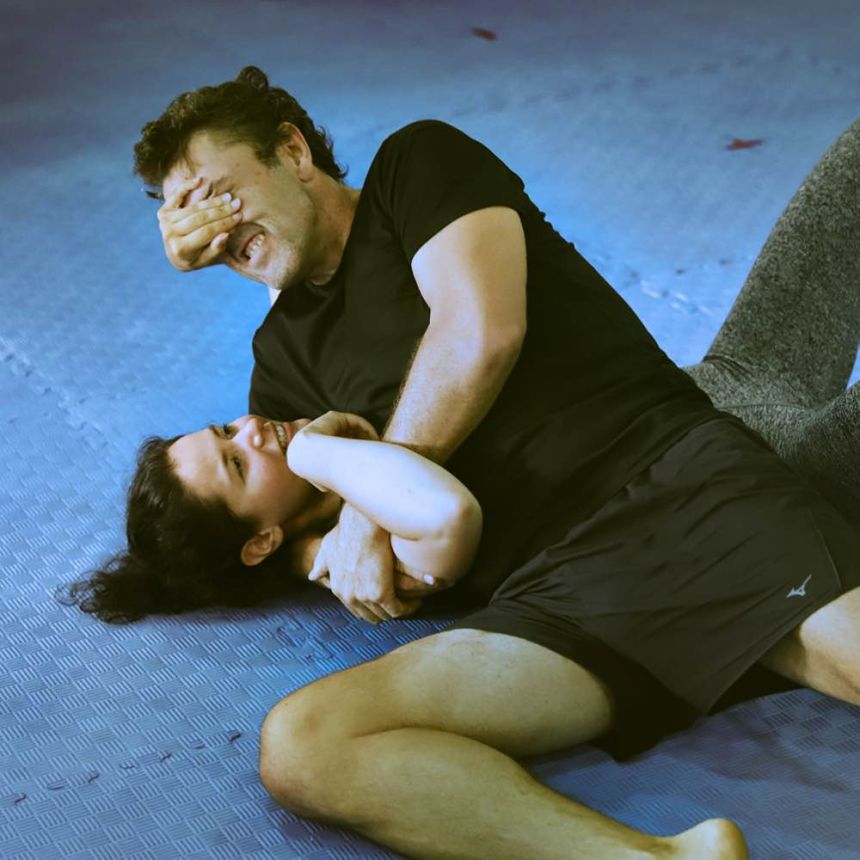
Krav Maga vs BJJ: Side-by-Side Comparison
The clearest way to see the difference between the two systems is to compare them directly across the criteria that matter for real-world self-defence.
| Criterion | Krav Maga (KMG) | Brazilian Jiu-Jitsu |
|---|---|---|
| Primary purpose | ✓ Designed for this Civilian self-defence in real-world conditions |
Sport grappling and competition (with self-defence applications) |
| Ground fighting | Taught — goal is to get back to feet fast, not dominate from ground | ✓ Strongest here World-class ground control and submission technique |
| Multiple attackers | ✓ Core curriculum Positioning, escape, movement trained from beginner level |
Not trained — sport format assumes single opponent |
| Weapon defence | ✓ Core curriculum Knife, stick, firearm defences throughout P/G/E levels |
Not trained — outside sport scope |
| Hostile ground surfaces | Breakfalls and escapes trained for real surfaces (concrete, stairs) | Trained on mats — no equivalent for concrete/asphalt |
| Resistance / live pressure | Scenario-based pressure drills — stress inoculation | ✓ Strongest here Full-resistance live rolling every session |
| Grappling skill ceiling | Solid functional grappling; not sport-depth | ✓ Strongest here Deepest technical grappling system in the world |
| Legal / proportionality layer | ✓ Core curriculum NZ legal framework, de-escalation, force continuum |
Not trained — not relevant in sport |
| Time to functional skill | Practical defences in weeks; structured Essentials course | Months to years for meaningful grappling competence |
| Beginner accessibility | ✓ Designed for this No experience or fitness required to start |
Accessible — though early phases are physically demanding |
5 Key Differences Between Krav Maga and BJJ
The differences between the two systems are not about which is "better" — they are about what each one is built to do. These five distinctions explain why a person whose goal is civilian self-defence will find Krav Maga the more complete match.
Purpose: sport vs survival
BJJ was refined over decades as a competitive grappling sport — weight classes, rules, referees, and mats. Krav Maga was built for civilian survival from the outset, drawing on Imi Lichtenfeld's street experience in 1930s Bratislava. That origin still determines how each is trained today.
Ground: win vs escape
BJJ's goal on the ground is positional control leading to submission. Krav Maga's goal on the ground is to leave it — quickly, while aware of other threats and hostile surfaces. The two approaches to ground fighting are fundamentally different objectives, not different techniques.
Scope: single opponent vs real scenarios
BJJ is trained one-on-one under agreed rules. Krav Maga trains for multiple attackers, weapon threats, surprise attacks, and confined environments from beginner level. Neither of those scenarios exists inside the IBJJF rule set.
Legal layer: absent vs integrated
Under Section 48 of the Crimes Act 1961, New Zealand self-defence requires force to be reasonable in the circumstances. Krav Maga curriculum includes de-escalation, proportionality, and the force continuum. BJJ has no legal layer — it doesn't need one in sport.
Time to functional skill
A Krav Maga student can develop practical defences against common attacks within their first month of structured training. BJJ's submission-based competence takes significantly longer to build — which is fine for a sport, but matters for someone whose primary goal is self-protection now.
What Krav Maga and BJJ Have in Common
Both Krav Maga and BJJ reject the idea that a martial art is useful only if it can be performed against compliant partners. Both pressure-test their material against genuine resistance. Both share a respect for body mechanics, leverage, and positioning over raw strength. And both have produced practitioners who can demonstrate, under live conditions, that their training works.
That shared foundation matters. Students who arrive at Krav Maga with a BJJ background usually have excellent grappling instincts to build on. The reverse is also true — a Krav Maga practitioner who later trains BJJ tends to develop into a more well-rounded grappler than someone with no prior body-contact experience.
What Is BJJ Actually Designed For?
Brazilian Jiu-Jitsu is a grappling-focused martial art and combat sport developed in early-20th-century Brazil by Carlos Gracie and Hélio Gracie, who adapted Japanese judo and jiu-jitsu for smaller practitioners. Modern competitive BJJ is most commonly trained under IBJJF rules, with weight classes, time limits, points for positional dominance, and submission as the highest-scoring outcome.
The sport context shapes everything about how BJJ is trained. Matches happen on a mat, between two practitioners of broadly similar weight, with no weapons, no second person, no time pressure beyond the round, and a referee who can stop the match. None of that mirrors a real assault.
Within that environment, BJJ produces extraordinary capability: positional control, submission technique, the ability to neutralise larger opponents through leverage, and composure under live grappling pressure. None of that is dismissed here. It is simply trained for a specific frame.
Where BJJ Genuinely Has the Edge
It is worth being honest about what BJJ does better than most self-defence systems, including Krav Maga. Pretending otherwise weakens the case for either path.
- Live rolling volume. Most BJJ gyms run multiple full-resistance rolling sessions every week. The cumulative reps under genuine pressure produce a level of grappling skill that few self-defence-only programmes can match.
- Submission and positional depth. The standalone skill ceiling in ground positions, transitions, and submissions is higher inside a BJJ-focused programme than inside most self-defence-focused programmes.
- Smaller-against-larger leverage. BJJ's core proposition — that technique and leverage can neutralise a strength advantage — is publicly testable and widely demonstrated.
- Composure under grappling pressure. Being underneath a heavier, resisting human is a specific kind of stress, and BJJ trains it more directly than almost any other discipline.
How Is Krav Maga Different?
Krav Maga was built for one purpose: giving ordinary people effective responses to real threats, fast. There is no sport framework, no scoring, and no assumption that the other person is behaving like a trained opponent inside agreed boundaries. The training is organised around what civilians actually face: grabs, chokes, pushes, close-range violence, multiple attackers, weapon threats, and the shock of not being ready.
According to Eyal Yanilov — who trained directly with Imi Lichtenfeld and now leads Krav Maga Global as Head Instructor — the system is structured around prevention and avoidance, de-escalation, simple physical responses, and safe disengagement. That framing is closer to situational awareness training than to fight preparation.
For the broader explanation of how the system layers across the full timeline of a confrontation, see The Self-Defence Training Timeline, How Krav Maga Works, and the complete breakdown on the real-world effectiveness of Krav Maga.
Why the Ground Is the Wrong Place to Be in a Street Situation
BJJ is, fundamentally, a ground-fighting art. Going to the ground in a real situation creates a set of serious problems that simply do not exist on the competition mat. Consider a concrete scenario: a verbal confrontation outside a bar that escalates to a shove, then a takedown attempt, on a wet pavement. Pulling guard — the standard BJJ response to being grabbed — turns a manageable standing problem into a far more dangerous ground problem.
- The surface is hostile. Concrete, asphalt, gravel, and broken glass cause injury from impact alone, before any technique is applied.
- Multiple attackers become catastrophic. Focused on controlling one person on the ground, you are completely exposed to anyone else who is standing. A second attacker stomping a head on concrete is a different problem from anything inside the IBJJF rule set.
- Fatigue arrives fast and there is no bell. Sport BJJ has rounds, breaks, and a referee. A real ground struggle has none of that.
- Weapons become accessible. A person you are grappling with can still reach a pocket and draw a weapon. Close-quarters grappling makes it harder to see this happening, not easier.
- There is no tap-out. The implicit safety contract of sport BJJ — that submission ends the match — does not exist on the street.
- Size and strength still matter more than they do on the mat. Leverage helps, but a substantially heavier person on top of you on concrete is a fundamentally different problem from the same scenario on a mat.
How Krav Maga Approaches the Ground Differently
Good Krav Maga training emphasises useful skills across all stages of a confrontation, with the ground treated as somewhere to leave — not somewhere to fight from. A concrete example: an attempted bear-hug takedown in a carpark, with a second person closing distance. The Krav Maga response is built around recognising the threat early, breaking the structure of the takedown, staying on the feet if possible, and disengaging while remaining aware of the second attacker.
If the ground is unavoidable, the training covers:
- Breakfalls and rolls — to absorb impact and avoid injury from the surface itself.
- Ground defence that accounts for standing attackers — protecting head and body while monitoring for additional threats.
- Position-specific escapes — getting back to a knee or to the feet as quickly as possible, rather than working toward submission.
- Weapon-aware grappling — controlling the attacker's weapon-side hand while creating space.
The Core Self-Defence Distinction
While sport BJJ optimises for positional control and ground submission within strict rulesets, Krav Maga Global New Zealand trains you to prevent the takedown entirely, protect against additional standing attackers, and return to your feet instantly if forced to the ground. In real-world civilian violence, prolonged ground engagement is treated as a critical tactical risk rather than a path to victory.
The Legal Side Matters Too
In New Zealand, defending yourself is not the same as being free to use any level of force you choose. Section 48 of the Crimes Act 1961 establishes self-defence as a legal justification, but only where the force used is reasonable in the circumstances as the defender believed them to be. Proportionality matters.
Applying a competition-grade submission to the point of unconsciousness or serious injury in a street context raises real proportionality questions that no BJJ match needs to consider. A trained grappler is also held to a higher implicit standard — the law tends to expect someone with combat training to use control rather than peak force where control is available.
For the longer treatment, review the national legal framework regarding reasonable force and self-defence laws in New Zealand.
Can You Train Both?
Many people train both — and they often complement each other well. BJJ builds genuine grappling skill: positional awareness, leverage, comfort under pressure, and submission technique. Krav Maga adds the self-defence layer: standing skills, weapons, multiple-attacker scenarios, decision-making under threat, and legal considerations.
For people already training BJJ, Krav Maga fills the parts the sport does not address. For people whose only goal is self-defence, Krav Maga is the more direct route — but supplementary BJJ training will sharpen grappling instincts considerably.
So Which Is Better for Real-World Self-Defence?
Krav Maga and BJJ are solving different problems, and "better" depends on the problem you are trying to solve. If the goal is sport grappling, BJJ is one of the best systems in the world. If the goal is real-world civilian self-defence — including weapons, surprise, multiple attackers, and legal context — Krav Maga is the more direct and complete match.
If you are weighing similar comparisons, see Krav Maga vs MMA, Krav Maga vs Boxing, and Best Martial Art for Self-Defence.
What People Ask About Krav Maga vs BJJ
BJJ has real value — its grappling principles are sound, and training against a resisting partner builds genuine capability. The limitation is what BJJ does not cover: multiple attackers, weapons, hostile ground surfaces, the absence of a tap-out, and the legal consequences of applying competition-grade submissions in a street context. For sport grappling BJJ is excellent. For complete self-defence it is incomplete.
The ground surface itself causes injury. You are completely exposed to any other standing attacker. Ground struggles are exhausting and there is no round timer. A person you are grappling with can still access a weapon. And the safety contract of the tap-out does not exist on the street. The goal in self-defence is to avoid the ground, and to get back to your feet immediately if you end up there.
Yes — and your BJJ background will be a genuine asset. The grappling principles, body awareness, and comfort with contact all carry over directly. What Krav Maga adds is the self-defence layer: standing skills, weapons defences, multiple-attacker scenarios, decision-making under threat, and the legal framework of using force in New Zealand.
Krav Maga teaches ground defence — which is different from ground fighting. The focus is on falling safely, protecting yourself, creating separation, accounting for other threats, and getting back to your feet quickly. The goal is not to stay on the ground and work toward submission; the goal is to leave the ground as safely and quickly as possible.
In a sport grappling context — agreed rules, single opponent, no weapons, refereed, on a mat — a trained BJJ practitioner would generally have the advantage. That outcome does not answer the self-defence question. Krav Maga is trained for different scenarios: no rules, often no warning, often more than one attacker, frequently weapons, and on hostile surfaces.
Brazilian Jiu-Jitsu was developed in early-20th-century Brazil by Carlos and Hélio Gracie, who adapted Japanese judo and jiu-jitsu — particularly through their connection to Mitsuyo Maeda — for smaller practitioners, and refined it into a sport over subsequent decades. Krav Maga was developed by Imi Lichtenfeld, a Hungarian-Slovak boxer, wrestler, and gymnast who adapted his competitive skills for street self-defence in 1930s Bratislava. The two systems came from different problems — sport grappling versus civilian survival — and that origin still shapes how each is trained today.
Start Developing Practical Self-Defence Capability
No prior martial arts experience or elite fitness required. Active training in Auckland and Hastings — structured programmes designed for ordinary adults.
Find Training Near You