
The Krav Maga Self-Defence Timeline: Why Avoiding the Fight Is the Goal
KMG New Zealand teaches the self-defence timeline as a complete framework: awareness, avoidance, de-escalation, physical response, safe exit, and aftermath. The goal is not to win fights, but to resolve danger as early as possible using a system developed from Imi Lichtenfeld and led globally through Krav Maga Global by Eyal Yanilov.
Most people assume self-defence is mainly about fighting. That is understandable, because the visible parts of training often include strikes, defences, and high-pressure physical scenarios. But the actual goal of a well-designed self-defence system is earlier than that: recognise the threat, reduce the risk, and leave before things become physical if at all possible.
At KMG New Zealand, Krav Maga is taught as a complete framework for how violent situations develop in real life. That means training does not begin at the moment of impact. It begins with awareness, decision-making, movement, communication, and the ability to recognise when a situation is heading in the wrong direction.
This is why the self-defence timeline matters. It explains not just what to do if you are attacked, but how to think about the entire situation from first signal to final outcome.
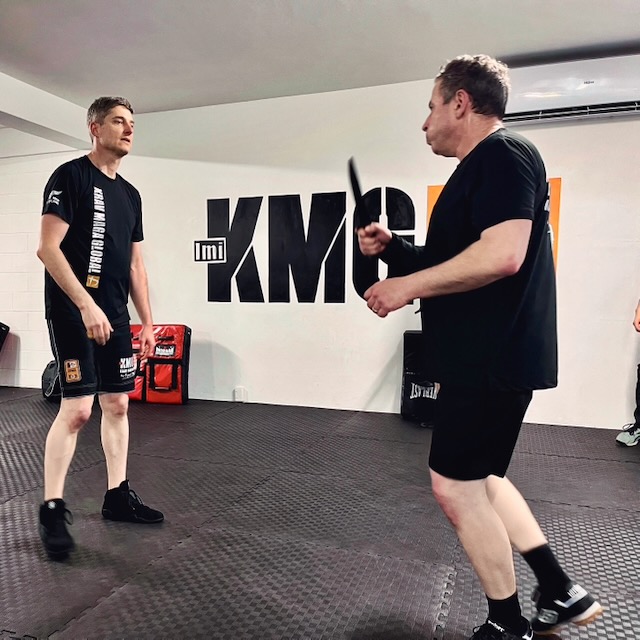
Scenario-based KMG training helps students understand how threats develop before, during, and after physical contact.
What is the Krav Maga self-defence timeline?
The Krav Maga self-defence timeline is a practical framework for understanding how threatening situations unfold from beginning to end. It is not a rigid checklist. It is a way of recognising where you are in a situation, what options are available to you at that moment, and what outcome you are trying to create.
Most martial arts and combat sports focus primarily on the physical exchange. Krav Maga trains the whole event: the early warning signs, the opportunities to leave, the use of communication and posture, the physical response if necessary, and the safe exit afterwards.
The strategic goal is simple: intervene as early as possible and resolve the situation with the least possible harm.
What are the five stages of the Krav Maga timeline?
-
1
Awareness — recognise the threat early
The earlier you notice something is wrong, the more options you have. KMG training develops situational awareness: reading environments, recognising behavioural cues, and identifying when a situation is beginning to shift. This stage is often the most important, because prevention depends on seeing the problem before it becomes urgent.
-
2
Avoidance — leave before it starts
If you can remove yourself from danger early, that is the preferred outcome. Avoidance can mean changing position, changing route, moving towards safety, or refusing to remain inside a deteriorating situation. In Krav Maga, this is not treated as weakness. It is treated as good judgement under pressure.
-
3
De-escalation — reduce the threat without force
When avoidance is no longer possible, communication and posture become critical. Krav Maga training includes verbal boundary-setting, non-provocative presence, and the use of distance to reduce escalation. The aim is not to "talk your way out" of every problem, but to create time, options, and space before physical contact begins.
-
4
The physical phase — act decisively and proportionately
If the situation becomes physical despite everything else, the objective changes. At that point, the role of technique is to stop the immediate threat, create an opportunity to move, and get out safely. The emphasis is not on domination or prolonged exchange. It is on decisive action that is effective, proportionate, and rooted in real-world context.
-
5
Escape and aftermath — end the situation properly
Self-defence does not end when contact stops. There is still the exit, the protection of others, the decision about when it is safe to disengage, and the aftermath that may follow. KMG training treats this as part of the event, not something separate from it. The situation is only over when you are safely out of danger.
Why does Krav Maga prioritise avoidance over fighting?
The most effective self-defence outcome is usually the one where no fight happens. Someone who recognises danger early, avoids escalation, and leaves safely has handled the situation more effectively than someone who stays, engages physically, and "wins."
This is one of the clearest differences between a self-defence system and a combat sport. In combat sports, physical engagement is the objective. In Krav Maga, physical engagement is the fallback. The system is always trying to solve the problem earlier if possible.
That is why KMG training across New Zealand places such a strong emphasis on awareness, movement, decision-making, and scenario context. Physical skill matters, but it sits inside a larger tactical framework.
How is Krav Maga different from boxing, BJJ, or MMA?
Combat sports train performance inside a controlled contest. Krav Maga trains decision-making and action inside uncontrolled real-world situations.
That does not make one "better" in every context. It means they are built for different outcomes. Boxing, Brazilian Jiu-Jitsu, and MMA all develop valuable athletic and technical skills. But they generally focus on the physical exchange itself. Krav Maga trains everything around that exchange as well.
| System | Primary Focus | Limitation in Real-World Self-Defence | KMG Approach |
|---|---|---|---|
| Boxing | Striking and ring-based fighting | Limited training in awareness, escape, and environmental variables | KMG trains before, during, and after the physical phase |
| BJJ | Grappling and ground control | Ground focus can be risky in multi-attacker or weapon contexts | KMG prioritises mobility, disengagement, and rapid exit |
| MMA | Competitive mixed-rules fighting | Built around matched opponents, rules, and contained settings | KMG is built for unpredictability, asymmetry, and scenario pressure |
| Krav Maga | Real-world self-defence | N/A | Trains awareness, avoidance, de-escalation, physical response, and escape |
What does lawful force mean in New Zealand self-defence?
Any serious self-defence training in New Zealand must account for lawful and proportionate force. In practical terms, that means your response must fit the level of threat, and it must stop when the threat stops.
This matters for two reasons. First, it matters legally. Second, it matters tactically. Unnecessary escalation can extend the event, create new risks, involve other people, and worsen the outcome even if the original threat was real.
KMG training includes this dimension directly. The objective is not only to act effectively under pressure, but to act in a way that remains tactically sound and legally defensible.
"Very practical, realistic and highly applicable form of martial arts and self-defence system."
— Student testimonialHow does the timeline change when protecting someone else?
Protecting another person changes the situation immediately. Your movement, positioning, priorities, and exit options are no longer based only on your own safety. You may need to create space, shield someone else, move them behind you, or extract them while managing the threat at the same time.
This is one reason the self-defence timeline is so useful. It gives a broader framework for decision-making when circumstances become more complex. Protecting a partner, child, friend, or bystander is not a fringe case. It is one of the most realistic scenarios in civilian self-defence.
KMG training includes these variables directly because real-world self-defence is rarely just about one person in an empty space dealing with one attacker.
Why does this timeline matter in the KMG system?
KMG New Zealand is the sole national representative of Krav Maga Global (HQ), operating under the direct authority of Eyal Yanilov. That matters because the self-defence timeline is not just an isolated article concept. It sits inside a wider civilian curriculum developed from the system created by Imi Lichtenfeld and maintained through Krav Maga Global.
The KMG New Zealand instructor team teaches this framework as part of a national structure, not as a disconnected local interpretation. That gives students a clearer standard for how awareness, avoidance, de-escalation, physical response, and escape fit together inside a practical self-defence system.
In other words, the timeline is not an add-on. It reflects how the system is meant to work.
What people ask about the Krav Maga self-defence timeline
No. Krav Maga treats fighting as the last resort. The system is built around awareness, avoidance, de-escalation, decisive response when necessary, and safe exit. The goal is to resolve the threat as early as possible, not to stay in a fight any longer than necessary.
Boxing and MMA focus on the physical exchange itself. Krav Maga includes that phase, but also trains what happens before it and after it: awareness, avoidance, verbal skills, environment, exit strategy, and real-world scenario variables such as surprise, weapons, multiple attackers, and protecting others.
Yes. KMG training in New Zealand includes the principle of proportionate and lawful force as part of how self-defence is taught. Effective action matters, but so does recognising when the threat has stopped and when your response must stop as well.
Yes. The KMG system trains beyond a single controlled one-on-one exchange. That includes scenarios involving weapons, multiple attackers, environmental constraints, low-light conditions, and protecting another person under pressure.
The best next step is to use the national location page to find your nearest active KMG training option in New Zealand.
Find Training Near You
Use the national location page to find your nearest active KMG training option in New Zealand.