
What Is Krav Maga? A Complete Guide for Beginners
Krav Maga (Hebrew for "contact combat") is a practical self-defence system developed by Imi Lichtenfeld in 1930s Bratislava and refined into its modern civilian form by Krav Maga Global (KMG) under Head Instructor Eyal Yanilov. It is built around real-world violence: surprise attacks, weapons, multiple attackers, and the reality that ordinary people need usable skills quickly. KMG New Zealand is the sole national representative of Krav Maga Global, teaching the same internationally maintained curriculum used across 60+ countries.
Most people asking "what is Krav Maga?" are looking for something real. Not a sport with rules that disappear the moment a situation becomes messy, and not a traditional martial art where years of training are required before anything feels usable.
Krav Maga exists to solve that exact problem. It is built around practical self-defence, rapid decision-making, and techniques that still make sense when stress, surprise, and uncertainty are involved.
This guide explains where Krav Maga came from, how it works, why it differs from other systems, and why beginners across New Zealand are drawn to it.
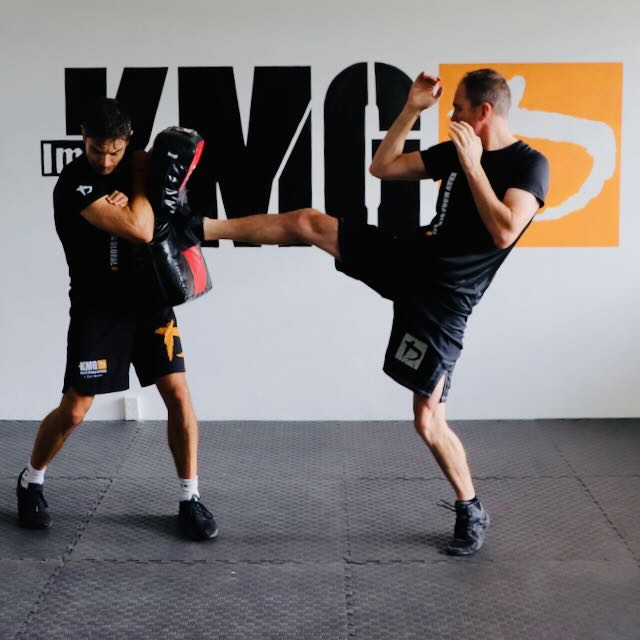
KMG training is built around practical movement, pressure-tested fundamentals, and self-defence for ordinary people.
Where did Krav Maga come from?
Krav Maga was created by Imi Lichtenfeld — a Hungarian-Slovak boxer, wrestler, and gymnast who learned early that sport fighting and real violence are not the same thing. During the 1930s, he helped defend Jewish communities in Bratislava and discovered that surviving real conflict required different priorities from winning in a ring or on a mat.
That insight became the foundation of Krav Maga. After moving to what later became Israel, Imi developed the system further and spent decades refining it for use by ordinary people. The system kept the same core principle: techniques must be practical, efficient, and usable by everyday people without years of specialist training.
After Imi's death in 1998, Eyal Yanilov carried the system forward, founding Krav Maga Global in 2010 to maintain the system's integrity through a single internationally consistent curriculum and a rigorous instructor certification programme. That is the lineage KMG New Zealand sits within today.
What does "Krav Maga" actually mean?
Krav Maga is Hebrew for "contact combat." The name is straightforward because the system itself is straightforward: it is about dealing with physical confrontation quickly and effectively, especially at close range.
The term also points to one of Krav Maga's biggest strengths. It is not built around impressive-looking movement for its own sake. It is built around direct actions, practical counters, and responses that can still function when adrenaline is high and time is limited.
Krav Maga works with natural human reactions rather than against them. That is one reason many beginners find it more immediately usable than systems that require long technical development before skills feel instinctive.
How is Krav Maga different from other martial arts?
The biggest difference is purpose. Many martial arts were developed around sport, tradition, or highly specialised forms of combat. Krav Maga was built specifically around self-defence: stopping a threat, creating an opportunity to escape, and staying functional under pressure.
That changes the entire training logic. There are no katas, no sport scoring systems, and no assumption that an attacker will behave like a trained partner. Training is built around likely scenarios such as grabs, chokes, sudden strikes, aggressive pressure, weapons, and the need to move quickly from defence to escape.
Real self-defence is messy, fast, and unpredictable. Krav Maga addresses that directly. Instead of preparing people for a controlled contest, it prepares them for situations that are chaotic, imperfect, and often over in seconds.
If you want to compare Krav Maga more directly with specific systems, see Krav Maga vs BJJ, Krav Maga vs MMA, and Best Martial Art for Self-Defence.
"The teaching curriculum is very structured, organised and logical. Very practical, realistic and highly applicable."
— The kind of feedback practical self-defence training often attractsWhat do you actually learn in Krav Maga training?
Krav Maga training covers striking, movement, defence, awareness, and scenario-based problem solving. At the beginner level, that usually means stance, footwork, basic strikes, fall breaks, and defences against common grabs and chokes.
As students progress through the KMG curriculum, training expands into more complex material: weapon threats, multiple attackers, third-party protection, and the transition from immediate defence to safe disengagement. The curriculum is structured, so students are not guessing what matters or what comes next.
KMG training also includes the mental side of self-defence — awareness, verbal management, decision-making under pressure, and understanding when not to engage physically. The first self-defence question is rarely "which technique?" It is usually "can this be avoided, defused, or escaped?"
For more on the legal context of self-defence in New Zealand, including section 48 of the Crimes Act 1961, see Self-Defence Law and Ethics.
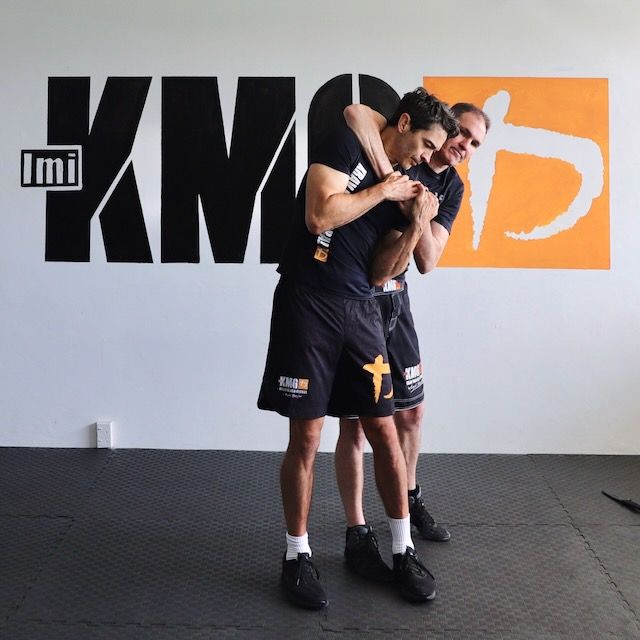
Scenario-based partner drilling helps connect technique, pressure, and decision-making.
Is Krav Maga right for complete beginners?
Yes. Krav Maga is specifically designed for ordinary people, not experienced fighters. Beginners are not an afterthought in the system. They are the reason the system exists.
The KMG curriculum is structured so new students can enter without prior martial arts experience and start building capability step by step. There is no expectation that someone arrives already fit, coordinated, or confident. The training is designed to develop those qualities over time.
Beginners are the norm, not the exception. That matters because a genuine self-defence system should not depend on athleticism, youth, or years of specialist background before it becomes useful.
Do you need to be fit to start Krav Maga?
No prior fitness is required. Better fitness always helps, but Krav Maga is not supposed to be reserved for highly athletic people. The system is designed to work for ordinary bodies in ordinary circumstances.
Most people find that coordination, awareness, and confidence improve early. Fitness often improves alongside training rather than needing to come first. That is a much more realistic entry point for adults who want practical skills, not another barrier to starting.
A self-defence system that only works for the already-fit is a poor self-defence system. One of Krav Maga's defining ideas is that useful skills should be available to ordinary people from the beginning.
Why does Krav Maga make sense in a New Zealand context?
Krav Maga makes sense in New Zealand because the self-defence problem here is the same as anywhere else: violence is sudden, imperfect, and rarely fair. People are not looking for ring skills. They are looking for practical capability, awareness, and confidence in situations that can change very quickly.
KMG New Zealand is the sole national representative of Krav Maga Global, operating under the direct authority of Eyal Yanilov. The KMG New Zealand instructor team works within that international structure to maintain curriculum consistency and a self-defence approach that fits New Zealand reality — including the legal context where civilians cannot lawfully carry weapons for self-defence.
That national structure matters because it links what students learn here to a recognised international standard while keeping the focus on real self-defence rather than isolated local interpretation.
So what is Krav Maga, in simple terms?
Krav Maga is a practical self-defence system designed to help ordinary people deal with real violence efficiently. It is not a sport, not a ritual, and not a system that assumes ideal conditions.
It teaches people how to protect themselves under pressure, make better decisions quickly, and prioritise escape over dominance. That is why it feels different from traditional martial arts and why it continues to appeal to beginners looking for something grounded in real-world application.
If the goal is practical self-defence, Krav Maga is one of the clearest answers available. When taught through the KMG structure in New Zealand, it sits inside a system with direct lineage, recognised standards, and a clear national framework.
What else do people usually want to know?
Krav Maga is often grouped with martial arts, but it is more accurately described as a self-defence and combat system. It has no forms, no competition, and no traditional rituals. KMG New Zealand teaches the Krav Maga Global system, which is structured around practical use in real situations.
Krav Maga was created by Imi Lichtenfeld, a Hungarian-Slovak boxer, wrestler, and gymnast, who developed the system in 1930s Bratislava for civilian self-defence. The modern international form of the system is taught through Krav Maga Global, founded in 2010 by Eyal Yanilov — Imi's closest student.
"Krav Maga" is Hebrew for "contact combat." The name reflects the system's direct, practical approach: dealing with physical confrontation quickly and effectively, especially at close range, without the constraints of sport rules or traditional forms.
Yes. Krav Maga was built for ordinary people rather than experienced fighters. The structured KMG curriculum helps beginners build practical capability step by step without needing a prior martial arts background.
No. Fitness helps, but you do not need to get fit first to begin. The training itself helps build the coordination, awareness, confidence, and conditioning that support self-defence.
The best next step is to use the national locations page and find the training option closest to you. Active KMG training is currently available in Auckland and Hastings, with waitlists open for other New Zealand cities. Visit the locations page on krav-maga-global.co.nz for full details.
Find Training Near You
Use the national locations page to find your nearest active KMG training option in New Zealand.
Find Training Near You