
Krav Maga vs Boxing for Self-Defence: A Complete Guide
Boxing develops real punching skill, timing, and composure under pressure — all of which carry over into self-defence. The gap is scope, not quality. Boxing stops at the striking exchange. Krav Maga continues into what happens before and after: reading danger early, managing grabs and chokes, responding to weapons and multiple attackers, and making legally proportionate decisions under stress. For ordinary adults whose goal is civilian self-defence — not competition — Krav Maga covers more of the problem.
Boxing deserves respect. It is one of the clearest ways to learn how to strike, move, manage distance, and stay functional while someone is trying to hit you.
But real-world self-defence is not always a clean striking exchange. Someone may grab your clothing, rush you at close range, block your exit, bring a friend into the situation, or force you to make a decision before you feel ready.
This is the uncomfortable reality many people miss: most violence does not begin from a balanced fighting stance against one person directly in front of you.
It starts from surprise, pressure, intimidation, crowding, grabbing, or sudden escalation at extremely close range. That is exactly why many people eventually move from sport fighting into Krav Maga training.
That is where the comparison changes. Boxing trains one important part of self-defence very well. Krav Maga trains the wider civilian problem.
For the wider framework, read our complete breakdown on the real-world effectiveness of Krav Maga.
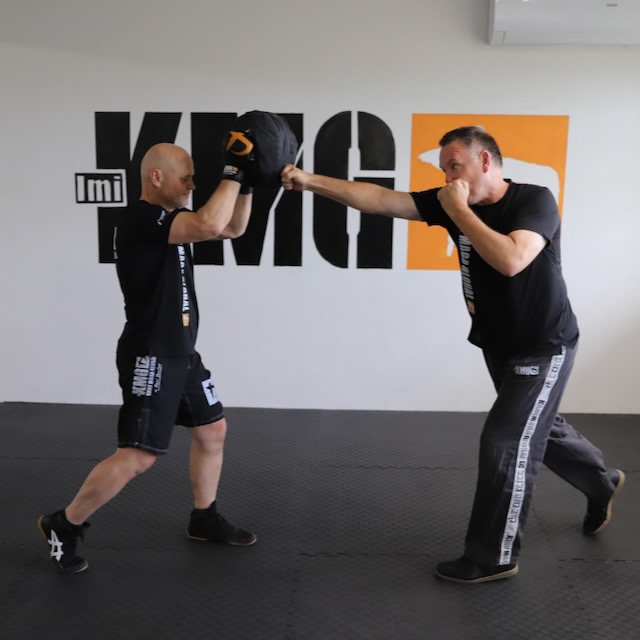
KMG striking training is built for real-world self-defence rather than ring exchange alone.
The quick answer: boxing is strong, Krav Maga is broader
If your main goal is to become a better puncher, boxing is one of the best choices available. It builds sharp hands, footwork, timing, defensive reactions, and genuine pressure tolerance.
If your goal is practical civilian self-defence, the question becomes wider. You need to think about awareness, avoidance, close-range pressure, grabs, chokes, surprise aggression, multiple attackers, weapons, legal proportionality, and escape.
Simple distinction: Boxing is built around skilled striking against one opponent in a rule-based environment. Krav Maga Global New Zealand trains striking as part of a wider self-defence process: notice danger early, manage distance, disrupt the threat, avoid being controlled, and leave as soon as it is safe.
| Area | Boxing | Krav Maga |
|---|---|---|
| Main Focus | Punching and striking exchangeExcellent within sport striking rules. | Broader self-defence systemCivilian protection, disruption, and safe escape. |
| Real-World Starting Point | Assumes a ready opponentUsually begins from stance, range, and mutual engagement. | Clear Krav Maga advantageTrains surprise, disadvantage, grabs, crowding, and sudden escalation. |
| Pressure Training | Excellent inside boxing rangeStrong sparring and striking pressure. | More relevant to civilian chaosPressure from grabs, surprise, multiple directions, and scenario stress. |
| Tools Available | Hands onlyPunches to head and body. | Clear Krav Maga advantagePunches, palms, elbows, knees, kicks, vulnerable targets, and escape tactics. |
| Grabs & Chokes | Not a core focusUsually outside boxing rules. | Clear Krav Maga advantageCore training area from early levels. |
| Weapons | Not addressedNo knife, stick, or weapon-threat framework. | Clear Krav Maga advantageWeapon awareness, distance, escape, and advanced defences. |
| Multiple Attackers | Not designed for thisBoxing assumes one opponent in front. | Clear Krav Maga advantageMovement, positioning, scanning, and escape under pressure. |
| Size & Strength Gap | Attribute-dependentReach, power, speed, and athleticism matter heavily. | Designed for asymmetryUses vulnerable targets, disruption, and escape to help smaller people respond. |
| Goal Under Stress | Win the exchangeStay and outperform the opponent. | More practical for civiliansCreate safety, disengage, and get away. |
| Beginner Accessibility | Good for fitness and strikingProgress often depends on sparring comfort. | Designed for ordinary adultsSuitable for beginners who want practical self-defence, not competition. |
5 Key Differences Between Krav Maga and Boxing
The difference is not that boxing is weak. Boxing is excellent inside its lane. The difference is that real self-defence often begins outside that lane — closer, messier, less fair, and with less time to think.
Purpose: sport vs civilian protection
Boxing was refined as a competitive sport — one opponent, shared rules, a referee, and a defined exchange. Krav Maga was built for civilian survival from the outset by Imi Lichtenfeld, who was himself an accomplished boxer and understood exactly where sport striking ends and real violence begins.
Tools: hands only vs full range
Boxing uses punches to head and body — period. Krav Maga trains elbows, knees, kicks, palm strikes, hammer fists, and attacks to vulnerable targets. In civilian self-defence, using bare hands to punch hard surfaces repeatedly risks injury. Krav Maga trains for that reality from day one.
Scope: one opponent vs real scenarios
Boxing assumes a single opponent, directly in front, in a controlled exchange. Krav Maga trains grabs, chokes, tackles, weapon threats, multiple attackers, and confined-space situations from beginner level. None of those exist in the boxing ruleset because they don't need to.
Gloves: sport habit vs bare-handed reality
Boxing gloves change striking behaviour — they allow high-force head punching and build defensive habits around large padded hands. Bare-handed civilian self-defence is different. Even professional fighters have broken hands striking without gloves. Krav Maga trains bare-handed from the start, with palm strikes and hammer fists that reduce self-injury risk.
Legal layer: absent vs integrated
Under New Zealand law, self-defence requires force to be reasonable in the circumstances. Krav Maga curriculum includes de-escalation, verbal boundaries, proportionality, and the force continuum. Boxing has no legal layer — and doesn't need one in a sport context.
See How KMG Training Works in New Zealand
Most people starting Krav Maga are complete beginners. You do not need boxing experience, martial arts experience, or elite fitness to begin learning practical self-defence skills.
View Beginner Training LocationsWhich is right for you?
If you enjoy testing your punching skill against other trained people, boxing is hard to beat. It is technical, demanding, honest, and excellent for pressure.
But if your main concern is what happens when someone grabs you unexpectedly in a carpark, corners you outside a bar, rushes you at close range, or starts a confrontation when you were not ready, Krav Maga starts making more sense very quickly.
Krav Maga is not about proving you can win a fair exchange. It is about recognising danger early, responding decisively when you have to, using only the force you genuinely need, and getting yourself home safely.
A simple way to think about it: boxing is excellent if you want to become highly capable inside a striking exchange. Krav Maga is better suited to people who want practical tools for unpredictable real-world situations.
What does boxing do exceptionally well?
Boxing is a serious and highly effective striking discipline. It develops punching mechanics, footwork, timing, defensive reflexes, conditioning, and the ability to keep functioning under pressure. Few systems teach people to stay composed during fast, chaotic exchanges as consistently as boxing.
That matters. Someone with real boxing experience is usually harder to overwhelm than someone who has never trained at all. Good boxers understand movement, distance, pressure, and timing in ways that transfer positively into many other forms of training.
But boxing is still built around a very specific context: one opponent, directly in front of you, inside a rules-based striking exchange. That creates limitations once the environment becomes less predictable.
Important distinction: boxing is extremely effective at what it is designed to do. The issue is not whether boxing works. The issue is whether sporting striking alone fully matches the realities of civilian self-defence.
Why boxing can become limiting in real-world self-defence
Real violence rarely looks like a boxing match. Situations may start from surprise, involve multiple people, happen in confined spaces, or escalate before you have time to react properly. In many civilian situations, punching is not the safest, smartest, or most legally appropriate first option.
One limitation is that boxing mainly trains a single toolset: striking with the hands against one opponent in front of you. Krav Maga training has to account for the kinds of problems that make violence unpredictable: people closing distance suddenly, controlling you physically, introducing weapons, or forcing decisions before you are ready.
Range also changes the equation. Boxing specialises in punching range. In self-defence, distance is often safety. If someone has a knife or is trying to rush forward aggressively, staying further away with movement or defensive kicking can become critically important.
Another issue is the environment itself. Boxing assumes stable footing, clear space, and a known opponent. Civilian violence may happen on wet pavement, near furniture, around vehicles, in crowded nightlife areas, or from disadvantaged positions where you are already off balance or being controlled.
Gloves also change behaviour. Boxing gloves protect the hands and allow people to punch repeatedly with high force during training and competition. Bare-handed striking is different.
Even professional fighters have injured their hands striking bare-handed outside the ring. In August 1988, Mike Tyson broke a bone in his right hand during a street brawl with boxer Mitch Green in Harlem — without gloves. That is a very different reality from hitting pads or wearing heavily padded gloves in training.
Krav Maga therefore trains palm strikes, elbows, hammer fists, knees, low kicks, and attacks to vulnerable targets that reduce reliance on pure boxing-style head punching. The goal is not to "win a fight." The goal is to stay functional, create damage quickly if necessary, and escape safely.
Boxing also does not directly address grappling, ground control, or weapon threats. If a situation collapses into clinching, grabbing, tackling, or the ground, the tactical picture changes immediately.
This matters especially for smaller people, older adults, or women dealing with larger aggressive attackers. Boxing still depends heavily on athletic attributes like size, reach, speed, and physical exchange. Krav Maga deliberately trains vulnerable targets and explosive disruption because real self-defence does not assume equal conditions.
Perhaps most importantly, civilian self-defence is not only physical. Avoidance, de-escalation, verbal boundaries, legal proportionality, and knowing when leaving is the right call — these are all part of what you are actually deciding when something starts going wrong. A person may need to protect family members, create an exit, or disengage without escalating the situation unnecessarily.
Summary: boxing is built for a clean exchange between trained opponents. What happens when someone who is not trained — and not being sporting — decides to close distance, grab, or produce a weapon is a different training problem entirely.
Is boxing good for self-defence?
Yes, boxing can be useful for self-defence, especially for punching, footwork, timing, and staying composed under pressure. A person who has boxed seriously is usually more comfortable with distance, impact, and fast decision-making than someone who has never trained. That matters.
But boxing is not a complete civilian self-defence system by itself. It does not directly train responses to chokes, clothing grabs, tackles, kicks, weapons, multiple attackers, or situations where the safest option is to escape rather than continue exchanging strikes. Krav Maga is designed to cover more of what actually happens outside a gym — and boxing alone does not.
Why does context matter so much in this comparison?
Because boxing and Krav Maga are not solving the same problem. In real-world violence, the threat may involve grabs, chokes, clinch pressure, tackles, a surprise start, a weapon, or multiple people. The setting may be crowded, confined, dark, wet, or uneven. There are no rounds, no referee, and no assumption that the other person will behave like a trained opponent.
Many beginners are surprised by how quickly situations become physical at close range. There is often no time to square up the way people imagine. Someone may already be inside your personal space, holding your clothing, blocking your exit, or pushing you backwards before you have properly understood what is happening.
That difference matters in Auckland, Hastings, and across New Zealand because civilian self-defence is rarely clean or predictable. You may need to create distance, protect someone else, avoid falling, stop someone grabbing you, respond from surprise, or disengage quickly before the situation escalates. Many real incidents involve nightlife areas, carparks, alcohol-related conflict, public transport tension, or interpersonal escalation between people who already know each other.
Summary: Boxing assumes two people who both know what is happening. Most real situations do not start that way — and the moment they don't, the skills you actually need start to look different.
The problem with training for a fair fight
One thing many people do without realising it is imagine self-defence as a fair fight.
Two people. Both ready. Both standing. Nobody holding a weapon. Nobody grabbing clothing. Nobody trying to protect a partner, child, or friend. Nobody starting from surprise.
Real violence rarely works like that.
The moment those assumptions disappear, the training requirements change. You need awareness, positioning, fast disruption, simple tools under stress, and a way to get away safely. That is where Krav Maga becomes much more relevant than boxing alone.
That realisation is often the moment people decide to start training. Not because they expect violence, but because they recognise that if something does happen, they would rather have options than assumptions.
What does Krav Maga train that boxing does not?
Boxing is outstanding within a narrow lane. Krav Maga is built for a wider one. The KMG curriculum trains not just the physical phase, but the wider self-defence timeline: noticing something is wrong early enough to do something about it, managing it verbally if possible, acting decisively when necessary, and getting out of the situation once it is safe to do. Real attacks include grabs, chokes, multiple attackers, and weapons — none of which boxing addresses directly.
Krav Maga also trains decision-making. That means understanding when to move, when to create space, when to use verbal boundaries, when physical action may be necessary, and when the best option is to leave immediately.
Most real situations are rarely just an exchange of punches. Someone might grab your jacket, rush you into a wall, try to pull you off balance, or have another person standing close enough to join in. That is why Krav Maga training has to include more than good striking mechanics.
Did Krav Maga's founder come from a boxing background?
Yes. Imi Lichtenfeld, who developed Krav Maga, was a boxer, wrestler, and gymnast. Krav Maga was created by someone who understood boxing well and then built beyond the limits of any single sport. Effective striking remains a core part of Krav Maga, but in the KMG system it sits alongside takedown defence, clinch responses, ground survival, weapon awareness, and civilian decision-making.
For the wider historical context, see the origins of Krav Maga.
Why do kicks change the range problem completely?
Boxing is a hands-only system. Krav Maga includes kicks because they create earlier interception, more distance, and another layer of disruption before an attacker can close fully. In civilian self-defence, distance is usually safety. The longer someone stays attached to you physically, the more unpredictable the situation becomes.
A simple low kick, defensive kick, or kick used to manage distance is not about looking impressive. It is about interrupting forward pressure, making space, and giving you a chance to move rather than being forced into a prolonged close-range exchange.
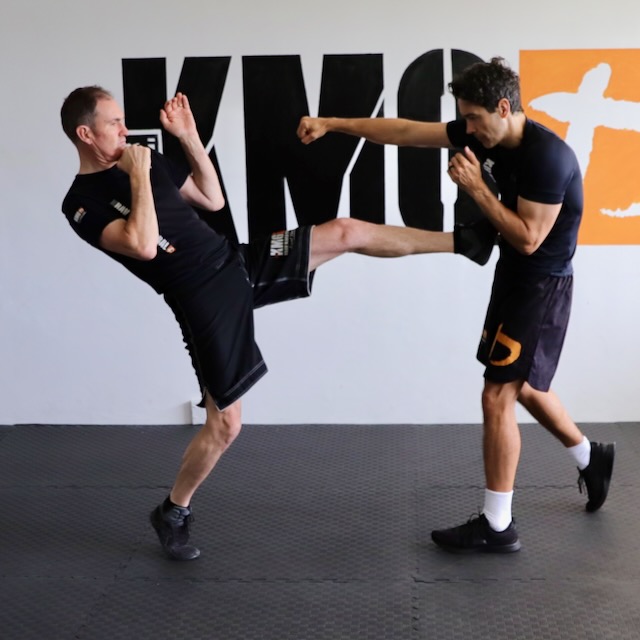
Kicks give Krav Maga a range-management option boxing does not have — distance is safety in self-defence.
Why can glove-based striking habits be a problem in real self-defence?
In real life, without gloves, punching hard into hard surfaces can easily damage the hand. Krav Maga trains bare-handed from the beginning and includes palm strikes and hammer fists that deliver force with less risk of self-injury. Training with gloves builds habits that do not always transfer cleanly to bare-handed self-defence.
Glove-based striking also changes defensive behaviour. Large gloves encourage high shell guards and repeated head-level exchanges that do not always transfer cleanly to bare-handed civilian violence where hand injury, legal proportionality, surprise attacks, or environmental hazards become major factors.
That does not mean gloves are bad. They are useful training tools, and boxing uses them for good reasons. The point is that a person also needs to understand what changes when the gloves are gone, the ground is uneven, and the goal is to get away safely rather than keep trading shots.
Summary: Gloves change what you can do, what you practice doing, and what feels normal under pressure. Training without them from the start means you are practising what you will actually have available.
Can boxing and Krav Maga complement each other?
Yes. Boxing develops sharp timing, striking confidence, distance awareness, and comfort under pressure — all of which transfer positively into Krav Maga training. The adjustment is strategic: in Krav Maga, those tools have to be integrated into a wider framework — one that accounts for situations boxing was not built around.
For someone who already boxes, Krav Maga can add civilian self-defence context. For someone who has never boxed, Krav Maga provides a more direct path into practical protection because striking is taught alongside the wider realities of personal safety.
One thing we often see in training is that beginners do not need to become aggressive to become more capable. They usually need structure, repetition, and a calm way to practise pressure. Over time, people tend to become less startled, less rushed, and more able to make simple decisions when something feels uncomfortable.
"Very practical, realistic and highly applicable form of martial arts and self-defence system."
Victor — North Shore studentWhy does KMG New Zealand approach this comparison from a national perspective?
KMG New Zealand is the sole national representative of Krav Maga Global (HQ), under the direct authority of Eyal Yanilov, the closest student of founder Imi Lichtenfeld. The KMG New Zealand instructor team works within that structure to keep curriculum, standards, and training logic aligned nationally.
That matters because self-defence training should not be random. The goal is a consistent, progressive system that helps ordinary people build awareness, confidence, and practical responses without turning training into sport fighting or unnecessary aggression. The legal layer matters too: students should understand reasonable force and self-defence laws in New Zealand, not just physical technique.
The best self-defence training should leave people calmer, not more paranoid. It should help you notice risk earlier, set boundaries sooner, move better under pressure, and understand when leaving is the safest and smartest option.
Boxing builds serious striking ability and pressure tolerance. But Krav Maga Global New Zealand is built for people who want practical self-defence outside a sporting environment — the kind of training that helps you notice danger earlier, respond under pressure, avoid being controlled, and get yourself home safely.
What People Ask About Krav Maga vs Boxing
For broader civilian self-defence scenarios, Krav Maga is designed to cover more variables than boxing alone. Boxing is excellent at one-on-one striking, but it does not directly address grabs, chokes, weapons, multiple attackers, or the wider self-defence timeline. Krav Maga is built for that broader civilian reality.
Yes. Boxing can help with punching, footwork, timing, distance, and staying composed under pressure. Those skills matter. The limitation is that boxing does not directly train many common self-defence problems, such as grabs, chokes, kicks, weapons, multiple attackers, or escaping from confined spaces.
Yes. KMG training is designed for ordinary people, including complete beginners. You do not need boxing experience, martial arts experience, or competition goals to start. Most beginners simply need a safe place to learn movement, boundaries, pressure, and practical responses step by step.
Krav Maga uses straight punches and combinations that overlap with boxing, but adapts them for real-world conditions. It also includes elbows, knees, hammer fists, palm strikes, and kicks suited to managing distance and disruption in ways boxing does not cover.
Yes. Boxing can complement Krav Maga by improving timing, striking, footwork, and comfort under pressure. Krav Maga then places those assets inside a framework that covers what happens when the situation stops following sport rules.
Boxing gives valuable striking skills, but it is not a complete self-defence system on its own. Real-world self-defence may involve grabs, chokes, tackles, weapons, multiple attackers, surprise, environmental hazards, and legal judgement — areas that Krav Maga trains more directly.
KMG New Zealand currently runs beginner-friendly Krav Maga training in Auckland and Hastings, with additional locations planned nationally. The national locations page helps connect students to the nearest available class or waitlist.
Start Building Practical Self-Defence Capability
Most people do not need to become fighters. They need to become harder to overwhelm. That is the problem Krav Maga was designed to solve.
You do not need boxing experience, martial arts experience, or elite fitness to begin. Structured introductory training in Auckland and Hastings is designed for ordinary adults who want realistic protection skills in a safe, controlled environment.
Book Your Introductory TrialSelect your nearest active New Zealand region to view starting dates, timetables, and trial availability.