
Does Krav Maga Work in Real Life?
Krav Maga works in real life when training is honest about what makes self-defence difficult: pressure, surprise, unfair conditions, and the need for simple decisions fast. Krav Maga Global New Zealand teaches the KMG system — developed by Eyal Yanilov from Imi Lichtenfeld's original system — and whether that training transfers depends almost entirely on how it is taught.
If you are asking this question, you are probably not interested in theory. You want to know whether training still makes sense when stress hits, when distance collapses, and when there is no time to think through a perfect sequence.
That is the right question to ask. A lot can look sharp in a calm gym. Real self-defence is different — fast, unfair, close, and often messy.
The value of Krav Maga is not that it promises certainty. It is that it trains for the realities that make self-defence difficult in the first place.
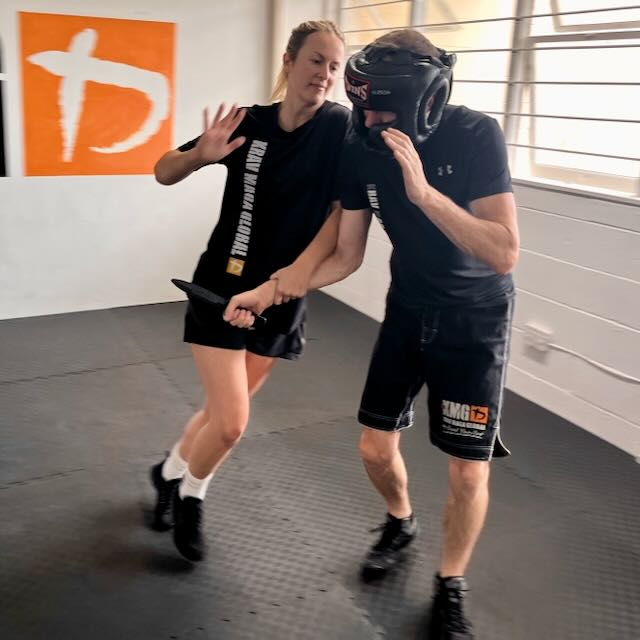
Reality-based training balances realism with control so students can train against serious problems without turning practice into reckless chaos.
What are you really asking when you ask whether Krav Maga works?
You are really asking whether your training will still be there for you when the situation is real. Not when you are calm. Not when you have space. Not when you know what is coming. You are asking what happens when your heart rate jumps, your timing changes, and the other person is not behaving like a training partner.
That is the standard that matters. Real-life self-defence is not about performing well in ideal conditions. It is about recognising danger earlier, making better decisions faster, and using practical actions that give you a real chance to protect yourself and get out.
Why does so much self-defence look less convincing outside the gym?
Because training and reality are not the same thing. In class, you usually have space, structure, coaching, and an agreed starting point. In real life, you may be surprised, crowded, verbally pressured, off-balance, carrying something, protecting someone else, or dealing with someone bigger and stronger than you.
There are no rounds, no agreed start, and no expectation that the other person will behave fairly. Adrenaline changes breathing, timing, judgement, and recall — so anything that depends on staying calm and precise becomes harder to access exactly when you need it most. Add an unfamiliar environment — concrete, walls, stairs, cars, poor lighting — and the gap between gym performance and real-life capability widens further.
This is exactly why healthy scepticism about self-defence makes sense. You should want a system that can answer these realities honestly.
What makes Krav Maga realistic in the first place?
Krav Maga is realistic when the training is built around function, not performance. It is not enough to say a system is practical. The training itself has to reflect the way violence actually shows up for civilians.
That usually means simple actions, gross-motor responses, realistic decision-making, pressure-based drills, and scenario logic — rather than long technical sequences that only work when everything stays neat.
KMG New Zealand teaches Krav Maga within the wider KMG framework developed from Imi Lichtenfeld's original system and maintained through Krav Maga Global under Eyal Yanilov — an organisation active in over 60 countries with more than 1,500 certified instructors worldwide. That matters because realism is not a slogan. It has to show up in the way the system is taught, repeated, and pressure-tested.
How does Krav Maga help your training transfer into real life?
KMG training tries to narrow the gap by building around the things that usually make people fall apart under pressure. It does not assume a fair fight. It assumes stress, uncertainty, and the need for simple useful decisions fast.
Simplicity under stress
The simpler the response, the easier it is to access when fear and urgency are high. Complexity is often the first thing to disappear when pressure rises.
Gross-motor emphasis
Large, direct movements are generally more dependable under pressure than highly intricate actions that depend on perfect timing and composure.
Pressure and fatigue in training
Useful training does not only happen when you are fresh and comfortable. Enough pressure and unpredictability makes your behaviour more honest — and more reliable.
Scenario-based relevance
Training needs to begin from positions you may actually find yourself in: seated, pinned, grabbed, crowded, surprised, or driven to the ground.
What distinguishes KMG training from Krav Maga that doesn't transfer?
The quality-control problem in self-defence is real — and acknowledging it honestly is part of what makes a serious training organisation different from one that is not. Schools vary widely. Training that relies on compliant drills without pressure, context, or legal grounding produces students who feel prepared but aren't. This is widely recognised as the main way Krav Maga fails to transfer, and KMG addresses it through three things most providers don't have.
First, a published Code of Ethics and Professional Conduct that is a binding condition of membership across the entire KMG network — covering integrity, accountability, respect, and professional commitment. This is the organisational standard that separates a certified KMG instructor from someone operating under a Krav Maga banner without accountability.
Second, mandatory Combat Mindset training delivered by Eyal Yanilov — a course all KMG instructors complete that prepares them to teach performance under stress, not just technique. The Combat Mindset curriculum addresses directly how adrenaline degrades decision-making, how training can prepare the nervous system to function when it would otherwise shut down, and how to build the mental conditioning that makes physical skills available under pressure.
Third, a global curriculum maintained from the same lineage Imi Lichtenfeld developed and Eyal Yanilov has refined across 50 years — with instructor certification standards that are consistent across every affiliated club worldwide.
KMG New Zealand instructors bring all of this into every class. That is what the certification standard is actually for.
What is the KMG approach to self-defence in practice?
The KMG approach is built around five connected principles that reflect how real civilian self-defence situations actually unfold. These are not five techniques — they are five stages of a decision framework that apply before, during, and after any threatening situation.
The KMG civilian self-defence framework
- Awareness — recognising the shift in a situation before it becomes physical
- Avoidance — using positioning, environment, and behaviour to remove yourself from risk
- Verbal response — de-escalation, boundary-setting, and buying time and space
- Proportionate force — physical action calibrated to the actual threat level and legal standard
- Escape — the primary goal of any physical response is to create an opportunity to leave safely
This framework is why KMG training covers much more than striking and defence. A student who leaves a threat early because they read the situation correctly has succeeded. A student who de-escalates a confrontation verbally has succeeded. A student who uses the minimum physical force necessary to escape has succeeded.
For the broader framework behind that, read The Krav Maga Self-Defence Timeline and Krav Maga, Self-Defence, Law and Ethics.
Why does this matter if you work with aggressive or unpredictable people?
For many students, this is not a theoretical question. They work in environments where aggression, intimidation, or volatility may be part of the job — health, nursing, physiotherapy, paramedics, teaching, transport, retail, animal control, and other public-facing roles.
If that sounds familiar, you do not need fantasy. You need options that make sense within the law, within your workplace expectations, and within your own ethics. In many situations, the right response is not to hit first. It is to recognise the shift early, create space, use verbal skills, de-escalate if possible, and stay proportionate if things become physical.
That is why KMG training includes the self-defence timeline, scenario training, verbal response, and both hard and soft techniques. A soft technique may solve a grab or control problem without striking. A harder response may become necessary if the threat escalates. That range is one of the reasons Krav Maga can be more useful in real life than a one-speed approach.
How do you know training is serious about real-life transfer?
One of the clearest signs is that training does not stay trapped inside a generic gym environment. If a skill only works when the space is open, the footing is stable, and the lighting is perfect, it has not really been tested properly.
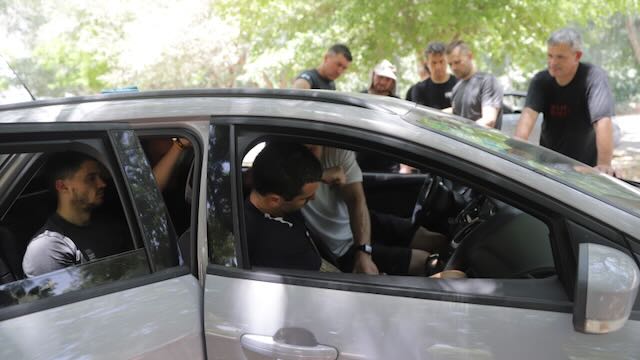
Scenario training in and around vehicles forces students to adapt core self-defence skills to cramped spaces, restricted movement, and escape under pressure.
That is why KMG New Zealand runs seminars in real environments with real restrictions. Training in and around a car changes everything — posture, striking space, visibility, and access to exits. It forces you to adapt core principles to a situation that is cramped, awkward, and highly realistic.
The same idea applies to public transport, bars, low-light environments, and park-based scenarios. Each one changes the problem. Each one forces training to prove it can still function when the environment stops helping you.
What does scenario training look like in an everyday incident?
Sometimes realism is not about dramatic violence. It is about common civilian problems that happen quickly and unexpectedly. Bag grabs, crowding, close-range aggression, intimidation, and sudden attempts to take control are all good examples.
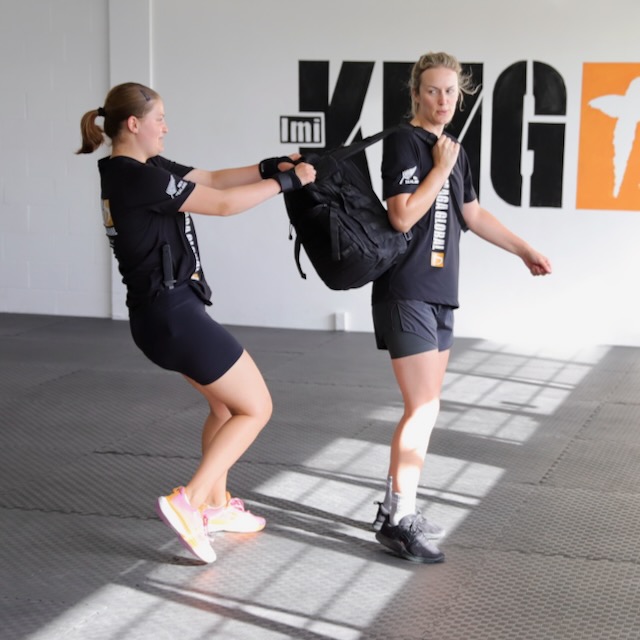
Scenario training connects self-defence principles to common real-life problems such as bag snatch attempts and sudden close-range aggression.
A bag snatch scenario matters because it forces real decisions. Sometimes the safest answer is to let the property go. Sometimes the situation is closer, messier, or more entangled. Good training helps you recognise the difference instead of pretending every problem has the same answer.
This is where scenario training becomes genuinely valuable — tying awareness, verbal response, positioning, physical action, and escape together in a way that feels much closer to how things actually unfold.
What does realistic ground defence look like if the attacker is bigger or stronger?
For civilian self-defence, ground defence is not about staying on the ground and playing a grappling game. If you are underneath someone bigger and stronger, the goal is to disrupt, create space, get up, and escape.
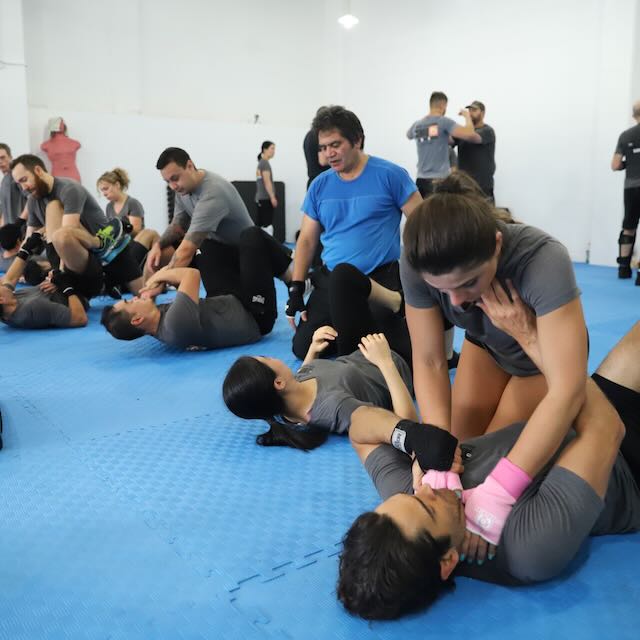
Ground defence training matters because real self-defence may involve being pinned or attacked from a physically disadvantaged position — where creating space and escaping is the priority.
This is one reason ground defence matters particularly for women and for anyone concerned about size or strength disadvantage. A practical response may involve disrupting posture, addressing an immediate choke or pin, attacking vulnerable points, and using that moment to recover position and stand up. The KMG approach under Eyal Yanilov prioritises escape over sustained engagement — which is the key distinction from sport grappling systems.
What should you look for — and what causes training to fall apart under pressure?
Something can look clean in class and still fail when conditions change — because the training was too cooperative to be honest. Under stress, you can freeze, hesitate, or find that what felt easy when you were calm simply is not available any more. If training never addresses that, the gap between class and real life stays too wide.
Good instruction builds pressure progressively and honestly, while keeping the learning structured and safe. It does not give you false confidence. It gives you better-tested responses. Here is what that looks like in practice:
| What to look for | Why it matters |
|---|---|
| Simple, clear teaching | Complicated material is harder to access under stress |
| Progressive pressure-testing | You need exposure to urgency and resistance without being overwhelmed too early |
| Scenario-based training | Context helps the skill make sense beyond the gym |
| Awareness, verbal response, and escape emphasis | Real self-defence is broader than just the physical exchange |
| Soft and hard response options | Different situations call for different levels of force and control |
| Instruction focused on function, ethics, and law | You need practical capability that remains proportionate and defensible |
| Certified instructors with accountable standards | KMG instructor certification requires a published Code of Ethics and mandatory Combat Mindset training — not just technical assessment |
If you are comparing systems more broadly, Best Martial Art for Self-Defence covers how Krav Maga sits alongside other options.
So, does Krav Maga work in real life?
It can, when the training is honest about what real violence actually looks and feels like. Krav Maga is at its strongest when it does not rely on hype. Its strongest case is that it prepares you for the things that usually make self-defence difficult: pressure, surprise, unfairness, environment, and the need for simple useful action when conditions stop being clean.
When taught to KMG standards — with certified instructors, a published code of conduct, and a curriculum that includes Combat Mindset training alongside physical technique — it gives you a practical framework for awareness, verbal response, scenario adaptation, proportionate force, and physical action that is meant to hold up beyond the gym. Progress tends to show up earlier than people expect — better awareness, better movement, less hesitation under pressure — and it deepens with consistent training over time.
For the underlying method, read How Krav Maga Works. For a closer look at who the training suits, read Who Krav Maga Is For.
What do readers usually ask about whether Krav Maga works in real life?
Krav Maga can work in real-life violence when it is trained as a practical self-defence system rather than as choreography. Its value is in helping you respond under stress, make decisions quickly, and create a chance to escape.
It is realistic when the training includes pressure, context, decision-making, and escape rather than only neat demonstration. Realism has to show up in how the training is done, not just in how it is described.
Yes. One reason Krav Maga emphasises vulnerable targets, disruption, and escape is that real self-defence is not about trying to out-muscle a stronger attacker. The goal is to create an opportunity to survive and get away.
Yes. KMG New Zealand runs seminars in real environments including vehicles, public transport, bars, parks, and low-light settings — so your training adapts when space, visibility, movement, and escape options change.
Yes. Many students work in health, education, transport, retail, and other public-facing roles where aggression is possible. Training is useful because it includes awareness, verbal response, proportionate options, and decision-making that fit real workplace expectations.
The national starting point is the KMG New Zealand locations page, which connects you to active training options and waitlist registrations across the country.
Find Training Near You
If you want self-defence training built to make sense beyond the gym, the national locations page is the best place to start.