
Mental Preparation in Self-Defence
Real self-defence includes adrenaline, fear, and fast decisions made under pressure. KMG New Zealand builds mental preparation into the curriculum from day one — not as a separate module, but woven through every session. Situational awareness, emotional regulation under stress, and the ability to think clearly when your body is flooded with adrenaline are all trainable. This is the hub for that cluster of skills.
Most people picture self-defence as a physical problem. When a threat appears, you respond. The body takes over.
That picture is incomplete — and the gap is where most real-world incidents are lost. The physical response matters. But the decisions that determine whether you use it, when you use it, and how clearly you can think while everything is happening — those are mental. And they're trained.
The Krav Maga system, as taught internationally by Krav Maga Global, treats mental preparation not as an add-on for advanced students but as a foundational layer that sits beneath every physical technique. Understanding why changes how you train.
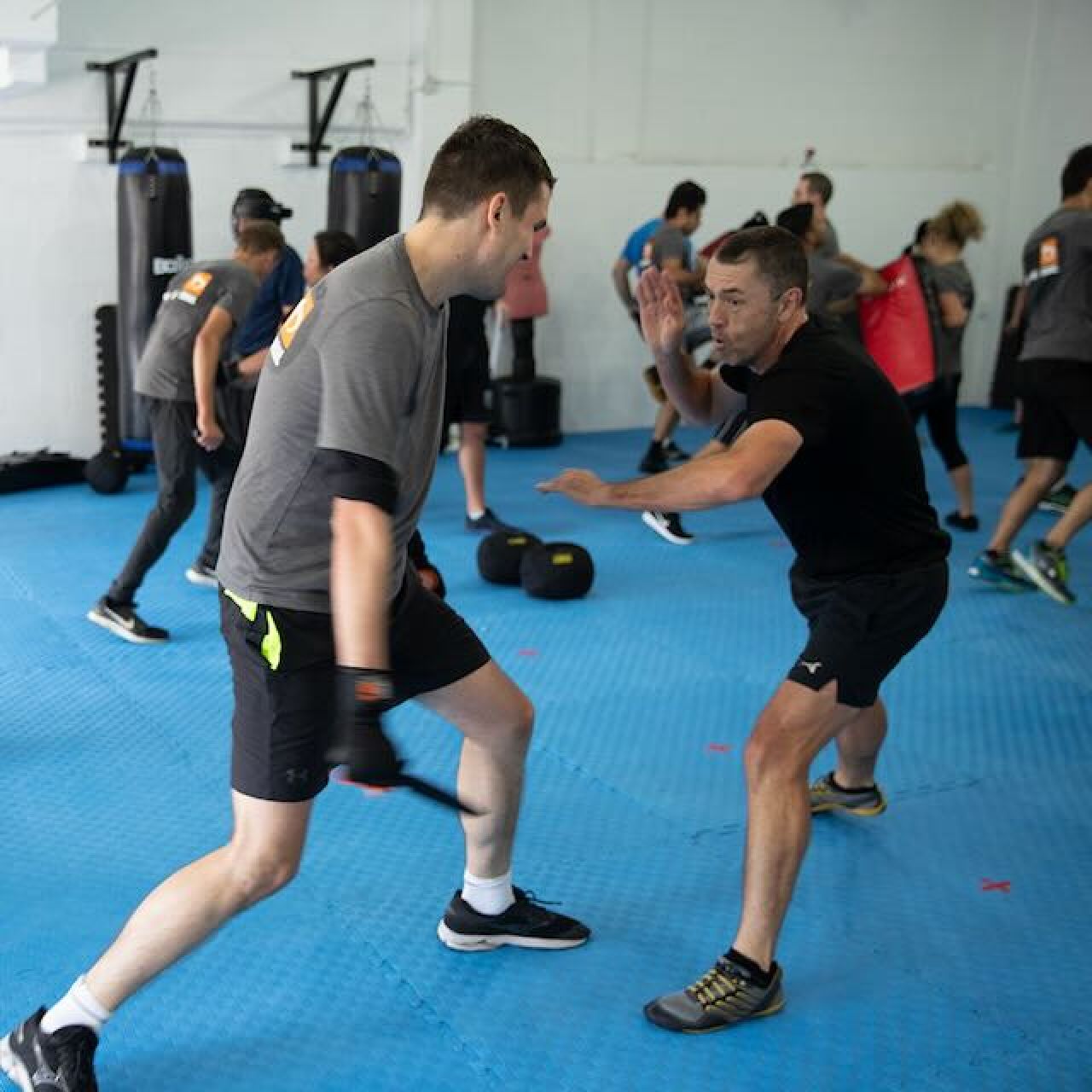
Scenario training at KMG New Zealand — mental readiness and threat recognition under pressure.
What "mental preparation" actually means in a self-defence context
Mental preparation in self-defence is not positive thinking, visualisation, or willpower — it's a set of trainable skills that determine how clearly you can function when your threat-response system is fully activated. When a real threat appears, your body responds before your conscious mind can intervene: adrenaline floods your system, your heart rate spikes, fine motor skills degrade, and your attention narrows sharply. What you do in that window depends entirely on what has been drilled into you before it happened.
The gap between knowing what to do and being able to do it under that kind of stress is not a character gap. It's a training gap. People who perform well in high-pressure situations — who make clear decisions, who move without hesitation, who stay functional even when afraid — have typically put themselves through controlled versions of that stress many times before. The response becomes familiar. Familiar responses don't freeze.
KMG training addresses this through scenario-based drills that simulate the psychological conditions of a real incident — not just the physical ones. Stress inoculation, decision-making under fatigue, awareness training, and verbal components are integrated into sessions from the beginning, not saved for advanced students who have "already learned the basics."
The role of awareness — and why it comes before everything else
Situational awareness is the first mental skill KMG training develops — and it's the one with the highest real-world leverage, because it's what creates time. Most dangerous situations don't arrive without warning. They develop. Behaviour changes before violence occurs. Posture, proximity, attention patterns, and the way a person is moving through a space all carry information — if you know how to read it and you're paying attention when it matters.
Someone who picks up on these signals early has options: they can leave the area, reposition, increase distance, or simply become more alert. Each of those options narrows or disappears as the situation develops. Recognition at the earliest stage isn't just useful — it's what determines whether the situation ever becomes a threat at all.
Awareness is trainable as a habit. Students who work on it consistently find it becomes automatic over time — not hypervigilance or anxiety, but calm background attention that takes almost no conscious effort. It's one of the earliest and most transferable things training produces, and it shows up in daily life well before any physical skill becomes fully usable.
Why people freeze — and how training changes it
The freeze response is a normal physiological reaction to sudden threat — not a character flaw, not cowardice, and not something that defines how you'll respond in the future. When the nervous system detects danger it hasn't encountered before, it sometimes pauses — waiting for more information before committing to a response. In evolutionary terms, this makes sense. In a real self-defence situation, it costs time you don't have.
Training reduces freezing by making threat scenarios familiar. When you have been through a situation — or something close to it — dozens of times under realistic conditions, the nervous system has a reference point. It doesn't have to pause. The response it trained for activates instead.
This is why KMG scenario training is designed to be uncomfortable. The stress is deliberate. Students are put in positions where they have to make fast decisions with incomplete information, under physical and verbal pressure, and then do it again. Not to harden people — but to shrink the gap between recognising a threat and responding to it. Over time, that gap gets very small.
Emotional control under stress — what it is and how it's trained
Emotional control in a self-defence context doesn't mean suppressing fear — it means maintaining the ability to make decisions while afraid. Fear is functional. It sharpens attention, accelerates reaction, and mobilises physical resources. The problem is when it overwhelms decision-making capacity — when it produces panic rather than focus.
The distinction between controlled fear and panic comes down to one thing: familiarity with the state. When you have felt the adrenaline spike, the narrowed vision, the urge to run or freeze — and trained through it, specifically — your response to that state changes. It becomes information rather than alarm. You recognise it. You can work with it.
This is what the verbal and scenario components of KMG training build alongside the physical work. Students who complete enough realistic scenario drilling — including confrontational verbal exchanges, sudden starts, and high-stakes decision moments — develop a baseline composure under pressure that doesn't look like suppressed emotion. It looks like calm. But it was built through exposure, not personality.
"I instinctively de-escalated a situation in a grocery store thanks to the reflexes I built here. It works."
— Raymund S. — KMG NZ memberDe-escalation as a mental skill — not just a verbal one
The ability to de-escalate a confrontation — to reduce tension rather than match it, to stay composed while the situation is still volatile — is fundamentally a mental skill, even though it expresses itself verbally. The reason most people struggle with it under real stress isn't that they don't know what to say. It's that the stress response they're experiencing pulls them toward match-or-withdraw, not toward measured calm.
KMG training builds this through scenario work that integrates verbal pressure with physical positioning. Students practise maintaining composure and speaking clearly while managing their body language, their distance, and their positioning simultaneously — because real situations require all of these at once. A technique-trained student who can't speak coherently under pressure has a gap that will show up exactly when it matters most.
For a full breakdown of the skills involved and how to build them, see the article on de-escalation and conflict avoidance.
Mental preparation when others are depending on you
The mental demands of protecting someone else — a partner, a child, a friend — are significantly higher than protecting yourself, and most people discover this the first time they attempt a third-party protection scenario. Managing a threat while simultaneously directing another person, staying calm enough to communicate clearly, and making fast decisions about positioning and escape — all while your stress response is fully activated — is a different cognitive challenge from solo defence.
For many people, this is precisely the scenario that motivated them to start training. The mental preparation dimension is inseparable from the tactical one: good positioning helps, clear communication helps, an escape-first framework helps. But all of these require that you can actually access them under pressure — which is the function of everything described above.
The article on protecting others in self-defence covers the tactical and legal dimensions in detail. The mental preparation that makes those tactics executable is built through everything in this cluster.
Mental preparation does not mean aggression
One of the most common misconceptions about self-defence training is that building mental toughness and physical capability makes people more confrontational. The opposite is consistently true. People who train realistically — who have developed genuine capability and put themselves through realistic stress — tend to become calmer and less reactive in ambiguous situations, not more aggressive.
The mechanism is straightforward: most ego-driven confrontations are driven by underlying anxiety about capability. When you're not sure you could handle something if it escalated, the ambiguity itself is stressful — and stress responses push toward aggression or defensiveness. When that uncertainty is replaced by genuine, tested capability, the ambiguity disappears. There's nothing to prove. The situation can be left.
Experienced KMG students consistently report that the largest shift isn't physical — it's mental. The sense of having real options, tested under pressure, changes how they move through the world. Not with aggression or overconfidence, but with a quieter kind of readiness that most people describe as simply feeling less anxious.
How the mental and physical layers work together
Physical self-defence technique and mental preparation are not separate tracks — they're the same training, experienced from two angles. Every scenario drill that builds a physical response also builds stress familiarity. Every repetition under realistic pressure trains the decision-making process as well as the movement pattern. The two cannot be cleanly separated because the situations they're preparing you for don't separate them either.
This is why KMG training is structured as it is — not as a pure technique curriculum with "mental training" as an optional add-on, but as an integrated system where the scenario conditions, the verbal components, the fatigue elements, and the physical content all reinforce each other simultaneously. What students describe as "the training clicking" — the moment where it starts to feel real rather than like exercise — is usually the moment where the mental and physical layers are functioning together rather than separately.
For a detailed look at how KMG structures training to replicate real conditions, see how Krav Maga trains for reality. For the women-specific dimension of the freeze response and how training addresses it, see why many women freeze in dangerous situations.
Frequently Asked Questions
It's built into the training structure, not delivered as a separate module. Scenario-based drills, verbal pressure components, stress inoculation, and decision-making under fatigue are all integrated into standard KMG sessions from Practitioner Level 1. You won't hear a lecture on mental preparation — you'll train in conditions that develop it directly.
Yes — and this is one of the most directly measurable effects of realistic self-defence training. The freeze response is triggered by unfamiliarity. Training makes threatening scenarios familiar, which is precisely how the freeze window shrinks. Students who have experienced the stress of realistic scenario work many times develop a reference point the nervous system can use when it needs to. The response time gets shorter, and the freeze gets shorter with it. It doesn't happen instantly — it's a product of consistent training over time.
Consistently, the opposite. People who train realistically — and develop genuine, tested capability — tend to become calmer and less reactive in ambiguous situations, not more aggressive. Most ego-driven confrontations are driven by anxiety about what would happen if things escalated. When that uncertainty is replaced by actual capability, there's less to prove and less need to react. The most experienced practitioners are typically the calmest people in the room.
Most students notice a shift within the first few months of consistent training — often described as feeling less anxious in environments they would previously have found uncomfortable, or being more aware of what's happening around them without it feeling like effort. The physical capability takes longer to build fully, but the mental shift tends to come earlier and carries clearly into daily life.
Yes — and the mental demands are higher when others are present. Protecting another person requires maintaining composure while simultaneously managing a threat, communicating clearly, and making decisions about multiple people's movement and positioning. KMG integrates third-party protection into the standard curriculum from Practitioner Level 1, with scenario components that develop this specific kind of composure. It doesn't develop automatically from solo training.
KMG New Zealand runs active clubs in Auckland (North Shore and West Auckland) and Hastings in Hawke's Bay. Courses are building in Wellington, Christchurch, Hamilton, Tauranga, and other cities. See the locations page for current options and to register your interest.
Find Training Near You
Active clubs in Auckland and Hawke's Bay. Courses building across New Zealand.
Find Training Near YouNo experience needed.