
Self-Defence Training in New Zealand
Most people who start training aren't looking to become fighters. They want to feel less nervous walking to their car at night. They want to know that if something happened — to them, or someone they're with — they wouldn't freeze. That's a reasonable thing to want. And it's exactly what good self-defence training builds.
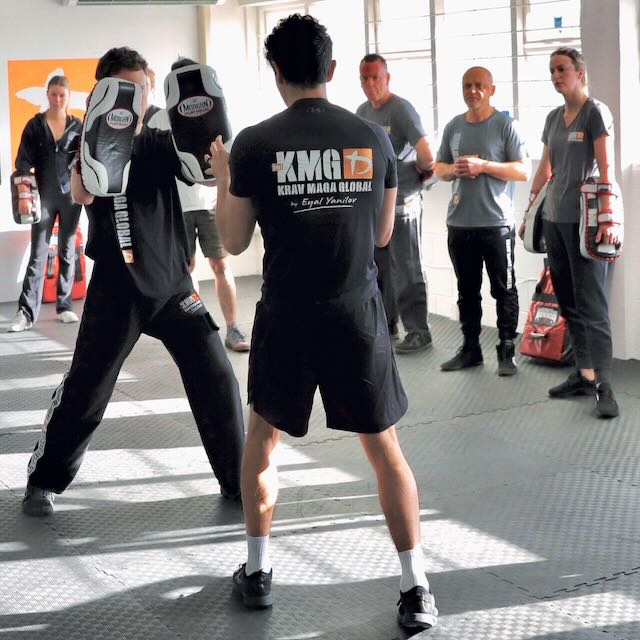
The most popular self-defence training in New Zealand includes Krav Maga, Brazilian Jiu-Jitsu, boxing, Muay Thai, and mixed martial arts — each suited to different goals. Krav Maga Global New Zealand runs certified Krav Maga classes in Auckland and Hastings, with training built around real-world situations, de-escalation, and New Zealand law. Of the systems available in NZ, Krav Maga is the only one designed specifically for civilian self-defence — not sport, not fitness, not competition.
What types of self-defence training are popular in New Zealand?
If you've been looking at options, the landscape can feel overwhelming. Different schools use different names, make different claims, and train in very different ways. Here's an honest breakdown of what's actually available — and what each one is built to do.
Krav Maga
Krav Maga is designed for one purpose: helping ordinary people protect themselves in real situations. Developed by Imi Lichtenfeld and refined into its modern civilian form by Eyal Yanilov through Krav Maga Global, the system is built around awareness, de-escalation, and simple physical responses that work under stress. There are no forms, no sport rules, and no competition — just practical training in the order that matters. It's the only system in this list designed from the ground up for the situations civilians actually face. KMG New Zealand runs certified classes in Auckland and Hastings, taught by internationally qualified instructors to the same standard used in 60+ countries.
Brazilian Jiu-Jitsu (BJJ)
Brazilian Jiu-Jitsu is a grappling system focused on ground control and submission holds — it's excellent for one-on-one situations that go to the ground. It has a strong competition culture in NZ, with clubs in most major cities. The training is technical and progressive, and the community is generally strong. The gap: BJJ doesn't cover striking, weapons, or situations involving multiple people — and its ground-focus isn't ideal if your priority is to escape quickly.
Boxing
Boxing builds real striking skill — hand speed, accuracy, footwork, and the capacity to stay functional under pressure. It's widely available across NZ and accessible to beginners. As a self-defence tool, it gives you something to work with in a confrontation. The limitation is that it addresses only striking at a specific range, and nothing on the ground, against weapons, or against multiple people.
Muay Thai
Muay Thai is one of the most practical striking arts available — it uses elbows, knees, and clinch work alongside hands and feet, giving you more tools than boxing alone. It's well-represented in NZ. Like boxing, it trains real physical capacity and teaches you to handle impact. Also like boxing, it's a sport system: it doesn't cover the non-striking dimensions of self-defence, and training has a competitive orientation that not everyone wants.
Mixed Martial Arts (MMA)
MMA combines striking and grappling and trains you to transition between ranges — it builds the most complete fighting skill set of any combat sport. There are good gyms across NZ and the training is challenging and effective. The honest caveat: MMA is built for one-on-one competition in a controlled environment. It doesn't address weapons, legal frameworks, or the mindset dimensions of civilian self-defence. It's excellent if you want to fight well. It's a different tool from one designed to help you stay safe.
Traditional Martial Arts (Karate, Judo, Taekwondo)
Traditional martial arts are widely available in NZ and offer real value — particularly for discipline, structure, and long-term practice. The self-defence application depends entirely on how the school trains: some schools train practically, most train primarily for grading and kata. If self-defence is your main goal, it's worth asking any traditional school how much of their training is scenario-based versus form-based before you commit.
What makes KMG training different from other self-defence options?
This is a fair question to ask of any school. Here's what's specific to how KMG New Zealand trains.
The curriculum is internationally standardised. KMG New Zealand teaches the same curriculum used by Krav Maga Global clubs in 60+ countries — structured across Practitioner (P1–P5), Graduate, Expert, and Master levels. You're not learning one instructor's interpretation of self-defence. You're training in a system that has been developed, tested, and refined at an international level for decades.
Training starts where most self-defence situations actually start — before anything physical happens. The KMG approach leads with awareness and de-escalation. Physical responses come later in the sequence, and only when nothing else has worked. This isn't softening the training — it reflects how real incidents actually unfold, and how New Zealand's self-defence law (Section 48, Crimes Act 1961) expects you to have responded.
You don't need to be fit, young, or experienced to start. KMG training is built around principles that work for the body you have now — not an idealised version of you. That's not a beginner-friendly marketing claim. It's a structural feature of how the system is designed: technique and awareness over size and athleticism.
Explore self-defence topics
Guides covering who self-defence training is for, what the law says in New Zealand, and how the KMG approach is structured.
Women's Self-Defence in New Zealand
Awareness, escape, and real-world skills — practical self-defence built around the situations women are most likely to face.
Read the guideIs Krav Maga Good for Older Adults?
Krav Maga rewards judgement, awareness, and efficiency — not youth or athleticism. Why it makes sense at any age.
Read the guideIs Krav Maga Effective?
What makes a self-defence system effective — and how the KMG curriculum is built to hold up in real-world situations rather than controlled conditions.
Read the guideMost Common Types of Assault in New Zealand
What the data shows about violent offending in New Zealand — and what it means for how self-defence training should be structured.
Read the guideIs Self-Defence Legal in New Zealand?
Self-defence is lawful under Section 48 of the Crimes Act — but only when the force used is reasonable. What the law says and what it means in practice.
Read the guideSituational Awareness for Beginners
The most important self-defence skill is recognising danger before it becomes physical. How to build it and why it matters more than most people assume.
Read the guideSelf-Defence Concepts — the full framework
The theory behind the practice — the self-defence timeline, law and ethics, NZ assault patterns, knife defence, improvised weapons, and what you can legally carry. Nine articles covering the concepts KMG training is built around.
Browse all conceptsFrequently asked questions about self-defence training in New Zealand
The most effective system depends on what you mean by effective. For fitness and sport performance, systems like Brazilian Jiu-Jitsu, Muay Thai, and MMA are excellent. For civilian self-defence — situations involving surprise, multiple people, or weapons — Krav Maga is the only system in New Zealand designed specifically around those scenarios. Krav Maga Global New Zealand teaches the internationally standardised KMG curriculum, which is built around awareness, de-escalation, and responses that work under real-world stress rather than controlled conditions.
KMG New Zealand runs regular Krav Maga classes at active clubs in Auckland (North Shore and West Auckland) and Hastings (Hawke's Bay). Classes are open to adult beginners and run weekly. Training is expanding to other New Zealand cities — if you're in Wellington, Christchurch, Hamilton, Tauranga, or another centre, you can register your interest and be the first to know when classes start near you. Visit the locations page for current training options.
Yes — and Krav Maga in particular is well-suited to people with no prior training. The system is built around principles that rely on awareness, timing, and simple responses rather than athletic ability or years of technique. Most people who train at KMG clubs come in with no martial arts background at all. The structured curriculum means you progress at a pace that makes sense, and instructors are used to working with complete beginners.
The core difference is purpose. Traditional martial arts and combat sports are built around rules, scoring, or historical forms. Krav Maga was built to help ordinary people survive real-world threats — which means no rules, no forms, no sparring for points. It also means training covers the dimensions most martial arts skip: de-escalation, situational awareness, multiple attackers, and weapons. The KMG curriculum is also unusual in that it's internationally standardised, so the same system is taught to the same standard across 60+ countries.
Most people notice a meaningful shift in awareness and confidence within a few months of regular training. In the KMG curriculum, the Practitioner 1 level — reached after roughly 40 classes over four to six months — covers the core responses for the most common real-world scenarios. That's not a full skill set, but it's a genuine foundation. The deeper you go into the curriculum, the more complex the scenarios you're trained to handle. Most people find the early months are where the most significant change happens in how they feel day to day.
Self-defence is lawful in New Zealand under Section 48 of the Crimes Act 1961, but only when the force used is reasonable and proportionate to the threat. KMG training covers this directly — the curriculum is structured so that de-escalation and avoidance come first, and physical responses are taught in the context of what New Zealand law permits. Understanding the legal framework isn't a footnote to training; it's part of it. The full guide to self-defence law in New Zealand covers Section 48 in detail.
Built around real situations, not sport
KMG New Zealand's self-defence curriculum is grounded in the KMG international system — developed under Eyal Yanilov, who trained directly under Imi Lichtenfeld, the founder of Krav Maga. Every element of training reflects a single priority: what works when a situation is real, unpredictable, and not subject to rules.
Find Training Near You
Active clubs in Auckland and Hastings. More cities building now.
Find Training Near You