
Is Krav Maga Good for Older Adults?
Krav Maga is well suited to older adults because it focuses on awareness, simple movements, practical decision-making, and real-world self-defence rather than athletic performance. In KMG New Zealand, many mature adults train because they want something structured, useful, and adaptable to the body they have now — not the body they had twenty years ago.
If you are asking whether you might be too old for Krav Maga, you are asking a practical question. You want to know whether this is realistic for your body, whether it is worth your time, and whether it can actually help you become safer.
The good news is that Krav Maga is not built around being young, fast, or naturally athletic. It is built around awareness, good decisions, simple responses, and the ability to deal with real-world problems in a practical way.
That is one reason many older adults train in KMG classes across New Zealand. They are not looking for trophies, ring fights, or acrobatics. They are looking for practical self-defence, real confidence, and a system that builds capability step by step.
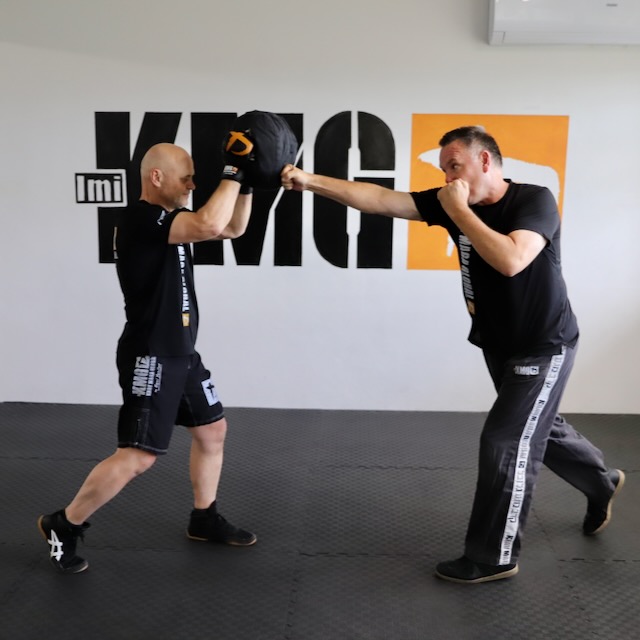
KMG New Zealand members in class. Many of our students are mature adults who train for practical self-defence, not competition.
Are you too old to start Krav Maga?
No. Krav Maga is not reserved for people in their physical prime. In many ways, it makes more sense for older adults than systems that rely heavily on competition, athletic speed, or repeated hard sparring.
Older adults often bring exactly the qualities that matter most in self-defence training: patience, judgement, consistency, and the willingness to learn with purpose. Krav Maga rewards those qualities because the system is not about showing off. It is about solving problems.
In KMG New Zealand classes, mature adults are already part of the training culture. That changes the question from "could someone my age do this?" to "how do I start building this properly?"
Key takeaway: age does not stop you from starting Krav Maga. The right training structure makes the difference.Why do older adults choose Krav Maga?
Most older adults who look at Krav Maga are not chasing a sport. They want practical self-defence. They want to know how to recognise trouble sooner, how to respond if someone grabs them, how to move more confidently in public space, and how to reduce the chance of becoming an easy target.
Practicality matters
You are learning skills you can relate to real situations, not just abstract movements or performance drills.
Structure matters
You are not guessing your way through random classes. KMG follows a progressive system that builds real capability over time.
Self-defence matters
The goal is personal safety, not proving toughness or staying in a fight longer than necessary.
Community matters
Seeing other mature adults training makes the path feel real, normal, and achievable from the start.
Is Krav Maga easier on the body than competitive martial arts?
For many older adults, yes. One reason Krav Maga appeals to mature students is that it is often a better fit than combat sports or hard competitive training environments where repeated impact, aggressive sparring, and athletic intensity are central to the experience.
Krav Maga training can still be serious, but serious does not mean reckless. The goal is not to turn every class into a fight. The goal is to build real self-defence skill safely, progressively, and honestly.
| Training Question | Krav Maga | Competitive Fight Training |
|---|---|---|
| Main goal | Practical self-defence and safe escape | Winning exchanges or competitive performance |
| Physical demand | Adaptable to the individual | Often built around high intensity and durability |
| Risk of unnecessary impact | Lower when training is controlled properly | Higher due to sparring, competition, or hard contact |
| Fit for mature beginners | Strong, because progress can be structured | Depends heavily on the gym and training culture |
Do you need to be fit or athletic before you start?
No. You do not need to arrive already fit enough to deserve training. You build fitness, coordination, confidence, and capacity through training. Krav Maga does not depend on being explosive in the way a sport system often does. The emphasis is on awareness, timing, posture, balance, positioning, and simple actions that work under stress.
How does Krav Maga adapt to your body as you get older?
Krav Maga works best when the principle stays strong even if the exact movement needs adjusting. If your knees, shoulders, back, or general mobility are not what they were twenty years ago, that does not automatically exclude you. Good instruction means adapting the delivery of the principle to the person in front of you while keeping the self-defence purpose intact.
You are not being asked to copy an idealised athletic version of the movement. You are learning how the principle works for your body and your current ability level.
Key takeaway: capability in Krav Maga comes from principles and good training, not from pretending every body moves the same way.What does training actually look like for an older adult?
It looks more practical and more controlled than many people expect. A good Krav Maga class is not a fight club. It is a structured learning environment where skill develops progressively. That can include:
- awareness and boundary-setting drills
- simple releases from grabs and holds
- movement, posture, and positioning
- pad work to build confidence and functional striking
- scenario training that links decisions to real situations
For many mature students, one of the biggest benefits is realising that self-defence does not have to mean fighting like a young athlete. It can mean learning how to think, move, respond, and leave safely.
If you want the first-step version of that experience, What Happens in Your First Krav Maga Class is the best next page to read.
Why do older adults often appreciate the KMG training structure?
Mature adults usually want to know that the training is going somewhere. They want to understand how progress works, what is being built, and whether the system is coherent. KMG New Zealand teaches within a wider international curriculum linked to Imi Lichtenfeld and Eyal Yanilov — training is not random. It is progressive.
For older adults, that structure is often a major advantage. It means you can focus on developing real capability rather than trying to decode whether a class is simply intense for the sake of intensity.
Is Krav Maga safe for older adults?
Any physical training carries some risk, but good Krav Maga training is designed to manage that risk intelligently. The training should be progressive, controlled, instructor-led, and appropriate to the student. The aim is not to absorb damage or win rounds — it is to become safer, more aware, and more capable.
So is Krav Maga good for older adults?
Yes. In many cases, it is one of the best self-defence options because it rewards judgement, awareness, efficiency, and structure rather than youth, speed, and athletic ego.
If you want self-defence training that is grounded, adaptable, and designed to help ordinary people become more capable, Krav Maga is a strong fit at any age. For the wider framework behind that, read What Is Krav Maga?, The Krav Maga Self-Defence Timeline, and Krav Maga, Self-Defence, Law and Ethics.
What do people usually ask about Krav Maga and older adults?
No. Krav Maga is designed to be practical and adaptable. Many mature adults begin later in life because they want real self-defence skills, not a competitive sport pathway.
Good training should be progressive, controlled, and adjusted to the individual. Like any physical activity, there is some risk, but Krav Maga is often a better fit than competitive fight-based training because it does not depend on hard sparring or athletic domination.
No. Fitness improves through training. Krav Maga is built around awareness, positioning, timing, and practical action, not around needing to arrive already athletic.
It is often a better fit if your goal is practical self-defence rather than competition. Krav Maga is generally more adaptable, less dependent on hard impact, and more focused on safety, awareness, and escape.
The best place to start is the national locations page at krav-maga-global.co.nz/locations — it shows the full KMG New Zealand network including waitlist registration for cities where courses are building.
Find Training Near You
Practical self-defence training that is adaptable, structured, and designed to build real capability at any age.