
The Most Common Types of Assault in New Zealand
Official New Zealand data groups violent offending around physical assault, sexual assault, and robbery — with around 185,000 New Zealanders affected by violent crime in 2023 alone. Krav Maga Global New Zealand uses that real-world picture to shape how training priorities are set: most real violence is close-range, fast, and often starts before the victim fully realises what is happening. Understanding the pattern helps people train for the right things.
Understanding the most common types of assault in New Zealand is useful for one reason above all: it helps people think more clearly about personal safety in the real world.
This is not about becoming fearful or expecting trouble everywhere. It is about understanding the kinds of situations that happen most often, how they typically begin, and what that means for awareness, positioning, and practical self-defence training.
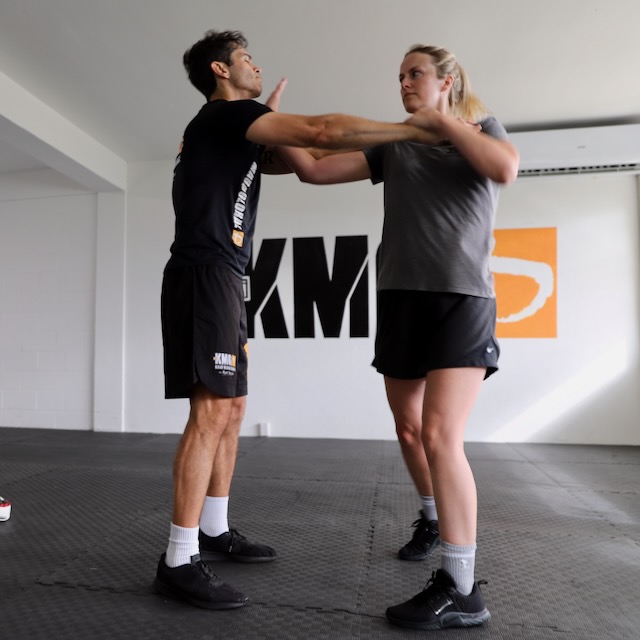
Real self-defence situations are close-range, fast, and often involve direct physical control. Training needs to reflect that.
Why this matters for personal safety
A lot of self-defence content online talks in general terms about "attacks" or "danger" without much real-world context. The problem is that it can either feel vague or become unnecessarily dramatic.
A better approach is to look at actual patterns. Official New Zealand data consistently groups violent offending around physical assault, sexual assault, and robbery. Looking at those patterns helps build a more realistic understanding of what everyday self-defence needs to prepare people for.
That does not mean training for every possible scenario. It means the most useful training tends to focus on common realities: close-range grabs, aggressive approaches, intimidation, attempts to control movement, and situations where awareness and early action matter just as much as physical skill.
Key takeaway: real-world self-defence training should reflect real-world patterns — not the most dramatic scenarios, but the most common ones.The main categories that matter most
Violent crime covers a wide range of behaviour, but from a personal safety perspective, a few broad categories matter most because they shape how people need to think and respond.
Physical assault
From pushing, grabbing, and striking through to more serious physical violence. The common thread in self-defence terms is close-range pressure and sudden escalation.
Threats and intimidation
Not every violent situation begins with immediate physical contact. Threatening behaviour, crowding, and intimidation often happen first — and are early warning signs that a situation is turning.
Robbery-related violence
Some assaults happen in the context of demands for property — phones, wallets, bags, or vehicles. In these situations, personal safety decisions matter far more than any idea of "winning."
Sexual assault and close-control violence
Some high-risk situations involve attempts to isolate, restrain, pin, or control a person rather than immediately strike them. This is one reason close-range escapes and ground defence matter so much in training.
Why strangulation and choking matter so much
One specific area worth understanding is strangulation or suffocation. The fact that this behaviour is specifically addressed in New Zealand law — under Section 189A of the Crimes Act 1961 — reflects how serious it is considered.
From a training perspective, this matters because self-defence cannot focus only on visible striking exchanges. It also needs to prepare people for close control, compression, pinning, and high-pressure situations at short range where panic can be the real enemy.
That is one reason practical training often includes standing choke releases, wall-pressure scenarios, and ground-based escapes. These are uncomfortable realities, but they are also exactly the kinds of situations where simple responses and calm decision-making matter most.
What this means in practice
If a common form of violence happens at close range, then training built only around long-range striking or single-step drills is missing a significant part of the picture. Pressure, movement, and escape from close range all need to be included.
Where and how these situations often begin
One of the most useful distinctions in crime data is the difference between public-space violence and violence involving known parties or private settings. Both matter, but they create different personal safety questions.
Public-space aggression
Alcohol-related confrontations, arguments that escalate, aggressive approaches, and intimidation in nightlife areas, transport spaces, or poorly managed public environments.
Close-range "interview" behaviour
Many assaults do not begin with a dramatic attack from distance. They begin with conversation, crowding, posturing, boundary testing, or someone closing the gap under a pretext.
Vehicle and transition spaces
Streets, driveways, car parks, and the moments between places are common situations for distraction. These are exactly the times when awareness tends to drop.
Known-person violence
A large amount of violence happens between people who know each other. Self-defence awareness is not only about strangers in public — it also involves recognising control, escalation, and danger early in familiar settings.
What this means for everyday people
The most important takeaway is that many assaults are not elaborate. They are close, fast, and often start before the victim fully realises what is happening.
That means some of the most valuable self-defence skills are also the simplest:
- keeping your attention up in transition spaces
- recognising when someone is closing distance for the wrong reasons
- not getting boxed in unnecessarily
- using your voice and movement early
- understanding that escape is almost always the real goal
If you want to go deeper on that side of personal safety, Situational Awareness for Beginners is the best companion article to this one.
A simple timeline of how violence often unfolds
Thinking about violence as a timeline makes self-defence feel much more practical and much less abstract. Most incidents follow a recognisable pattern — and intervening at any stage before "action" is almost always a better outcome.
| Stage | What it often looks like | What matters most |
|---|---|---|
| Selection | Distraction, vulnerability, poor positioning, being isolated or easy to approach | Awareness, posture, attention, avoiding easy-target behaviour |
| Encroachment | Closing distance, crowding, verbal pressure, boundary testing, intimidation | Recognition, movement, voice, creating space early |
| Action | Grab, shove, strike, pin, choke, or robbery demand | Simple physical responses, protection, movement, escape |
| Exit | Aggressor flees, victim escapes, or incident breaks up | Getting safe, scanning, seeking help, reporting, looking after injuries |
Self-defence is not only about the "action" stage. Many of the best decisions happen earlier — when there is still time to move, leave, or avoid being controlled in the first place.
How this should shape self-defence training
If the most common realities are close-range pressure, grabs, intimidation, sudden escalation, and escape opportunities, then training should reflect that.
Awareness before impact
Good training should include what happens before anything physical begins — not only what to do after someone has already attacked.
Close-range responses
A lot of useful self-defence is built around breaking contact, protecting the head and neck, creating distance, and regaining movement in tight spaces.
Pressure and realism
Techniques have to make sense when people are surprised, off-balance, crowded, or stressed. Training needs realism without becoming reckless.
Escape as a priority
The goal is not to stay in danger any longer than necessary. Safety and exit options should always be front of mind.
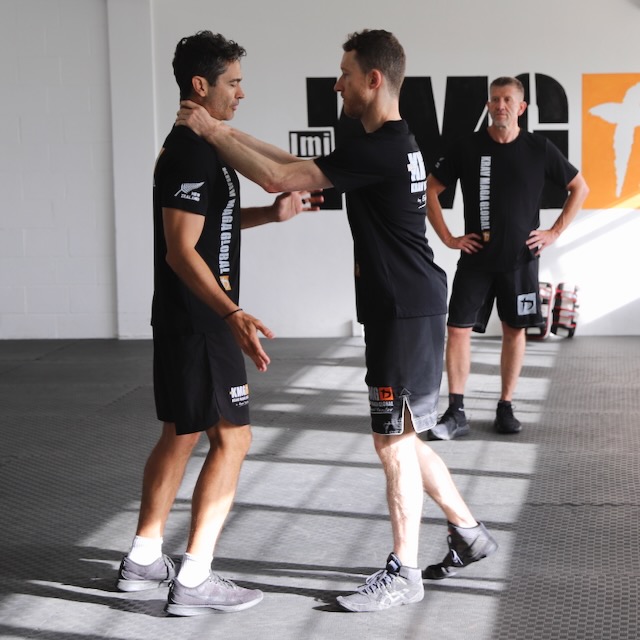
Practical training builds responses for the kinds of situations that happen most often — close-range, fast, and often unexpected.
The bigger point
The value of crime data is not that it creates fear. The value is that it helps people focus on the patterns that matter most, so training becomes more practical and more relevant to everyday life.
Why this fits the Krav Maga approach
Krav Maga tends to make sense to many people because it does not treat self-defence as only a striking problem. It treats it as a wider personal safety problem that includes awareness, positioning, avoidance, simple physical response, and getting clear safely.
That approach becomes much easier to understand when you look at the kinds of violence that actually happen most often. Real incidents are rarely neat, fair, or predictable. They are usually much closer to the kinds of scenarios that practical self-defence training is meant to address.
The KMG New Zealand instructor team builds training around these realities — not the most dramatic scenarios, but the most common ones. For a broader explanation of that training philosophy, read Does Krav Maga Work in Real Life?, Is Krav Maga Effective?, and How Krav Maga Works.
Understanding the pattern helps you train smarter
The most common types of assault in New Zealand do not point toward fear. They point toward clarity.
They show that practical self-defence is less about complicated scenarios and more about a handful of recurring realities: close-range pressure, intimidation, grabs, sudden escalation, and the need to notice danger early enough to keep options open. That is exactly why awareness, movement, decision-making, and escape-focused training matter so much.
What people ask about assault patterns and personal safety in New Zealand
Official New Zealand data groups violent offending primarily around physical assault, sexual assault, and robbery. Physical assault — ranging from grabbing and pushing through to serious violence — is the most common category. Most incidents are close-range and often involve intimidation or crowding before physical contact begins.
According to the Ministry of Justice's 2025 publication, around 185,000 New Zealanders were victims of violent crime in 2023, with violent crime defined as physical assault, sexual assault, and robbery. The New Zealand Crime and Victims Survey found around 30% of adults were victims of a personal or household crime in 2024.
Violence occurs in both public and private settings. Public-space assaults often involve nightlife areas, transport, and transition spaces like car parks and streets. A significant proportion of violence also involves people known to each other, including in domestic and familiar settings.
Section 189A of the Crimes Act 1961 specifically covers strangulation or suffocation because these behaviours carry serious physical risk and are strongly associated with escalating violence. From a self-defence training perspective, this reinforces why close-control scenarios — including ground defence and choke releases — are a core part of practical training.
Given the patterns of real-world violence, the most practically useful skills are: situational awareness and early recognition of risk, creating distance and using verbal boundaries before situations escalate, simple close-range responses to grabs and pressure, and understanding that escape is almost always the right goal.
Active KMG training is currently available in Auckland and Hastings. The national locations page connects you to the full network, including waitlist registrations for cities where courses are being developed.
Train for Practical Personal Safety
If you want self-defence training that reflects real-world situations, the best next step is to find a class near you and see how awareness, movement, and practical response are taught together.