
How Krav Maga Trains for Reality — Pressure Testing, Safe Equipment, and Why It Matters
KMG New Zealand uses progressive pressure testing — drills that increase in speed, resistance, and unpredictability as students develop capability. Protective equipment like head guards and rubber training weapons allow the training to be realistic without being reckless. This reality-based approach, built into the Krav Maga Global curriculum, helps students build usable confidence instead of confidence that only exists in controlled conditions.
A common question from people researching Krav Maga is whether the techniques are ever genuinely tested — or whether the training is just choreographed drilling that falls apart the moment something unexpected happens.
It is a fair question. And the answer is built into how the KMG curriculum is designed.
Within KMG New Zealand, training starts with sound technique, then gradually adds resistance, timing pressure, environmental complexity, and decision-making. The result is not chaos. It is structured realism.
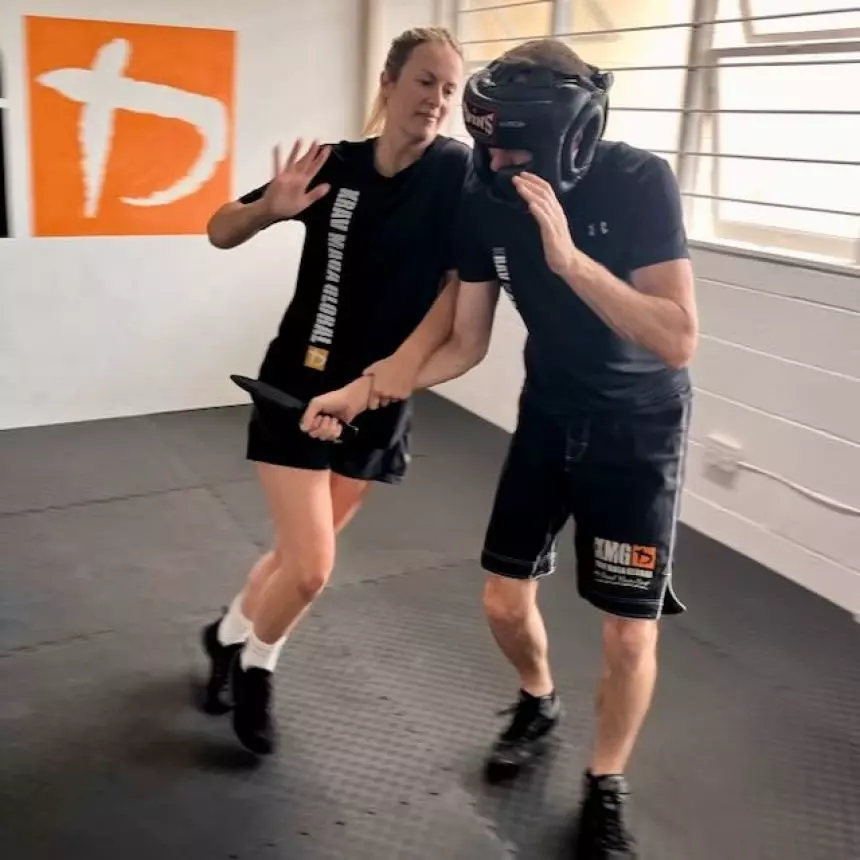
Pressure drilling with a rubber knife and protective head guard — realistic training, managed safely.
Why does comfortable training break down under pressure?
Techniques drilled against a cooperative partner at controlled speed will work perfectly — in that exact condition. The moment something changes — faster movement, genuine resistance, an unexpected angle — untested technique tends to break down. The body has not experienced the real version of the scenario, so when pressure arrives, the response is not there.
This is the gap between training that looks good and training that works. Many martial arts drills build confidence in a version of the scenario that is too tidy, too cooperative, or too predictable.
Krav Maga training is specifically designed to close that gap by introducing pressure progressively rather than leaving it out altogether.
What does pressure testing actually look like?
Pressure testing is introduced progressively — not thrown at beginners on day one. The KMG curriculum builds in stages: technique is established in controlled conditions first, then resistance increases, then speed increases, then unpredictability is added. Each stage is calibrated to where the student is in their development.
In practice, this might look like:
- A knife defence drill that starts slow and cooperative, then builds to realistic attack speed with a rubber training knife
- A striking combination drilled on pads, then applied against a partner wearing protective equipment at genuine intensity
- A scenario drill with multiple attackers, an unexpected transition, or a confined space where the student has to apply technique under conditions they cannot fully predict
The goal is to build a response that holds under pressure — not to overwhelm students before they have anything to hold onto.
Why does protective equipment make training more realistic?
There is a common misconception that protective equipment softens training. The opposite is usually true. Protective equipment allows the training to go to intensities that would not be possible without it.
A head guard means a training partner can apply realistic pressure at striking range without accidental injury stopping the drill. A rubber knife means a knife defence can be drilled at genuine attack speed — not the slow, careful movement that bears no resemblance to how a knife assault actually happens.
Within the KMG curriculum, protective equipment is introduced when the training calls for it. It is not a gimmick and it is not there to make training look hard. It is there to make useful realism possible safely.
Why does Krav Maga use rubber knives and training weapons?
The hero image on this page shows exactly this principle in action: a rubber training knife being used in a scenario drill at realistic pressure. The student defending has to respond to a genuine attack pattern — not a slow, telegraphed movement that gives away every intention.
Weapon defence is one of the areas where the gap between controlled drilling and realistic training matters most. A knife defence that is only ever drilled against a cooperative, slow attack gives a dangerously false picture of what knife encounters actually look like.
The KMG curriculum addresses this by introducing weapons training progressively — awareness and basic principles first, then increasingly realistic scenarios as technique develops. For more on how that connects to real-world self-defence, read Does Krav Maga Work in Real Life?
What is stress inoculation and why does it matter?
Stress inoculation is not only about whether the physical technique holds up. It is about building the psychological resilience to function when adrenaline hits. The physiological response to a real threat — elevated heart rate, tunnel vision, compromised fine motor control — does not arrive during cooperative drilling. It arrives when something feels genuinely urgent and unpredictable.
Reality-based training progressively exposes students to higher-pressure scenarios so that this response becomes familiar rather than overwhelming. Techniques that have only been drilled in calm conditions often fail under real stress — not because the technique is wrong, but because the student has never had to apply it while activated.
Students who train this way consistently often describe a different response to pressure outside the gym as well: calmer decisions, less freezing, and a more grounded sense of what to do next. For the broader self-defence framework that this training supports, read The Krav Maga Self-Defence Timeline.
Is high-pressure training safe for beginners?
Yes — because the pressure is introduced progressively, not immediately. Beginners start in controlled drilling conditions, exactly as you would expect. The intensity builds as technique and confidence develop. Nobody is thrown into high-pressure scenario work before they have the foundations to handle it.
The KMG New Zealand instructor team manages training environments by monitoring intensity, pairing students appropriately, and introducing protective equipment and higher-pressure drills when students are ready for them rather than on a fixed timetable.
This is one reason the system can work well for people across a wide range of starting fitness levels and backgrounds. The training adapts to where you are, not the other way around. For more on how that connects to the legal and ethical framework of self-defence, read Krav Maga, Self-Defence, Law and Ethics.
"Excellent practical and effective self defence for ordinary people in the real world. Easy and quick to learn. It works for anyone regardless of gender, age or size."
Scott — KMG NZ memberWhy does this training approach matter in the KMG curriculum?
The KMG curriculum is designed to build usable self-defence under pressure, not just neat-looking technique. That is why reality testing is introduced in a structured way rather than left out or replaced with permanently cooperative drilling.
KMG New Zealand is the sole national representative of Krav Maga Global (HQ), under the direct authority of Eyal Yanilov. The KMG New Zealand instructor team teaches inside that broader framework, which is why pressure, equipment, and progressive resistance are treated as training tools rather than optional extras.
Students are not just learning what the technique is meant to look like. They are learning how it behaves when conditions become less comfortable. That difference is one of the clearest reasons why reality-based training matters.
What people ask about reality training in Krav Maga
Yes. The KMG curriculum builds progressive pressure testing into the training structure. Techniques are established in controlled conditions first, then drilled with increasing resistance, speed, and unpredictability as capability develops. Scenario drills, protective equipment, and rubber training weapons allow the material to be genuinely tested without unnecessary injury risk.
Stress inoculation is progressive exposure to higher-pressure training so that the physiological response to stress — elevated heart rate, tunnel vision, compromised fine motor control — becomes familiar rather than overwhelming. It helps students apply technique when adrenaline is high instead of only when everything is calm and cooperative.
Rubber training weapons allow weapon defence scenarios to be drilled at realistic speed and intensity. A knife defence drilled only against slow, cooperative attacks creates a false sense of preparation. Safe training tools make genuinely useful scenario drills possible.
Yes. Beginners start in controlled conditions and the pressure builds progressively as their capability develops. The KMG New Zealand instructor team calibrates intensity to where each student is — nobody is thrown into high-pressure scenario work before they have the foundations to handle it.
The gap between cooperative drilling and real situations is one of the most common failure points in self-defence training. Reality training closes that gap by introducing the same variables — speed, resistance, unpredictability, stress — in a controlled environment so the response is available when conditions are not controlled.
Active KMG training is currently available in Auckland (North Shore and West Auckland) and Hastings in Hawke's Bay. See the locations page for current options and to register your interest for cities where courses are building.
Find Training Near You
Use the national locations page to find your nearest active KMG training option in New Zealand.