
Defending Against Improvised Weapons — And Using Everyday Objects in Your Defence
Krav Maga Global trains both sides of improvised weapons from the start: how to defend against objects used as weapons by an attacker, and how to use available objects — a bag, an umbrella, a belt, a chair — to create distance, shield yourself, or strike to escape. This is formally codified as Unit 19 of the KMG curriculum, and the mindset behind it is introduced to beginners from their first sessions.
Most people think of weapons as things carried on purpose — a knife, a bat, a firearm. But in most real-world violent incidents, the weapon is whatever happens to be nearby. A bottle. A chair. A belt. A rock from a carpark.
This is not an advanced topic reserved for experienced students. It runs through the KMG curriculum as a thread — starting with how you scan and read your environment, and building over time into deliberate training with a wide range of objects in realistic scenarios.
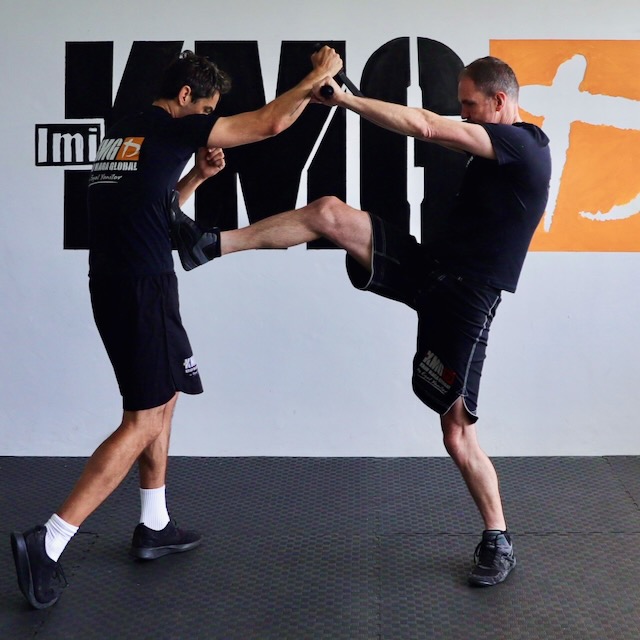
Instructor Aaron (KMG Expert 2) defending an overhead stab with an improvised object — realistic scenario training at KMG New Zealand.
What is an improvised weapon?
An improvised weapon is any object not designed for combat that can be used to cause harm, create distance, shield against an attack, or disrupt an attacker's ability to act. In a self-defence context, this covers two distinct categories: objects used against you by an attacker, and objects you might use in your own defence.
The distinction matters because they require different responses. When an attacker picks up a bottle or a chair, they have extended their reach and changed the nature of the threat. When you identify an object near you that could help — a bag to shield with, an umbrella to create range — the question is whether you can access it without creating more risk than it resolves.
Key takeaway: improvised weapons appear in both directions — used against you, and available to you. Krav Maga trains both sides from the start.What categories does Krav Maga use?
Rather than teaching a fixed list of objects, Krav Maga Global trains a classification system — so the principles transfer across any object an attacker picks up, or any object available to you. Once you understand which category an object belongs to, you understand how to use it and how to defend against it.
Category 1
Blunt / Impact
Bottles, coffee mugs, heavy books, torches, a fire extinguisher. Defending against these shares principles with stick and club defence.
Category 2
Sharp / Edged
Keys, pens, broken bottles, screwdrivers, scissors. The cutting or stabbing threat — not the object's everyday use — shapes the response.
Category 3
Shield / Barrier
A bag, backpack, jacket, chair, laptop. Objects that create a barrier — particularly useful when facing an edged weapon where distance alone isn't enough.
Category 4
Reach / Flexible
Belts, scarves, lanyards, towels, cables. Can create distance, entangle, or redirect. Also used against you — choke threats using fabric are a real pattern.
Category 5
Projectile / Distraction
Anything throwable — keys, coins, a drink. Used to create a moment's hesitation. A distraction that buys half a second is worth training.
Category 6
Environmental
Walls, doors, vehicles, furniture, stairs. Using terrain — positioning relative to a parked car, using a doorway to limit angles of attack.
How does Krav Maga defend against improvised weapons?
When an attacker uses an improvised object, the fundamental principles of Krav Maga defence don't change — but the threat profile does. A bottle swung overhead has a different arc than a closed-fist punch. A chair extends reach significantly. A belt or cord introduces choking, entanglement, and whipping threats that bare hands don't produce.
Stick, club, and blunt object defence
Introduced progressively through Practitioner levels, training begins with defending against overhead and diagonal strikes — patterns that appear whether the weapon is a wooden bat, a bottle, or a length of pipe. Deflecting and neutralising the attacking limb, combined with immediate counter-attack, forms the foundation.
Flexible weapon threats
Belts, chains, and cord introduce threat patterns most people have no mental model for. Training builds recognition of the three primary dangers — the whip strike, the grab-and-pull, and the choking application — and defences that disrupt the attacker's control before it can be fully applied.
Environmental threats
An attacker using a door to trap you or a vehicle to pin you against a wall is also using improvised weapons — just structural rather than handheld. Scenario-based training at intermediate and advanced levels brings these in deliberately, because physical responses to being trapped differ significantly from open-space defences.
Key takeaway: improvised weapons are common in real violence precisely because they're available everywhere. Training for them early means not being caught unprepared by opportunistic attackers.How do you use everyday objects in your own defence?
Learning to identify and use objects for your own defence is one of the most practically applicable skills Krav Maga develops — because it doesn't require physical capability beyond picking something up. A small person with a bag can create meaningful distance from a larger attacker. An umbrella changes reach. A coat thrown at someone's face produces the hesitation needed to exit.
Krav Maga's position on this is practical. An object in your defence serves one of three purposes: it creates physical distance from the attacker, it shields against incoming attack, or it produces sufficient disruption to allow escape. It is rarely about winning a fight with the object — it is about buying the seconds needed to leave.
Key takeaway: objects in defence are trained as distance-creators and barriers, not bludgeons. The goal is always to buy the time needed to get out.How is this structured in the KMG curriculum?
Within the official KMG curriculum, Unit 19 — Using Common Objects as Weapons in Defensive Tactics — draws together training that has been building across earlier units. But the conceptual groundwork is laid much earlier, from P1.
-
P1–P2
Awareness and scanning introduced The habit of reading the environment — identifying exits, potential threats, and available objects — is built into situational awareness training at foundation level. Students aren't yet training to use objects technically, but they're beginning to think in those terms.
-
P3–P5
Blunt weapon defence — overhead and diagonal attacks Defending against stick and club attacks introduces the technical framework. The same deflection-and-counter logic transfers to defending against improvised blunt objects. Basic use of available objects for shielding and distance creation begins here.
-
G1–G2
Flexible weapons, complex scenarios, object categories formalised Belt and cord threats added. Scenario work becomes more complex — multiple environmental constraints, objects at varying distances, defence while holding or carrying something.
-
G3+
Unit 19 formalised — weapon-vs-weapon, continuous attack defence Full Unit 19 integration, including using improvised objects against a conventionally armed attacker, defending continuous weapon attacks, and stick-fighting principles.
What does this look like in class at KMG New Zealand?
Improvised weapons thinking appears across regular training at KMG New Zealand, not only in dedicated sessions. Environmental scanning is built into how warm-up circuits are sometimes structured. Bag-and-shield drills appear when working on creating distance. Scenario rounds regularly include objects — training partners may pick up a foam bat, a bag, or a rubber training stick as part of an attack pattern without warning.
At the dedicated level, workshop sessions go deeper — spending a full session on a specific category of object, running scenarios where students identify and use what is available in the room, or working through the defending-against-continuous-weapon-attack patterns that require more repetition to build reliable responses.
One consistent point Instructor Aaron makes in class: the object is not the answer. The answer is the decision to act, the movement that takes you off the line of attack, and the counter-pressure that gives you an exit. The object simply changes what options you have as you work through that sequence.
In New Zealand, an improvised object used in self-defence is still legally a weapon. What matters under the Crimes Act 1961, section 48 is whether your response was proportionate to the threat. Krav Maga's emphasis on de-escalation first, and using force only when necessary and proportionate to escape, is directly relevant here. See the full article on self-defence law and ethics in New Zealand →
Common questions about improvised weapons training
Not in the sense of full technical sessions at P1 — but the thinking is introduced from the start. Situational awareness training, which begins in the first few sessions, explicitly includes identifying what is around you and what role it could play. Early blunt-object defence work builds the technical foundation that later applies to improvised objects. By mid-Practitioner levels, students are doing scenario-based rounds where objects in the room may be used by either party.
Training varies by level and session focus, but commonly includes: bags and backpacks (shielding and distance); umbrellas and walking sticks (reach and deflection); belts and lanyards (flexible weapon threats and responses); chairs (both as a shield and as a blunt weapon threat); foam or rubber approximations of bottles, pipes, and sticks. The key principle is that any object trains to its category, so the skills transfer across similar objects.
The primary differences are in threat profile and timing. A blunt object like a bottle relies on impact force, so the defence focuses on deflecting the swing and controlling the attacking arm. An edged weapon can cause damage across its entire arc, with less commitment required from the attacker, which typically calls for more aggressive initial redirection and faster transition to control. At advanced levels in KMG, weapon-versus-weapon scenarios explore how these interact when both parties have objects available.
Yes, with conditions. New Zealand law allows reasonable force to be used in self-defence, and picking up an available object to defend yourself can be lawful. The key factors are whether you genuinely believed force was necessary, and whether your response was proportionate to the threat you faced. Using a heavy object against someone who posed no serious threat would not meet that standard. Krav Maga training addresses this directly — the legal and ethical principles of self-defence are part of the curriculum, not an afterthought.
At Krav Maga Auckland, improvised weapons scenarios are woven through regular training and appear regularly in scenario rounds. Specific workshop sessions on weapon categories run periodically and are open to students from Practitioner level onwards. Krav Maga Global's formal Unit 19 content is covered progressively through Graduate level training for those progressing through the grading system.
Train the full system from your first session
Krav Maga Global is the only KMG-certified programme in New Zealand. Find training in Auckland and Hastings — or register early for your city.