
Is Krav Maga Effective for Self Defence in New Zealand?
Krav Maga Global New Zealand teaches Krav Maga as a civilian self-defence system within the lineage of Imi Lichtenfeld and Krav Maga Global under Eyal Yanilov. It can be highly effective when trained as a practical system built around awareness, pressure, simple responses, and safe escape — and when taught through a coherent national framework rather than as a disconnected local interpretation.
People searching for self-defence training in New Zealand usually want a clear answer to one question: does Krav Maga actually work in the kinds of situations ordinary people may face?
The answer depends on how effectiveness is defined. In self-defence, effective does not mean looking technical in a controlled environment. It means improving your ability to recognise danger, respond under pressure, protect yourself or others, and create a chance to get away safely.
That is where Krav Maga stands apart. It is not built as a sport and it is not organised around performance for an audience. It is built to help people function in fast, chaotic, high-stress situations where clean technique alone is not enough.
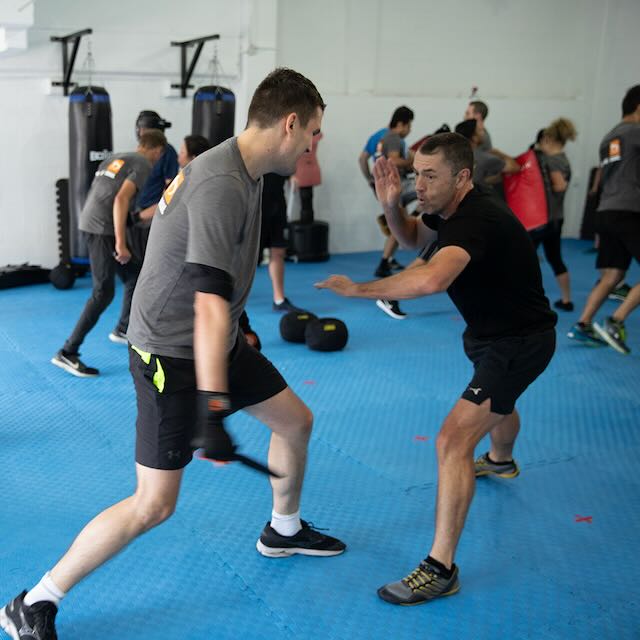
Effective self-defence training has to account for pressure, speed, uncertainty, and realistic threat patterns.
What does "effective" actually mean in self-defence?
In self-defence, effective means improving your chances in a chaotic situation, not performing perfectly. Real incidents are fast, emotional, unpredictable, and often messy. There is no referee, no agreed starting point, and no guarantee that the threat will arrive in a clean one-on-one format.
That means a useful system must do more than teach isolated techniques. It has to build awareness, timing, pressure response, decision-making, and the ability to keep working when adrenaline is high.
For most civilians, that is the real test. The question is not whether a system looks good in theory. The question is whether it helps ordinary people make better decisions and take usable action under pressure.
Key takeaway: effectiveness in Krav Maga is about practical function under stress, not perfect execution in ideal conditions.Why can Krav Maga be effective for ordinary people?
Krav Maga is designed around simplicity, directness, and real-world context. That matters because most people seeking self-defence are not training for competition. They want something they can learn, retain, and apply when frightened, surprised, or physically overwhelmed.
Simple responses under stress
Under adrenaline, complicated movement can break down. Krav Maga emphasises clear, direct actions that are easier to access when speed and pressure increase.
Decision-making, not just technique
Technique only matters if you can recognise the moment, choose the right response, and act quickly enough to create a safer outcome.
Built for civilians, not competitors
The system is designed for people who are not professional fighters — which means it accounts for the reality that most students will not have elite physical conditioning or years of ring experience.
Escape as the goal, not domination
In Krav Maga, the objective is to stop the threat, create an opportunity, and leave. That orientation shapes everything from technique selection to how scenarios are trained.
How does effective Krav Maga training actually work?
Effective Krav Maga training goes beyond static drilling. It includes pad work, partner exercises, movement, tactical positioning, stress exposure, verbal elements, and scenario-based decision-making.
You are not only learning what to do. You are learning when to do it, how to keep functioning when tired or startled, and how to move from the physical moment toward escape.
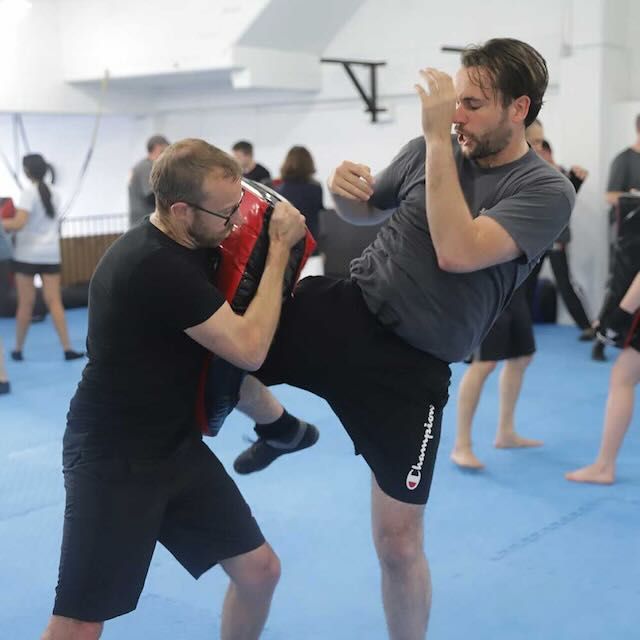
Pad work helps students develop timing, mechanics, pressure tolerance, and the ability to act decisively rather than freeze.
Within the KMG system, that progression matters. Beginners need structure and repetition. More experienced students need pressure, variation, and context. Real effectiveness grows from both, which is why training quality and instructor standard are so closely tied to outcomes.
Key takeaway: good training does not stop at technique demonstration. It develops usable behaviour under pressure.Is Krav Maga more effective than MMA, BJJ, karate, or Muay Thai for self-defence?
Different systems solve different problems well. Krav Maga is not trying to replace every martial art or combat sport. It is focused on civilian self-defence, threat management, and escape under unpredictable conditions.
Combat sports can build excellent timing, toughness, and technical skill. Traditional martial arts can build structure and discipline. Krav Maga differs because it places those physical skills inside a wider self-defence framework that includes awareness, pre-contact behaviour, multiple attackers, weapon threats, and the need to leave rather than continue exchanging.
| System | Primary Focus | How Krav Maga Differs |
|---|---|---|
| Krav Maga | Civilian self-defence, practical response, escape | Built around awareness, pressure, fast response, and safe exit in real-world situations |
| BJJ | Grappling, control, submissions | Krav Maga places more emphasis on striking, mobility, weapons, and disengagement |
| Karate | Structured striking and formal practice | Krav Maga is generally less formal and more scenario-driven in its self-defence application |
| Muay Thai | Stand-up striking, clinch, conditioning | Krav Maga uses striking inside a broader self-defence model rather than a competitive exchange |
| MMA | All-round competitive fighting | Krav Maga is not built around matched opponents, rounds, or a rules-based contest |
For a more detailed comparison across systems, read Best Martial Art for Self-Defence.
Key takeaway: Krav Maga is most effective when the goal is civilian self-defence rather than sporting performance.What makes KMG New Zealand a trustworthy source of Krav Maga?
Not all Krav Maga is taught to the same standard, and that distinction matters when evaluating effectiveness. The KMG system taught in New Zealand is directly connected to Krav Maga Global — the organisation founded by Eyal Yanilov, the primary student of Imi Lichtenfeld, the originator of Krav Maga.
That structure matters because it determines the standard students are trained to. Effectiveness is not just a function of the techniques — it is a function of how honestly and consistently those techniques are taught and pressure-tested.
Key takeaway: KMG New Zealand teaches within a verified international framework, not as an isolated local variation.What makes Krav Maga effective in a New Zealand context?
In New Zealand, self-defence has to be understood as more than just physical technique. It involves judgement, awareness, verbal boundary-setting, lawful force, and the ability to end the situation without creating more risk than necessary.
This is why serious Krav Maga training places so much emphasis on recognising danger early, managing distance, responding proportionately, and escaping as soon as possible. In many situations, the best self-defence outcome is not "winning." It is seeing the problem sooner and exiting earlier.
For the full framework behind that approach, read The Krav Maga Self-Defence Timeline and Krav Maga, Self-Defence, Law and Ethics.
Can Krav Maga fail to be effective?
Yes. No system is automatically effective just because of its name. Training quality matters. Coaching matters. Pressure matters. Progression matters. Consistency matters.
Krav Maga becomes less effective when it is taught as compliant choreography, when students are never required to apply skills under realistic pressure, or when the training creates false confidence instead of honest capability.
That is also why lineage and instructor development matter. The KMG New Zealand instructor team is responsible for teaching the system as a coherent self-defence framework — which is why the national structure exists rather than relying on disconnected clubs with no shared standard.
If you want to understand how this plays out in real-world training transfer, Does Krav Maga Work in Real Life? covers that in depth — including scenario training, environment adaptation, and what honest pressure-testing looks like in practice.
What people ask about whether Krav Maga is effective
Yes. Krav Maga is designed to be teachable to ordinary people, including beginners. Students can start building useful skills early because the system emphasises direct responses, awareness, and practical decision-making rather than athletic performance alone.
Krav Maga is specifically designed for real-world self-defence rather than sport. Its value lies in helping people recognise danger, act under pressure, and create an opportunity to escape safely. No system guarantees an outcome, but well-trained Krav Maga can be highly effective in the context it is designed for.
It depends on the goal. MMA and BJJ are highly valuable systems for fighting skill. Krav Maga is more specifically oriented toward civilian self-defence, including awareness, escape, weapon threats, and the unpredictability of uncontrolled situations.
Students can start learning useful principles quite early, especially around awareness, movement, and basic self-defence responses. Real effectiveness develops over time through repetition, pressure-based training, and consistent attendance.
Yes. KMG New Zealand is directly affiliated with Krav Maga Global, founded by Eyal Yanilov — the primary student of Imi Lichtenfeld, the originator of Krav Maga. That connection means the curriculum taught in New Zealand follows the same framework as the international KMG system, not a locally modified version.
Active training is currently available in Auckland and Hastings. The national locations page connects readers to the wider KMG New Zealand network, including waitlist registrations for cities where courses are being developed.
Find Training Near You
Use the national locations page to find your nearest active KMG training option in New Zealand.