
Krav Maga vs Filipino Martial Arts: A Complete Guide — Weapons Training, NZ Law, and What Actually Matters for Self-Defence
Filipino Martial Arts (FMA) — including Arnis, Eskrima, and Kali — is built around carrying and using weapons. In New Zealand, where civilians cannot lawfully carry weapons for self-defence, and where most real violence begins without a weapon in hand, that framing misses the actual problem. KMG New Zealand teaches Krav Maga: a self-defence system built around the situations ordinary New Zealanders actually face — unarmed, often surprised, and needing to get safe fast.
If you have been researching Filipino Martial Arts for self-defence, the interest makes sense. Arnis, Eskrima, and Kali have a serious reputation for practical weapons work, efficient angles, strong movement patterns, and realistic training logic. People drawn to FMA are usually asking the right questions about self-defence.
There is a second question that matters just as much in New Zealand: how does that training translate into everyday reality under New Zealand law?
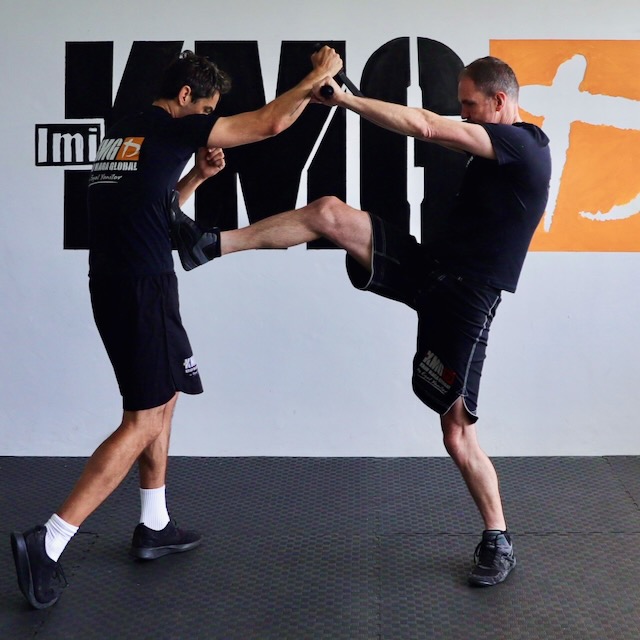
Weapon defence drilling within the KMG curriculum — defender-first orientation.
What Krav Maga and Filipino Martial Arts Have in Common
Both Krav Maga and Filipino Martial Arts treat weapons as part of the real-world threat environment, not as an advanced curiosity reserved for senior students. Both pressure-test their material against active partners. Both share a respect for angles, range, and timing. And both have lineages rooted in genuine conflict rather than choreographed performance.
That shared foundation matters. Practitioners who arrive at Krav Maga with an FMA background usually have excellent weapon-awareness instincts to build on. The reverse is also true — a Krav Maga practitioner who later trains FMA tends to develop deeper appreciation for how attackers move with edged and impact weapons.
What Is Filipino Martial Arts Actually Designed For?
Filipino Martial Arts is an umbrella term for the traditional weapons-based martial arts of the Philippines — most commonly known as Arnis, Eskrima, and Kali — refined over centuries of practical use, with weapons typically taught before empty-hand work. Modern FMA has competitive sport branches and serious self-defence applications, but the historical and pedagogical centre of gravity sits in stick, blade, and dagger work.
The training assumes a practitioner who carries or has access to a weapon, and the curriculum is built around using that weapon effectively — with empty-hand skill emerging from weapon mechanics rather than the other way around. Sinawali, single-stick flow drills, knife tapping, and blade-versus-blade work are foundational, not advanced.
Within that environment, FMA produces extraordinary capability: fluency with edged and impact weapons, sharp angle recognition, smooth range transitions, and a deep understanding of how attackers actually move with weapons in hand. None of that is dismissed here. It is simply trained for a specific frame.
What FMA Is Actually Good At — and Why That Is Not Self-Defence
FMA develops genuine specialist skill. Those skills are real — but they are specialist weapon-handling skills, not civilian self-defence skills. There is an important difference.
- Edged-weapon depth. Most FMA programmes spend hundreds of hours on knife and blade mechanics — far more than most self-defence curricula.
- Angle recognition. The FMA approach to attack angles gives practitioners a fast pattern-recognition framework across stick, blade, and empty-hand contexts.
- Flow and sensitivity drills. Hubud, sumbrada, and tapi-tapi drills build close-range tactile sensitivity that is rare outside FMA.
- Improvised weapon fluency. Because FMA treats the stick as a stand-in for rigid objects, practitioners develop natural fluency with environmental tools.
These are all interesting skills. None of them directly help when someone grabs you outside a bar, shoves you on public transport, or corners you in a carpark. FMA trains you to use weapons. Krav Maga trains you to survive situations — most of which do not start with a weapon in your hand.
Why Does the New Zealand Legal Context Matter So Much in This Comparison?
New Zealand civilians cannot lawfully carry weapons for self-defence. Carrying a knife, baton, stick, or other object with the intent to use it as an offensive weapon is an offence under the Crimes Act 1961 and related provisions, and firearms are governed separately under the Arms Act 1983. Self-defence is recognised as a legal justification under section 48 of the Crimes Act, but only where the force used is reasonable in the circumstances as the defender believed them to be.
This legal distinction is one of the main reasons KMG New Zealand emphasises awareness, avoidance, defence, and escape over weapon carrying.
That matters because any self-defence system built around weapon deployment must be judged not only by technical effectiveness, but by whether the core behaviour it assumes is lawful in everyday life. If your training is built around using a weapon, but carrying that weapon for self-defence is not a lawful civilian option, the training logic changes immediately.
FMA practitioners often point out, reasonably, that weapon mechanics transfer into empty-hand skill. That is true to a meaningful degree — range, angles, timing, and tactile awareness all carry over. But the primary orientation still shapes how the system is trained, and how a practitioner instinctively responds under stress. FMA develops strong weapon mechanics. Krav Maga develops the defender who may face a weapon and needs a lawful, proportionate, practical response.
For a broader overview of how lawful and proportionate force is framed in New Zealand, see our Self-Defence Law and Ethics page.
That realisation is often the moment people decide to start training. Not because they expect to face a weapon, but because they recognise that if something does happen, they would rather have options than assumptions — and those options need to work within the law they actually live under.
How Is Krav Maga Different?
Krav Maga was built for one purpose: giving ordinary people effective responses to real threats, fast — including weapon threats they did not see coming. The starting point is not "how do I use this weapon?" but "how do I survive if someone else has one?" That single reframing changes the entire training emphasis.
According to Eyal Yanilov — who trained directly with Imi Lichtenfeld and now leads Krav Maga Global as Head Instructor — the system is structured around prevention and avoidance, de-escalation, simple physical responses, and safe disengagement.
A concrete example. Imagine a knife pulled in the doorway of a bar at closing time, with a second person blocking the exit behind. The Krav Maga response is built around recognising the threat early, creating distance, controlling the weapon-bearing limb if engagement becomes unavoidable, disrupting decisively, and disengaging while staying aware of the second attacker. The disarm is a possible outcome, not the goal.
KMG training also incorporates pressure and stress-inoculation methods similar to combat sports environments, but applies them inside a broader self-defence framework that includes legal context, weapon threats, and disengagement priorities.
That leads to a curriculum with a very different emphasis from FMA:
- Threat recognition and avoidance — recognising weapon cues early and creating distance before things escalate
- Weapons defence — deflecting, evading, disrupting, and responding while a weapon threat is already in play
- Disarming as a defensive sequence — removing the weapon from the attacker's control as part of the defence, not as the objective
- Proportionate last-resort response — understanding what is tactically and legally defensible if a weapon is acquired during the defence
- Disengagement — getting away safely as the priority, not finishing the encounter
For the broader explanation, see How Krav Maga Works.
Identify pre-attack cues and weapon indicators early.
Create distance, de-escalate, or exit if possible.
Protect against the immediate threat if escape is not possible.
Create a moment to break the attacker's control.
Disengage safely and get away from danger.
Is the Weapons-Aware Training People Want from FMA Already Present in Krav Maga?
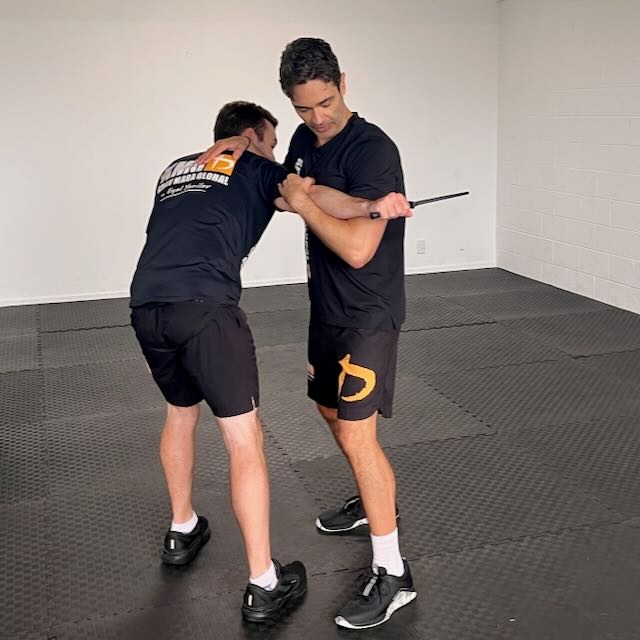
Weapons defence training within the KMG system — recognise, defend, disrupt, escape.
If you are drawn to FMA because of its weapons focus, the KMG curriculum also addresses weapons early and seriously. Weapon awareness is not treated as an advanced curiosity. It is treated as a realistic part of the threat environment from the early levels of training.
This is one of the strongest points in Krav Maga's favour for people wanting practical protection. Many traditional systems delay weapon content for years. KMG introduces the logic of weapon threats early because the threat exists whether or not you have been training for a decade.
The difference is still orientation. FMA develops deeper specialist weapon mechanics in isolation. Krav Maga develops the broader self-defence framework that includes weapons, legal context, stress response, decision-making, and escape. For most people starting from scratch in New Zealand, that broader framework is the more direct fit.
Why Does Krav Maga's Weapons Curriculum Cover So Many Different Threats?
The breadth of Krav Maga's weapons curriculum comes from the reality in which the system was formed. It was never based on the assumption that violence would arrive in a neat or predictable way. Imi Lichtenfeld's early self-defence experience in 1930s Bratislava involved protecting his community against real, often improvised violence — and that lineage shaped the system's assumption that any object in the environment can become a threat.
The KMG weapons curriculum addresses a deliberately broad range of threats because real violence is unpredictable. That includes:
- Knives and bladed objects — including common stabbing and slashing threats from various angles
- Longer blades — where range and swing mechanics differ from short blades
- Sticks and blunt objects — including improvised impact weapons grabbed from the environment
- Flexible weapons — where motion and timing differ from rigid objects
- Thrown or improvised objects — reflecting how disorderly real attacks can be
- Firearm threats — including different positions and threat geometries
Across all of these, the KMG approach is consistent: recognise, avoid if possible, defend if necessary, disrupt decisively, and get out safely.
"The most useful training is the training that still makes sense once the situation stops looking clean and controlled."
— A practical self-defence principleCan Krav Maga and Filipino Martial Arts Complement Each Other?
Some practitioners train both, and there is a narrow legitimate use for FMA within a Krav Maga framework. Understanding how an attacker moves with a blade or stick can sharpen defensive awareness — how weapons travel, what angles they come from, what a person looks like before they draw. That threat-recognition layer has value.
But that is a narrow application — using FMA to understand how attackers behave, not to become a weapon deployer. The moment FMA training shifts from "understand the threat" to "carry and use a weapon," it becomes both unlawful and irrelevant to the self-defence problems most New Zealanders actually face.
For someone starting from zero with practical self-defence as the goal, KMG New Zealand is the more direct pathway. It builds the legal, tactical, and physical framework first, then integrates weapon awareness into that framework.
So Which Is Better for Real-World Self-Defence?
For civilian self-defence in New Zealand, Krav Maga is the more appropriate system. FMA assumes you have a weapon. In New Zealand, you cannot lawfully carry one for self-defence — and even if you could, most real violence doesn't begin from a prepared weapon position. It begins from surprise, confusion, and a situation that escalated faster than you expected. Krav Maga trains for that. FMA does not.
If you are weighing similar comparisons, see Krav Maga vs MMA, Krav Maga vs BJJ, and Best Martial Art for Self-Defence.
What Makes KMG the National Reference Point for This Comparison?
Krav Maga Global New Zealand is the sole national representative of Krav Maga Global, operating under the direct authority of Eyal Yanilov, the closest student of founder Imi Lichtenfeld. The KMG New Zealand instructor team works within that international structure to maintain curriculum consistency, instructor standards, and a self-defence framework that fits New Zealand reality. For more on the system itself, see About Krav Maga Global.
What People Ask About Krav Maga vs Filipino Martial Arts
Yes. FMA is a serious and highly respected weapons system, with deep technical content in stick, blade, and improvised weapon work. The question on this page is not whether FMA works, but whether its weapon-first orientation matches the legal and practical reality of self-defence in New Zealand.
No. Carrying a knife, stick, baton, or similar object with intent to use it as an offensive weapon is an offence under the Crimes Act 1961, and firearms are tightly regulated under the Arms Act 1983. That is why lawful self-defence training in New Zealand has to focus on awareness, avoidance, defence, escape, and proportionate response rather than a carry-and-deploy weapons model.
Yes. KMG trains recognition, defence, disruption, disarming, and escape against a wide range of weapon threats — knives, longer blades, sticks, flexible weapons, improvised objects, and firearms. The orientation stays grounded in self-protection rather than offensive weapon use, and disarming is treated as a defensive outcome rather than the goal.
Yes. FMA's depth in weapon mechanics, angles, and flow can complement Krav Maga training, and many practitioners train both. The key is framing FMA as a tool to deepen threat awareness and movement understanding, rather than as a carry-and-deploy model in a New Zealand self-defence context.
Both would be far better placed than someone with no weapons-aware training at all. An experienced FMA practitioner brings deeper blade-mechanics knowledge and angle recognition. An experienced Krav Maga practitioner brings a defender-first framework — early threat recognition, distance management, disengagement priority, and a legally grounded sense of proportionate response.
KMG New Zealand has active training in Auckland and Hastings, with courses developing in Wellington, Hamilton, Christchurch, and other cities. The locations page has full details, including waitlist registration for cities where classes are not yet running.
Find Your Nearest KMG Trial Class
Learn how KMG New Zealand applies awareness, legal self-defence principles, weapon-threat training, and stress-tested drills inside a supportive beginner-friendly environment.
Use the national locations page to find current training options across New Zealand.