
Military Krav Maga vs Civilian Krav Maga — What's the Difference?
Military and civilian Krav Maga share the same origins and the same core principles — but they are designed for entirely different environments, objectives, and legal contexts. Krav Maga Global develops both a structured civilian curriculum taught in 60+ countries and specialist tactical programmes for military, law enforcement, and security professionals.
When most people hear "Krav Maga," they think of Israeli special forces. That association isn't wrong — Krav Maga was developed through real military service, and it has been used by the Israel Defense Forces since the 1940s.
But there's more to the story. Civilian Krav Maga wasn't an afterthought — it became one of the primary focuses of Imi Lichtenfeld's work after he left military service. Understanding the difference between the two clarifies something important: the version taught to ordinary adults in New Zealand is purpose-built for civilian life, not a diluted copy of something designed for soldiers.
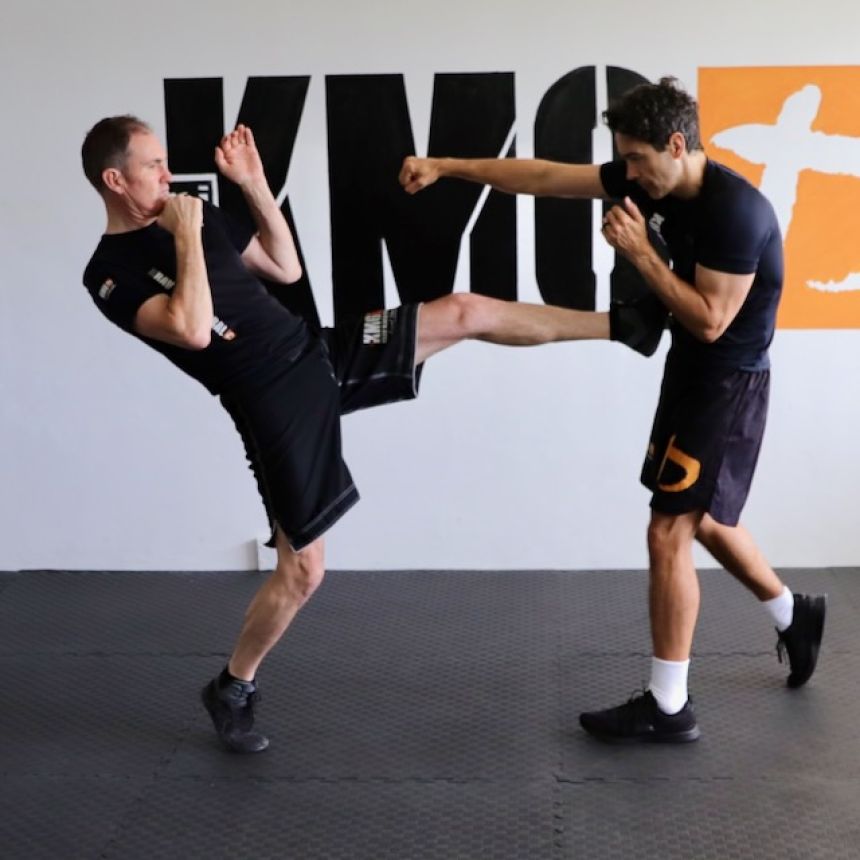
Krav Maga training in New Zealand — civilian curriculum, real-world principles.
Was Krav Maga Originally a Military System?
Yes — Krav Maga was developed through genuine military experience, not invented for a curriculum. Imi Lichtenfeld began refining his approach to self-defence while protecting Jewish communities in Bratislava in the 1930s, where he applied real fighting skills against real threats. After emigrating to Mandatory Palestine in the late 1940s, he began teaching combat skills to the Jewish paramilitary groups that would become the IDF.
What made the system distinctive from the beginning was its emphasis on practical effectiveness under pressure. Imi wasn't designing techniques for a sport or a tradition — he was solving a real problem. Responses had to be simple, reliable, and functional under the kinds of physical and psychological stress that combat actually produces.
That founding principle — build what works, not what looks impressive — is still the foundation of both military and civilian Krav Maga today. The environments and objectives have diverged significantly; the underlying approach has not.
Why Did Imi Lichtenfeld Develop a Civilian Version?
After leaving military service, Imi spent decades deliberately adapting and refining Krav Maga for ordinary civilians — and this work became central to his legacy. He recognised that civilians face fundamentally different situations from soldiers, and that a system designed for battlefield objectives would be poorly matched to the actual threats ordinary people encounter.
A soldier operates within military command structures, with defined mission objectives, weapons protocols, and rules of engagement set by law and chain of command. A civilian walking home from work faces an entirely different reality: an unpredictable assault, a grab in a carpark, a confrontation that might de-escalate with the right response, or a situation where escape is the correct priority.
Imi's civilian adaptation addressed this directly. The focus shifted toward:
- Awareness and avoidance as the primary tools — not physical technique
- De-escalation as the preferred first response
- Simple, instinctive physical responses that work under adrenaline
- Legal proportionality — using force appropriate to the civilian context
- Protecting others, not completing a mission
- Sustainable long-term training for people without combat backgrounds
This wasn't a simplified version of military training. It was a deliberate evolution of the same principles, redesigned for a different human reality.
What Does Military Krav Maga Focus On?
Military Krav Maga is adapted to the specific operational requirements of soldiers, law enforcement, and security professionals — and those requirements differ significantly from civilian life. The tactical and professional streams of training reflect objectives that most civilians will never encounter.
Depending on the unit and role, military and tactical applications of Krav Maga may include:
- Weapons integration — combatives while carrying and retaining personal weapons
- Combat under load — operating in body armour or with equipment
- Weapon retention and disarming — preventing an adversary from taking your weapon
- Confined space operation — vehicles, corridors, doorways
- Threat neutralisation priority — operational aggression as the default, not de-escalation
- Team tactics and coordination — combatives as part of a unit operation
These are legitimate and well-developed specialist areas — but they exist in a completely different legal and operational context from anything a civilian encounters. Teaching them to ordinary adults without that context doesn't make civilian training more effective. It makes it less relevant.
Krav Maga Global maintains specialist tactical departments for military, law enforcement, and security professionals through dedicated courses and certification pathways — separate from the civilian curriculum.
What Does Civilian Krav Maga Focus On?
The civilian KMG curriculum is built around the threats ordinary people actually face, the legal environment they operate within, and the psychological reality of how untrained adults respond under sudden stress.
In practical terms, this means the curriculum covers:
- Situational awareness — recognising and avoiding potential threats before they escalate
- Verbal boundary-setting — de-escalating confrontations before they become physical
- Defence against common assaults — grabs, chokes, pushes, strikes from close range
- Ground defence — managing situations that go to the floor
- Protecting others — family, children, bystanders
- Adrenaline management — training under stress so responses stay accessible under pressure
- Proportional response — understanding and applying what is legally and ethically appropriate
The KMG curriculum is structured progressively through Practitioner, Graduate, Expert, and Master levels — a graded framework that allows complete beginners to build capability systematically over time. It is the same standard used across KMG-affiliated clubs in New Zealand and in 60+ countries worldwide.
In New Zealand, the civilian context also includes specific legal considerations around self-defence law and reasonable force — understanding what you are legally permitted to do is treated as part of the curriculum, not an afterthought.
Is Civilian Krav Maga "Watered Down"?
No — civilian Krav Maga isn't a simplified version of military training. It's a purpose-built system for a different operational context, applying the same core principles to different problems.
This distinction matters because the "watered down" framing assumes that military training represents the most complete or demanding version of Krav Maga, and that civilian training represents less of the same thing. That's not accurate.
Consider the comparison from the other direction: a civilian who trained specifically in de-escalation, awareness, common assault defence, and legal proportionality is better prepared for the situations they will realistically face than a soldier trained for battlefield objectives. The training isn't less — it's different, and more relevant.
| Military / Tactical | Civilian (KMG Curriculum) | |
|---|---|---|
| Primary objective | Neutralise threats, complete mission | Survive, escape, protect |
| Legal framework | Rules of engagement, military law | Civil law, reasonable force |
| Common scenarios | Armed adversaries, unit operations, weapons retention | Grabs, chokes, street assaults, domestic situations |
| Default response | Aggression and neutralisation | Awareness, de-escalation, escape |
| Training sustainability | Intensive, time-limited deployment cycles | Progressive, long-term, accessible to all ages |
| Weapons integration | Central — armed and unarmed | Minimal — focused on unarmed defence |
The civilian curriculum is demanding in its own right. Training under realistic stress, progressive pressure testing, and scenario work that mirrors actual civilian threats — these are not soft-option substitutes for military training. They are designed to produce the specific capability civilians need.
How Does Eyal Yanilov's Work Shape the Civilian Curriculum?
Eyal Yanilov — the founder of Krav Maga Global and Imi Lichtenfeld's primary student — has been the central figure in systematising and scaling the civilian curriculum internationally. His contribution is precisely the kind of work that separates credible civilian Krav Maga from loosely affiliated offshoots.
That systematisation matters because modern civilian training requires more than techniques. It requires progressive structure, instructor quality control, legal context, and training methodology designed for adults who have lives outside the gym. That's what the KMG civilian curriculum delivers.
Why Police and Military Forces Use Krav Maga — And What That Tells Us
The fact that military and law enforcement organisations use Krav Maga globally doesn't mean civilian training is a lesser version — it means the underlying principles are sound enough to serve both populations when appropriately adapted.
Law enforcement applications are, in some ways, closer to the civilian curriculum than to military combat training. Police officers operate within civilian legal frameworks, frequently face unarmed or minimally armed individuals, and need techniques that work under stress on people who may be intoxicated, mentally unwell, or simply resistant — not trained adversaries. The proportionality and scenario-based structure of the civilian curriculum addresses this well.
The military relevance confirms something different: that the foundational principles — simplicity, instinctive response, adaptation to the body's actual stress responses — are robust enough to serve professional contexts too. That's a credibility signal for civilian training, not a challenge to it.
Frequently Asked Questions
No — and that's by design. The civilian curriculum taught through Krav Maga Global shares the same core principles as military Krav Maga but is built for entirely different scenarios, legal contexts, and objectives. Imi Lichtenfeld deliberately developed a civilian version of Krav Maga after leaving military service, recognising that ordinary people face different threats and operate within different constraints. The KMG civilian curriculum covers awareness, de-escalation, common assault defence, and legally appropriate response — not battlefield tactics or weapons integration.
Civilian Krav Maga is not a simplified version of military training — it's a purpose-built system for a different context. A well-structured civilian programme trains scenario-based skills under realistic stress: common assault defence, grabs, chokes, ground situations, and adrenaline management. That's more relevant preparation for what civilians actually face than training built around armed adversaries and unit tactics. The KMG curriculum specifically trains the situations New Zealand adults are statistically more likely to encounter.
Yes — Krav Maga Global maintains specialist tactical departments with dedicated programmes for military, law enforcement, and security professionals. These are separate certification streams from the civilian curriculum and are run through specialist courses. In New Zealand, the KMG programme is the civilian curriculum — the tactical courses are not currently offered here. What KMG New Zealand delivers is the same structured civilian standard used in 60+ countries.
No — the civilian KMG curriculum explicitly treats physical response as a last resort. The curriculum begins with situational awareness and de-escalation. Physical technique is trained for situations where those options have failed or aren't available. The system is also legally grounded — proportional response and what constitutes reasonable force under New Zealand law are treated as part of the training, not external to it. People who train seriously tend to become less reactive, not more aggressive.
Because the core principles — simplicity, instinctive response, functionality under pressure — are sound enough to serve multiple populations when appropriately adapted. Military and law enforcement applications are specialist versions of the same underlying approach, adapted for their specific operational requirements. Their use of the system is a credibility signal for the foundation, not a statement that civilian training is inferior. Law enforcement applications in particular often sit closer to the civilian curriculum than to military combat training.
KMG New Zealand operates the civilian KMG curriculum through active clubs in Auckland (North Shore and West Auckland) and Hastings, with waitlists building in Wellington, Christchurch, Hamilton, Tauranga, and other cities. All KMG NZ instructors are certified through the same international KMG pathway — the same standard used in 60+ countries worldwide. Find your nearest club or register your interest at the locations page.
Find Training Near You
The civilian KMG curriculum. Internationally certified instructors. Active clubs in Auckland and Hawke's Bay — waitlists building across New Zealand.
Find Training Near You