
Self-Defence Tips for Women in New Zealand
The best self-defence tips for women are not complicated moves. They are practical skills: recognising danger early, setting boundaries, creating distance, escaping grabs, protecting the head and neck, getting up from the ground, and acting under pressure instead of freezing.
If you are looking for self-defence advice, it is easy to find lists of techniques: strike here, twist this way, escape like this. Some of that can be useful, but real self-defence rarely happens in neat, predictable steps.
In real situations, the bigger question is usually simpler and more urgent: Can you recognise the problem early, make a decision, and create a chance to get away?
That is why practical self-defence for women needs to focus on skills, not just moves. A technique only helps if you can access it under stress, against resistance, when your body is flooded with adrenaline and the situation is moving quickly.
For more context on the types of situations these skills are designed for, read Most Common Types of Assaults in New Zealand.
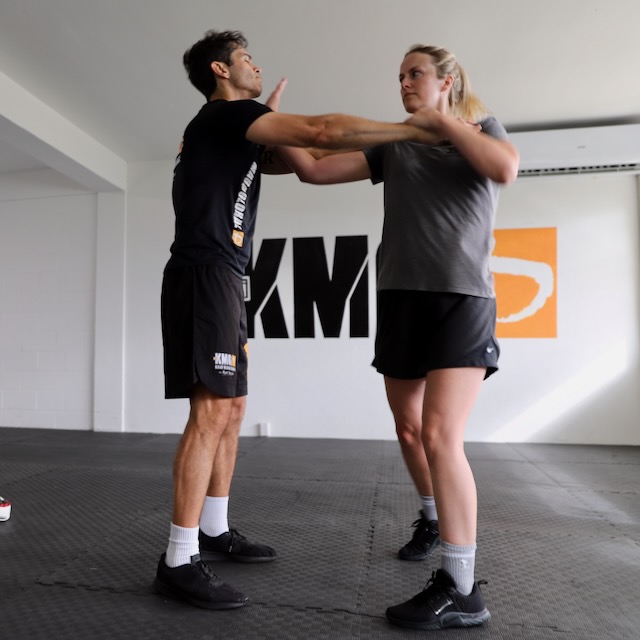
Practical women’s self-defence training focuses on awareness, close-range threats, escaping control, and getting safe quickly.
Why self-defence for women needs to be practical
Good self-defence is not about winning a fight. It is about creating the opportunity to leave safely. That matters because many real-world threats do not look like a sporting contest. They may involve surprise, intimidation, close-range pressure, grabbing, pushing, being followed, or being blocked from leaving.
For women in New Zealand, practical self-defence also needs to consider the situations people are actually concerned about: walking to the car, leaving work late, being approached in public, dealing with unwanted attention, managing a threatening person at close range, or freezing when something suddenly escalates.
That does not mean living in fear. It means having a simple, realistic framework for recognising danger earlier and responding sooner.
Key takeaway: self-defence is not a collection of clever moves. It is the ability to recognise risk, act early, and create a route to safety.The best self-defence skills for women
The skills below are ordered by when they tend to matter in a real situation — from the earliest warning signs through to physical response. The earlier you can act, the more options you usually have.
Situational awareness
The most important self-defence skill is noticing when something is wrong before it becomes physical. That could mean noticing someone closing distance, blocking your path, ignoring social cues, watching you too closely, following you, or trying to isolate you. Awareness is not paranoia. It is simply paying attention early enough to make better decisions.
Trusting your instincts and acting early
Many people wait too long because they do not want to seem rude, overreact, or make the situation awkward. But if something feels wrong, it is better to create space early than to wait until the situation becomes harder to leave. One of the most useful self-defence skills is giving yourself permission to act sooner.
Using your voice and setting boundaries
A clear voice can interrupt escalation. Saying “stop”, “back up”, “don’t touch me”, or “I don’t want your help” can create a social line that makes the situation clearer to you, the other person, and anyone nearby. Boundary-setting is not just communication. In self-defence, it can be an early warning system and a practical tool.
Creating distance
Distance gives you options. It gives you time to leave, call for help, move toward other people, use your voice, or prepare to defend yourself if necessary. If someone is bigger, stronger, or aggressive, creating even a small amount of space can change the situation. In practical self-defence, space is often more valuable than strength.
Escaping grabs and close-range control
Many threatening situations begin close up: someone grabs your wrist, clothing, hair, bag, arm, or body. The goal is not to wrestle for control. The goal is to break contact, disrupt the person, create space, and move. This is one of the most important physical self-defence skills because it connects directly to real situations women often worry about.
Protecting the head and neck
Close-range threats can involve pushing, striking, grabbing, choking, or pressure around the neck. Protecting the head and neck is critical because these are vulnerable areas. Neck pressure and strangulation are especially serious warning signs in violence and abuse contexts, so learning to defend and move from this position is highly relevant.
Getting up from the ground
If you end up on the ground, the priority is not to stay there and fight. The ground may be hard, unsafe, wet, crowded, or covered with objects. There may also be more than one person involved. Practical ground defence is about protecting yourself, disrupting control, getting your feet back under you, and moving away as quickly as possible.
Acting under pressure instead of freezing
Freezing is common. It does not mean weakness. It means the brain has hit a situation it does not yet know how to process. Good training builds familiarity with pressure so the body learns to move, speak, protect, and respond even when adrenaline is high. For more on this, read Why Many Women Freeze in Dangerous Situations.
What should you do if someone grabs you?
If someone grabs you, your first aim is to break control and create space. Do not think of it as a fair contest. You are not trying to prove strength or dominate the other person. You are trying to interrupt their control long enough to get away.
That may involve using your voice, moving your body, targeting vulnerable points, striking if necessary, and immediately moving toward safety. The details depend on the situation, but the principle stays the same: escape the control, make space, and leave.
This is one reason Krav Maga training puts so much focus on close-range situations. A lot of real self-defence does not start at a comfortable distance. It often starts when someone is already too close.
How can women avoid freezing in a dangerous situation?
Freezing is one of the biggest concerns people have about self-defence. Many women worry they might know what to do in theory but still freeze when something actually happens.
That concern is realistic — and it is trainable. The way to reduce freezing is not to memorise more techniques. It is to build familiarity with the types of situations, pressure, and decisions that create hesitation.
Training helps by giving your brain reference points: “I have felt this pressure before”, “I know what this position is”, “I have practised moving from here.” That familiarity can reduce the gap between recognition and action.
Key takeaway: people do not usually freeze because they are weak. They freeze because the situation is unfamiliar. Training makes the unfamiliar more recognisable.How Krav Maga brings these skills together
Krav Maga is built around simple responses to realistic problems. The aim is not to collect impressive techniques. The aim is to develop practical capability: awareness, decision-making, movement, striking, escaping control, and getting away.
In a real situation, these skills do not happen separately. You may need to notice a warning sign, use your voice, move back, defend a grab, protect your head, strike to create space, and leave — all within seconds.
Simple actions under stress
Complex techniques are harder to access under pressure. Practical self-defence favours simple movements that can be remembered and applied quickly.
Training for real distances
Threats often happen close up. Training needs to include grabs, pressure, pushing, and confined space — not just ideal long-range technique.
Confidence based on capability
Real confidence comes from knowing you have practised practical responses, not from hoping you will somehow know what to do in the moment.
Escape as the objective
The aim is not to win a fight. The aim is to protect yourself, make space, and get to safety as quickly as possible.
This is why Krav Maga is often a good fit for women who want practical self-defence rather than a competitive martial art. It is direct, realistic, and focused on what ordinary people may need to do under pressure.
For more context, read Is Krav Maga Good for Women? and Do You Need to Be Strong to Defend Yourself?.
So, what is the most important self-defence skill?
The most important self-defence skill is not a single move. It is the ability to act early.
If you can recognise danger sooner, trust your judgement, set a boundary, create distance, and move before the situation becomes worse, you are already using self-defence. Physical skills matter, but they work best when they are supported by awareness and decision-making.
That is the real purpose of training: not to make people aggressive, but to help them become more capable, more prepared, and less likely to freeze when action is needed.
Key takeaway: the best self-defence skill for women is the ability to recognise risk early and take simple, decisive action to get safe.Common questions about self-defence tips for women
The best self-defence tip is to act early. If something feels wrong, create distance, use your voice, move toward safety, and do not wait until the situation becomes physical. Physical techniques matter, but early recognition and decision-making are often more important.
Start with awareness, boundary-setting, creating distance, escaping common grabs, protecting the head and neck, and getting back to your feet if you fall. These skills are practical because they apply to many different situations rather than one perfect scenario.
No. Strength can help, but practical self-defence relies more on timing, positioning, awareness, using vulnerable targets when necessary, and creating space to escape. Good training is designed to work for ordinary people, not just strong or athletic people.
Freezing is a normal stress response. The goal of training is to reduce hesitation by making pressure more familiar. Practising simple responses, voice use, movement, and escape under controlled stress can help you move from freezing to action faster.
Yes, Krav Maga can be a strong option for women because it focuses on practical self-defence, simple responses, close-range problems, escaping control, and acting under pressure. It is not based on size, strength, or sporting rules.
Krav Maga Global New Zealand has active training locations and city pages for people looking for structured self-defence training. Start at the national locations page: krav-maga-global.co.nz/locations.
Find Self-Defence Training Near You
Build practical self-defence skills through structured Krav Maga training in New Zealand.