
Why Do Women Freeze in Dangerous Situations?
Freezing in danger is not weakness, stupidity, or failure. It is a normal human stress response. For many women, self-defence training is not about becoming fearless — it is about recognising danger sooner, reducing hesitation, and learning how to act under pressure.
If you have ever wondered whether you would freeze in a dangerous situation, you are not imagining a rare problem. The freeze response is extremely common.
Many women worry they might know what to do in theory but still freeze when something actually happens. That concern is realistic — but it is also trainable.
The important thing to understand is that freezing does not usually happen because someone is weak. It happens because the brain is suddenly overloaded with stress, uncertainty, fear, surprise, or confusion and has not yet decided how to respond.
That is why good self-defence training matters. It helps people recognise danger earlier, make decisions faster, and move from hesitation to action more quickly.
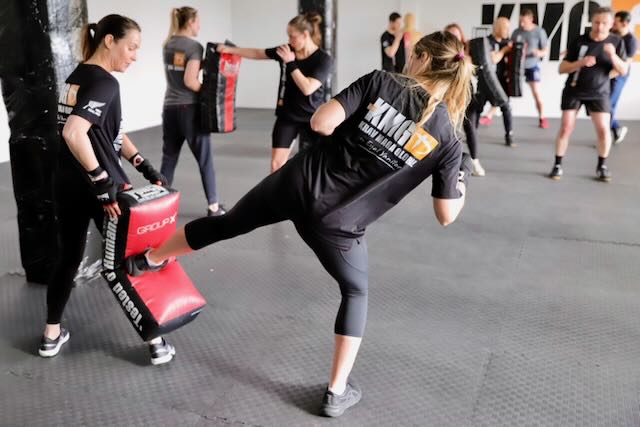
Practical self-defence training helps women build familiarity with stress, pressure, and fast decision-making.
What is the freeze response?
The freeze response is part of the body's normal survival system. Most people have heard of fight or flight, but freeze is just as real. When the brain suddenly detects danger, confusion, or overload, it may temporarily pause while trying to understand what is happening and choose a response.
This can feel like hesitation, going mentally blank, struggling to move, delayed reactions, feeling stuck or disconnected, or being unable to speak clearly.
That does not mean someone has consciously chosen to do nothing. It usually means the nervous system is overwhelmed and trying to process the situation fast enough to respond.
Key takeaway: freezing is not a character flaw. It is a normal stress response that can happen to anyone.Why do many women freeze in dangerous situations?
Because dangerous situations are often confusing before they are clearly dangerous.
Many real-world situations do not begin with obvious violence. They begin with discomfort, pressure, unwanted attention, someone invading personal space, manipulative behaviour, or social awkwardness that slowly escalates.
That uncertainty is exactly what creates hesitation.
Surprise
Most people are not mentally prepared for sudden confrontation or aggression. The situation arrives faster than expected.
Confusion
The brain may still be asking “is this really happening?” while valuable seconds pass.
Fear of overreacting
Many women hesitate because they worry about seeming rude, dramatic, or wrong.
Social conditioning
Many people are used to avoiding conflict and managing awkwardness politely, even when something feels unsafe.
This is one reason women’s self-defence is not only about physical techniques. It is also about recognising danger earlier and trusting your instincts sooner.
Does freezing mean you would fail in a real situation?
No. Freezing does not mean someone is weak, passive, or incapable. Strong people freeze. Athletic people freeze. Trained people freeze too.
The important difference is often not whether someone freezes briefly — it is how quickly they recover, recognise what is happening, and begin acting.
That is where training helps.
Key takeaway: self-defence training is not about becoming fearless. It is about shortening hesitation and improving decision-making under stress.How does self-defence training reduce freezing?
Training helps because it makes stressful situations feel less unfamiliar.
When the nervous system has already experienced pressure, fast movement, close-range confrontation, shouting, grabbing, or urgency in training, the brain has more reference points available when stress appears in real life.
Good self-defence training builds:
Recognition
The ability to notice danger earlier instead of rationalising it away.
Simple responses
Simple movements and actions are easier to access under pressure than complex techniques.
Decision-making
Scenario training helps connect awareness to action rather than leaving people stuck between the two.
Familiarity with pressure
The more often the brain experiences controlled stress in training, the less overwhelming it becomes.
Krav Maga training is specifically designed around realistic pressure, simple movements, close-range situations, and quick decision-making rather than perfect choreography.
What should women aim for instead of “never freezing”?
The goal is not perfection.
The goal is recognising danger earlier, trusting your instincts faster, setting boundaries sooner, creating distance earlier, and accessing simple action under pressure.
That is what practical self-defence training actually develops.
Many women find the biggest shift is not becoming aggressive or fearless. It is learning that they are capable of acting sooner than they thought.
Why is this especially important in women's self-defence?
Because many dangerous situations involve hesitation before physical violence ever begins.
Someone gets too close. Someone ignores boundaries. Someone keeps following. Someone blocks the exit. Someone keeps pushing socially after being told no.
Those moments matter.
The earlier someone recognises the problem and responds to it, the more options they usually have available.
That is why good women’s self-defence training in New Zealand needs to include awareness, decision-making, stress exposure, and realistic scenario work — not just isolated physical techniques.
For more context, read Most Common Types of Assaults in New Zealand and Is Krav Maga Good for Women?.
Key takeaway: women’s self-defence is often about recognising danger and acting earlier — before the situation fully escalates.So why do women freeze in dangerous situations?
Because freezing is a normal human response to stress, surprise, overload, and uncertainty — not because women are weak.
The most useful response is not shame or self-criticism. It is understanding how the freeze response works and training in a way that helps reduce hesitation and improve action under pressure.
That is where real confidence begins: not pretending fear disappears, but learning how to move through it more effectively.
For practical next steps, read Situational Awareness for Beginners and Self-Defence Tips for Women in New Zealand.
Common questions about freezing in dangerous situations
Yes. Freezing is a normal stress response. It can happen when the brain is overloaded, surprised, or trying to understand a threat quickly enough to choose a response.
No. Freezing does not mean you are weak or incapable. It means your nervous system is reacting to stress. Training can help shorten that hesitation and make action more available.
Yes. Good training helps by making situations feel less unfamiliar, giving you simpler responses to access under stress, and improving your ability to recognise what is happening sooner.
Hesitation often comes from surprise, confusion, fear of overreacting, or social conditioning around politeness and conflict avoidance. That is one reason self-defence training needs to include decision-making, not just physical skills.
The best place to start is the national locations page at krav-maga-global.co.nz/locations.
Find Training Near You
Practical self-defence training that helps build confidence, awareness, and the ability to act sooner under pressure.