
How Does Krav Maga Work?
Krav Maga Global New Zealand teaches a structured self-defence method built around one core idea: your training should still hold up when the situation stops being clean. That means working with how the body actually responds under fear — using simple movements, clear decision-making, and a framework that prioritises avoidance and de-escalation before physical response. The KMG New Zealand instructor team delivers this within the international framework led by Eyal Yanilov and Krav Maga Global.
The phrase "practical self-defence" gets used loosely. Almost every system claims it. The more useful question is how Krav Maga actually works — what design decisions make it different, and why those decisions matter when the training is tested outside a cooperative gym environment.
This page explains the mechanics behind the KMG method: why the system is structured the way it is, what happens to the body under real fear, and how the training is designed to remain usable when conditions are no longer ideal.
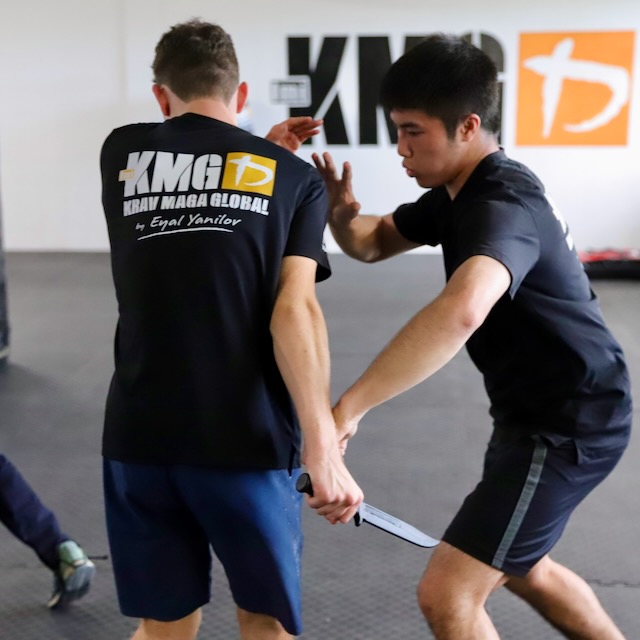
Knife defence drills in KMG training — building responses that hold up under pressure, not just in cooperative practice.
Key Takeaways
- Krav Maga is designed to work with the body's stress response, not against it.
- The method prioritises avoidance and de-escalation before physical action.
- Techniques are selected for simplicity and gross motor reliability under adrenaline.
- Progressive pressure testing is what separates usable skill from gym performance.
- KMG New Zealand delivers the same curriculum framework as the international KMG system.
Why does real violence look different from the gym?
This is the starting point for understanding how Krav Maga is designed. Training environments are structured. Real situations are not. In class you have space, lighting, cooperative partners, and a known starting position. In a real assault you may be surprised from behind, crowded in a confined space, dealing with someone bigger, or already physically compromised before you have time to react.
On top of that, the body behaves differently under genuine fear. Heart rate spikes. Fine motor control declines sharply. Vision narrows. Decision-making accelerates but becomes less precise. Any technique that depends on calm, exact execution becomes harder to access exactly when you need it most.
This is the gap that Krav Maga is built to close — not by pretending stress does not change performance, but by designing around the way performance actually changes under stress.
Key takeaway: the design challenge for any real self-defence system is building skills that survive the transition from training to reality.How does Krav Maga work with the body under fear?
The most important design decision in Krav Maga is the emphasis on gross motor movement. Under adrenaline, large muscle movements remain available far longer than intricate, precision-dependent techniques. Fine motor skill — the kind needed for complex locks, precise targeting, or multi-step sequences — degrades quickly under real fear. Gross motor movement — the kind needed to strike hard, push off, drive forward, or create separation — holds up much better.
Krav Maga builds on that reality. Defences tend to use the body's instinctive reactions as their starting point. When something comes at your face, your hands rise. When grabbed, the instinct is to pull away or turn. KMG training shapes those natural reactions into usable defence and counterattack, rather than trying to replace them with movements that require fine coordination under pressure.
The result is a system where the training and the stress response point in the same direction, rather than pulling against each other.
Key takeaway: gross motor emphasis is not a shortcut — it is a deliberate response to how the body works under genuine fear.What is the avoid, de-escalate, act framework?
The most widely misunderstood thing about Krav Maga is that it is primarily about fighting. Authentic KMG training is better understood as a complete self-protection framework, and the physical response is the last part of it, not the centre.
The framework moves through three stages:
- Avoid — recognise the warning signs early, create distance, leave. The earlier you can resolve a situation, the better the outcome. Most of the time, the best self-defence decision is one that keeps you out of the physical exchange entirely.
- De-escalate — when avoidance is no longer possible, verbal boundary-setting, posture, and positioning can change the dynamic. The goal is not to talk your way out of every situation, but to create time and space before physical contact begins.
- Act decisively — when physical defence becomes unavoidable, the objective shifts. Stop the immediate threat, create an opportunity to move, and escape. Not to dominate. Not to continue exchanging. To end the immediate danger and leave.
Awareness and avoidance are taught as core skills, not as side notes. This is one of the clearest signs of a serious self-defence system — it helps students earlier in the timeline, not just after the assault has already begun. For the full breakdown, read The Krav Maga Self-Defence Timeline.
Key takeaway: the physical phase of Krav Maga only begins after avoidance and de-escalation have failed. That ordering is deliberate.Why does simultaneous defence and counterattack matter?
Many people imagine self-defence as a two-step sequence: absorb, then respond. Krav Maga compresses that gap. In many situations, the defence and the counterattack happen together, or with minimal separation between them.
The reason is straightforward. In a real assault, every extra beat matters. A defender who only blocks or redirects — without immediately disrupting the attacker's ability to continue — can still be losing the exchange even after a technically correct defence. KMG trains students to address the incoming threat while simultaneously creating disruption that changes the attacker's next action.
This is not about aggression for its own sake. It is about efficiency — reducing the window in which the defender is still in danger.
How does KMG handle weapon threats?
Weapon defence is one of the areas where Krav Maga's design philosophy is clearest. The primary objective when facing a weapon is not to disarm the attacker. It is to avoid the weapon, create distance, and escape.
Disarming is trained because the situation may demand it — but KMG is careful not to create false confidence around how difficult weapon situations actually are. A knife, for example, is an extremely dangerous threat. The honest training position is that avoidance and escape should be pursued first, aggressively. Physical disarming enters the picture only when there is no other option.
That nuance is part of what distinguishes honest self-defence training from systems that present weapon disarms as reliable high-percentage techniques in real danger.
Key takeaway: KMG treats weapon disarming as a last resort. Avoidance and escape are always the first objective.How does pressure testing make training usable?
Knowing a technique in theory is not the same as being able to use it when it matters. This is the most important distinction between training that transfers and training that does not.
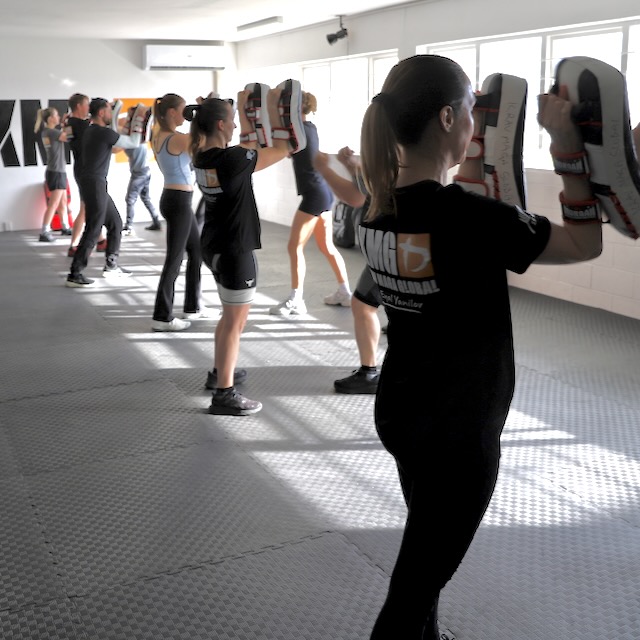
Live class training builds the habit of applying technique under real physical and cognitive pressure, not just in cooperative drills.
KMG classes move beyond isolated repetition by progressively introducing variables: surprise, poor starting position, verbal pressure, fatigue, limited space, and uncertain timing. This is how students develop decision-making rather than just pattern repetition. It might mean defending from a seated position without warning, working under physical exhaustion, or adapting to environments that change the variables — confined spaces, low light, or real-world settings that bear no resemblance to a gym floor.
The point is not to know more techniques. It is to become more functional when conditions are no longer cooperative.
The KMG New Zealand instructor team maintains this standard as part of the same curriculum framework used across Krav Maga Global's international network. That consistency matters — it is what separates a recognised system with accountable standards from a loosely branded collection of unrelated training.
Key takeaway: pressure testing is not an optional advanced feature. It is what makes the training honest.How do you know the training you are getting is the real thing?
The self-defence category has a credibility problem. A lot of schools use similar language — "realistic," "practical," "street-tested" — while teaching very different things. Some training creates false confidence. Some is built around impressive-looking movements that have never been honestly tested under pressure.
The markers of serious training are consistent: techniques that are simple and direct rather than elaborate; drills that include real resistance and unpredictability; instruction that acknowledges the difficulty of real violence rather than overstating what training can guarantee; and clear lineage to a recognised curriculum with maintained standards.
KMG New Zealand operates within the international Krav Maga Global framework, led by Eyal Yanilov — the primary student of Imi Lichtenfeld, the originator of Krav Maga. That direct organisational connection, maintained through Krav Maga Global HQ, is what gives the curriculum its standard and its accountability. It determines how instructors are trained, how the curriculum is maintained, and how standards are held across the network. It is not a branding claim. It is a structural relationship.
"A self-defence system should be judged by what remains usable under pressure, not by how impressive it looks in ideal conditions."
— KMG New ZealandWhat do people ask about how Krav Maga works?
No. KMG is structured for ordinary adults, including complete beginners. The system builds usable self-defence capability progressively without requiring a martial arts background or high fitness level to start.
Yes. One of the system's core design assumptions is that the defender may be smaller, less powerful, or caught off guard. KMG training emphasises timing, vulnerable targets, disruption, and decisive movement rather than matching strength against strength.
Because the goal is not to fight — it is to stay safe. A situation resolved through awareness, positioning, and early exit is a better outcome than one that becomes physical. Krav Maga trains the whole timeline of a threatening situation, not just the moment of impact.
Because the self-defence category is full of vague branding. Lineage tells you whether a school operates within a real curriculum, whether instructors are trained to a recognised standard, and whether the teaching connects to the actual development of the system.
Because KMG emphasises high-percentage responses from the start, many students notice a practical shift in awareness, confidence, and basic self-defence ability within the first few months of consistent training.
Active KMG training is currently available in Auckland and Hastings. The national locations page connects readers to the full network, including waitlist registrations for cities where courses are being developed.
Find Training Near You
Find your nearest active KMG training option in New Zealand through the national locations page.