
How Self-Defence Training Reduces Freezing Under Pressure
Freezing under threat is not weakness — it's what happens when the brain encounters a situation it has no prepared response for. Realistic self-defence training addresses this directly: through scenario exposure that builds recognition patterns, progressive stress inoculation that makes adrenaline familiar, and simple high-repetition techniques that remain accessible when pressure spikes. The goal is not fearlessness. It's function despite fear.
One of the most common concerns people bring to self-defence training isn't about technique. It's this: what if I just freeze?
It's a legitimate question. And the honest answer is that freezing is a normal human response — not a character flaw, not a prediction of how you'll perform, and not something fixed by intention alone. It's something training specifically addresses, through methods that work with the brain's actual mechanics rather than against them.
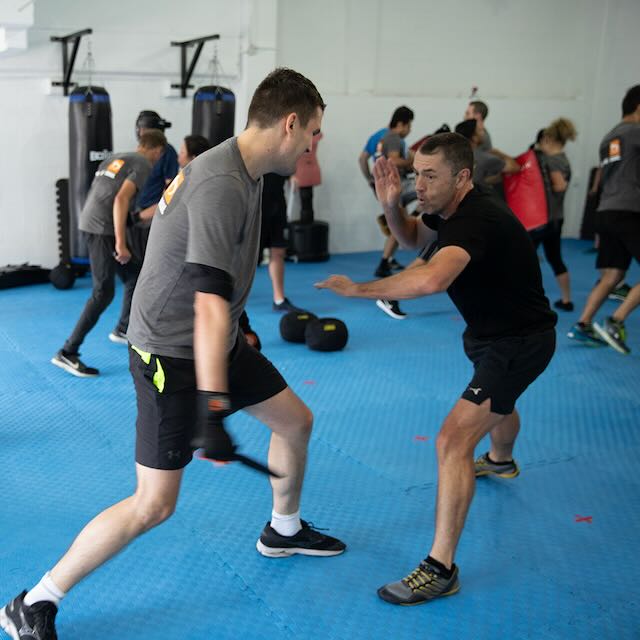
Pressure-based training at KMG New Zealand — building recognition and response under stress.
Freezing Is a Familiarity Problem, Not Just a Fear Problem
The freeze response is widely misunderstood as a failure of courage. In reality, it's more often a failure of recognition. The brain processes incoming information by matching it against stored patterns — situations it's encountered before, responses it's practised, outcomes it's seen. When no match exists, processing slows while the brain attempts to categorise what it's experiencing.
Fear amplifies this. Adrenaline narrows attention, accelerates heart rate, and shifts the brain toward reactive rather than analytical processing. Fine motor control degrades. Peripheral awareness contracts. The cognitive load of a threatening situation is genuinely high — and if the brain has never processed anything similar before, that load can temporarily overwhelm the system.
This is why simply being told what to do in a dangerous situation — reading about it, watching a video, understanding it intellectually — doesn't reliably produce performance under real stress. The knowledge is there, but the recognition pattern isn't. The brain needs to have processed the scenario before, at a physiological level, to respond quickly when it actually occurs.
Training addresses this directly — not by removing the stress response, but by making its components familiar enough that they don't prevent action.
Three Things Realistic Training Does to Reduce Freezing
KMG training reduces the freeze response through three reinforcing mechanisms, each targeting a different part of the problem:
Scenario Recognition
Repeated exposure to varied threat scenarios builds a mental library — so the brain recognises what's happening faster and wastes less time in categorisation.
Stress Inoculation
Progressive pressure exposure makes the physical experience of adrenaline familiar. Elevated heart rate and narrowed vision become known quantities, not overwhelming shocks.
Ingrained Responses
Simple techniques drilled under pressure become accessible when fine motor control degrades. High-repetition training under varied conditions is what makes responses reliable, not just possible.
These aren't separate training modules — they're interwoven throughout the KMG curriculum from beginner level. Each class session builds all three simultaneously.
Scenario Training: Building Mental Pictures Before You Need Them
The most direct way to reduce the unfamiliarity that causes freezing is to have already processed similar situations — under pressure, in your body, not just in your head. This is what scenario-based training produces.
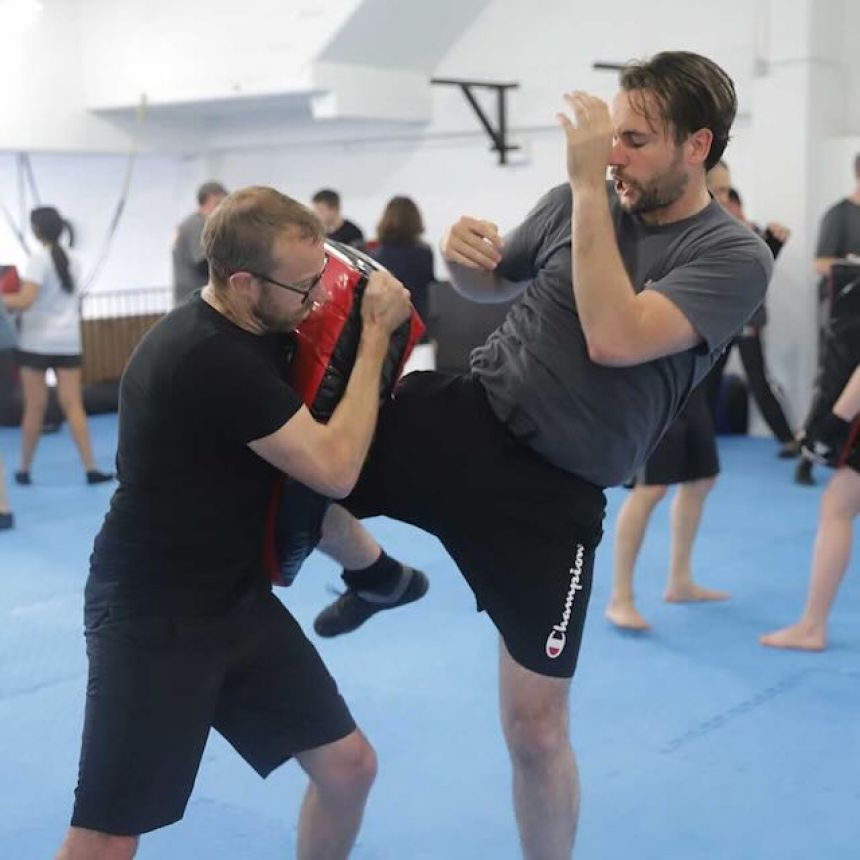
In KMG training, scenarios are used to expose students to the texture of real problems: verbal confrontation before any physical contact, surprise activation from unexpected angles, movement in confined spaces, multiple directions of threat, the presence of other people, decisions that have to be made under fatigue. The objective isn't to simulate violence perfectly. It's to build a mental reference library that the brain can search quickly when real pressure arrives.
The practical effect is pattern recognition. A student who has worked through dozens of scenario variations — grabs from behind, threats in confined spaces, aggressive verbal escalation — starts to recognise the components of dangerous situations earlier. The brain doesn't have to process everything from scratch. It matches incoming information against stored experience and produces a response faster.
This is also why situational awareness training matters so much as a foundation. Recognising pre-assault indicators — behaviour changes, positioning, closing distance — gives the brain a longer runway before the situation becomes physical. The earlier recognition occurs, the more processing time is available, and the less the freeze response can take hold.
Progressive Stress Inoculation: Making Adrenaline Familiar
Stress inoculation is the process of exposing students to increasing levels of pressure in a controlled environment, so the physical and psychological experience of stress becomes progressively less disorienting. It's the training principle that directly addresses the adrenaline problem — not by eliminating the response, but by making it a known quantity.
The principle is well-established: people adapt better when stress increases gradually than when they're thrown into overwhelming intensity without preparation. Beginner training in KMG starts with technique in controlled conditions — building understanding and basic competence. Pressure is then layered in progressively:
- Clean technique in cooperative drills — building understanding of what the response is
- Increased speed and resistance — introducing timing pressure and physical feedback
- Fatigue added — training responses when coordination is already compromised
- Verbal stress introduced — adding the cognitive load of communication and de-escalation
- Scenario complexity increased — unpredictable angles, multiple problems, environmental factors
- Third-party pressure — protecting another person while managing your own stress response
At each stage, the goal is the same: keep functioning. Not perfectly — functioning. Students learn to make decisions when their heart rate is elevated, to continue moving after a mistake, to stay oriented to the threat when their body is telling them to shut down.
Over time, elevated heart rate becomes a familiar physical state rather than a signal of emergency. The adrenaline dump that would previously have triggered freezing becomes recognisable — and therefore manageable. This is the core mechanism of stress inoculation: not desensitisation, but familiarisation.
Why Simple Techniques Are a Feature, Not a Limitation
Under stress, people don't rise to the level of their best training — they fall toward the level of their most ingrained responses. This is a well-documented pattern, and it has direct implications for how self-defence training should be structured.
Complex techniques that require precise timing, sequential decision trees, or fine motor control become significantly less accessible when adrenaline spikes. Vision narrows. Coordination degrades. The working memory that sequences steps is under heavy load from threat processing. A technique that worked perfectly in a calm drill may be completely inaccessible under real pressure if it depends on any of those degraded systems.
This is why the KMG curriculum is built around simple, direct, high-percentage responses that use gross motor movement rather than precision. Not because complex technique isn't valuable — but because responses that rely on gross motor skills, natural movement patterns, and heavy repetition remain accessible when everything else is compromised.
"[The instructor] is excellent — clear, practical and very engaging. You always leave having learned something real."
— Mike, Google · KMG North ShoreRepetition is what converts a technique from something you know into something you have. A response drilled hundreds of times under varied conditions — standing, moving, fatigued, under verbal pressure — is qualitatively different from one drilled a handful of times in ideal conditions. The former is in muscle memory. The latter is in conscious memory — and conscious memory is exactly what stress compromises first.
Decision-Making Under Pressure Is Also Trainable
Freezing isn't always a physical hesitation — sometimes it's a decision paralysis. What do I do? Is this really happening? Should I move or stay? Which direction? The brain stalls not because the body won't move but because it can't determine what movement to make.
Scenario training addresses this too. Students who have worked through varied scenarios develop what might be called a priority hierarchy — an automatic sequencing of the most important decisions that doesn't require conscious construction under stress. Awareness first. Positioning. Escape options. Counter-attack only if everything else has failed.
This is also why the KMG curriculum integrates de-escalation and avoidance alongside physical technique — not as separate modules but as part of a continuous decision framework. A student who has practised recognising escalation early, and who has a habitual response to that recognition (create distance, identify exits, use verbal skills), has made several decisions before the situation becomes physical. That prior decision-making reduces the cognitive load at the moment when pressure is highest.
For students who train specifically to protect others, decision-making under pressure is even more critical — because the decisions now include another person's position, movement, and capacity to follow instructions under stress.
What Realistic Confidence Actually Looks Like
Confidence built through progressive stress training is different in character from confidence built through compliant drills or theoretical understanding. The latter is fragile — it tends to collapse the first time real pressure arrives, because it was never tested against it. The former is durable, because it was built specifically by surviving pressure repeatedly.
Students who have trained through progressive stress exposure describe a specific kind of shift: not the absence of fear, but a changed relationship to it. The adrenaline still arrives. The heart rate still elevates. But it no longer signals "system failure" — it signals "this is what training prepared me for."
That shift doesn't make someone more aggressive. In most cases it makes them less reactive — because the confidence that comes from genuine capability doesn't need to prove anything. People who know what they can do under pressure tend to be calmer in the situations that precede pressure, because they're not managing an underlying anxiety about whether they'd cope.
This connects directly to the broader mental preparation framework in self-defence — the cluster of psychological skills that realistic training develops alongside physical technique. Stress inoculation is one component; awareness, emotional control, and decision-making under load are others. They reinforce each other, and they develop together through the same training process.
Frequently Asked Questions
No training can guarantee perfect performance — but realistic training significantly reduces the likelihood and duration of freezing. The freeze response is triggered by unfamiliarity and cognitive overload. Scenario-based training directly reduces unfamiliarity, and progressive stress inoculation reduces cognitive overload by making the physical experience of adrenaline familiar. The result isn't fearlessness — it's faster recovery and continued function despite stress.
Stress inoculation is the progressive exposure of students to increasing levels of pressure in a controlled training environment. Starting with technique in cooperative conditions, training gradually introduces speed, resistance, fatigue, verbal stress, and scenario complexity. Each stage builds the student's familiarity with the physical and psychological experience of stress — so that when real pressure arrives, it is less disorienting and less likely to overwhelm decision-making.
Under stress, fine motor control degrades, vision narrows, and working memory is under heavy load from threat processing. Complex techniques that depend on precise timing or sequential decision-making become significantly less accessible in these conditions. Simple responses using gross motor movement and natural patterns remain accessible because they don't depend on the systems that stress compromises most. High repetition under varied conditions converts those responses from conscious knowledge into ingrained capability.
Most students notice a shift within the first few months of consistent training — typically described as feeling calmer under physical pressure in class, recovering from mistakes more quickly, and carrying themselves with less background anxiety in daily environments. The recognition patterns and stress familiarity build progressively over time. There's no fixed point at which training is "complete" — the capability continues to develop with continued exposure.
Yes. The progressive structure is specifically designed so that pressure increases gradually as students build capability. Beginners start with technique in cooperative conditions — high-intensity scenario work comes later, once foundational patterns are established. The progression is calibrated so that each stage is challenging but manageable. No prior experience is required to start.
KMG New Zealand runs active clubs in Auckland (North Shore and West Auckland) and Hastings in Hawke's Bay. Scenario-based and progressive stress training is part of the standard curriculum at all clubs. Courses are also building in Wellington, Christchurch, Hamilton, Tauranga, and other cities. See the locations page for current options.
Find Training Near You
Active clubs in Auckland and Hawke's Bay. Courses building across New Zealand.
Find Training Near YouNo experience needed.