
Ground Defence for Real-World Self-Defence
Ground defence in Krav Maga Global training is built around one priority: getting back up. Real-world environments — concrete, multiple attackers, weapons — make staying on the ground dangerous in ways that sport grappling never accounts for. KMG trains anti-grapple prevention, safe falling, practical ground escapes, and rapid return to standing.
Ground fighting has become widely known through MMA and Brazilian Jiu-Jitsu. Both are legitimate disciplines. But the goals of civilian self-defence are not the same as the goals of sport competition — and that difference shapes everything about how Krav Maga Global approaches the ground.
The KMG curriculum absolutely prepares students for situations where they may be knocked down, grabbed, tackled, or dragged to the ground. What it doesn't train is the idea that this is a good place to stay.
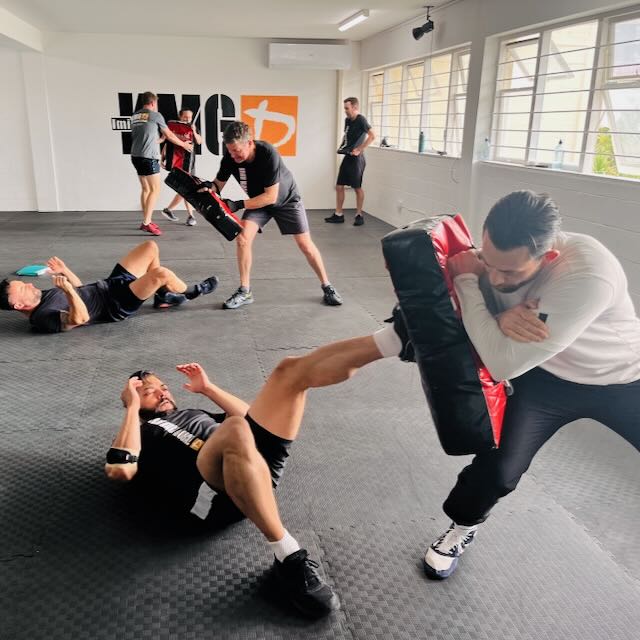
Ground defence training at KMG New Zealand — escape and return to standing.
Why Being on the Ground Is Dangerous in Real Violence
Sport grappling happens in controlled conditions that real-world violence doesn't share. On a mat, there are rules, a referee, weight classes, and one opponent. Outside that environment, the ground looks very different.
Concrete and uneven surfaces cause injury that mats don't. Broken glass, curbs, and furniture become hazards the moment you go down. Clothing restricts movement. Exhaustion arrives faster during grappling than people expect. And critically — an attacker may not be alone.
If a second person is standing nearby while you're pinned on the ground, your ability to protect yourself or escape drops sharply. Size and strength differences, which training can partially compensate for in standing situations, become much harder to manage when you're underneath someone who outweighs you.
This is why KMG training prioritises staying mobile, creating distance, and returning to standing quickly — not because ground skills are unimportant, but because the ground itself is a dangerous place in real violence.
Avoiding the Takedown in the First Place
The most effective ground defence is not going to the ground at all. A significant part of KMG ground defence training covers what happens before a takedown — the pre-assault behaviour, the closing of distance, the grab or clinch that precedes the throw.
The Krav Maga system, developed by Imi Lichtenfeld and carried forward internationally by Krav Maga Global, was built around this principle from the beginning: the optimal outcome is avoiding the worst positions entirely. Students learn to recognise how attackers typically try to control the fight — closing distance quickly, grabbing to disrupt balance, clinching to wrestle someone down. That recognition creates a window.
This is one reason situational awareness matters so much as a foundation. Reading an environment and a person's behaviour early gives you positioning options — distance, exits, angles — that change what the person trying to take you down is working with.
Anti-takedown training in KMG includes balance and movement drills, defence against grabs and clinches, and striking while maintaining mobility — responses designed to interrupt the takedown attempt, not just survive it after the fact.
Learning to Fall Safely
Many injuries in real violence come not from strikes but from the impact of falling. A sudden takedown onto concrete — unprepared — can cause serious injury before anything else happens. KMG training addresses this directly through falling and rolling practice that builds realistic protective habits.
Students learn to protect the head during a fall, absorb impact across the body rather than concentrating it, and recover movement quickly rather than lying still after going down. These aren't advanced skills saved for experienced students — they're introduced progressively from early in the curriculum, because the need for them isn't limited to advanced situations.
The practical benefit of this training extends beyond self-defence. The same habits that protect someone in a takedown also reduce injury from slips, trips, and workplace falls. Students often describe this as one of the first things they notice applying outside the gym.
Ground Escape and Recovery in KMG Training
When someone does end up on the ground, KMG teaches practical defensive responses designed around one outcome: getting back up. The emphasis is on counter-attacking decisively to disrupt the attacker's control, creating space, and standing up safely under pressure.
This is not about winning a grappling exchange. It's about not staying pinned. Preventing an attacker from achieving and maintaining a dominant position, disrupting their ability to continue, and creating the opportunity to disengage and escape — these are the measurable goals.
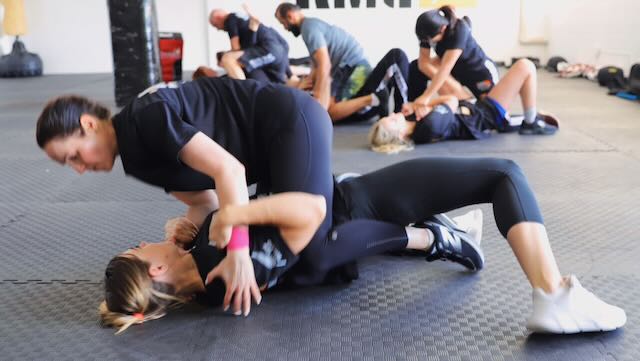
The practical skills involved — framing, releases, striking from the ground, movement patterns — are deliberately consistent with what students already know from standing training. This is intentional. Under adrenaline, familiar movements are more accessible than technical sequences learned in a completely different context.
Ground Defence vs Sport Grappling: Different Goals
BJJ and other grappling arts develop real skills — positional control, athleticism, and ground-fighting intelligence. That's not in question. The question is what those skills are optimised for, and whether those goals match civilian self-defence.
| Factor | Sport Grappling (BJJ/MMA) | KMG Ground Defence |
|---|---|---|
| Primary goal | Control and submission | Escape and return to standing |
| Number of opponents | One (rules enforced) | Accounts for multiple attackers |
| Environment | Matted surface, no hazards | Concrete, glass, furniture, obstacles |
| Weapons | None (rules enforced) | Weapons considered throughout |
| Time on ground | Extended engagement is normal | Minimised — ground is a dangerous place |
| Outcome measure | Points, submission, decision | Survival, escape, protecting others |
This comparison isn't an argument against grappling training. Understanding how to survive on the ground is essential — the difference is what you're training that survival to achieve. For a direct comparison of both systems, see Krav Maga vs BJJ.
The Mental Side of Ground Survival
One reason people panic when they go to the ground is the sudden loss of mobility and familiar orientation. Standing, you have options: you can move, you can create distance, you can disengage. On the ground, those options narrow quickly — and the stress response can make the narrowing feel more absolute than it is.
Realistic training builds familiarity with that experience. Students who have practised ground situations under controlled pressure are significantly less likely to freeze when they find themselves there unexpectedly — not because the situation is less serious, but because the environment is no longer completely unfamiliar.
This connects directly to the broader mental preparation framework in self-defence: the goal isn't to eliminate the stress response, it's to build enough familiarity that the response doesn't override your ability to act. Ground training is one of the most direct ways to build that familiarity with a specifically high-stress scenario.
Who Benefits from Ground Defence Training?
Ground defence is not an advanced topic reserved for students with existing grappling experience. It's part of the progressive KMG curriculum from early on, adapted for different fitness and experience levels.
Beginners benefit from early exposure to falling safely and basic ground positioning — not because they'll immediately face those situations, but because removing the unfamiliarity early makes every subsequent stage of training more effective. Women, older adults, and smaller-framed students often find the escape-focused approach particularly well-suited to their context: the goal isn't to overpower someone on the ground, it's to disengage from them.
Healthcare workers and security staff who work in environments where physical contact is a professional reality find ground defence training directly applicable. Parents who train often describe the awareness of multiple-attacker dynamics — what to do when others depend on you staying functional — as one of the most important things ground training develops.
Frequently Asked Questions
Yes. KMG training includes practical ground defence covering anti-takedown prevention, safe falling, defensive movement from the ground, counter-attacks, and rapid return to standing. The emphasis is on civilian self-defence priorities — escape and survival — rather than prolonged grappling engagement.
Real-world environments create specific risks that make extended ground engagement dangerous: concrete surfaces, environmental hazards, multiple attackers, and the possibility of weapons. Standing provides better mobility, wider awareness, more escape options, and a better ability to protect others. KMG trains getting up quickly not because ground skills don't matter, but because staying down in a real situation often makes the situation worse.
No. BJJ is a grappling sport that develops excellent positional control and submission skills — optimised for competition conditions. KMG ground defence is optimised for civilian self-defence: escape over control, minimal time on the ground, awareness of multiple attackers, and responses designed for real environments rather than a mat. Both systems include ground work; the goals and priorities are different.
Yes. Ground defence is introduced progressively from early in the curriculum — starting with safe falling and basic positioning, and building toward more complex escape and counter-attack scenarios over time. No prior grappling experience is required. The training is adapted for different fitness and experience levels.
Yes. Falling and rolling practice is part of the KMG curriculum — covering head protection, impact distribution, and rapid recovery of movement. These skills reduce injury risk both in self-defence situations and in everyday falls. Students typically find them applicable outside the gym relatively quickly after learning them.
KMG New Zealand currently runs active clubs in Auckland (North Shore and West Auckland) and Hastings in Hawke's Bay. Ground defence is part of the standard curriculum at all clubs. Courses are also building across Wellington, Christchurch, Hamilton, Tauranga, and other cities — see the locations page for current options.
Find Training Near You
Active clubs in Auckland and Hawke's Bay. Courses building across New Zealand.
Find Training Near YouNo experience needed.