
Krav Maga vs Kickboxing: Which Is Better for Self Defence?
Krav Maga Global New Zealand teaches a self-defence system for ordinary people, not a combat sport. Kickboxing and Krav Maga both develop real striking capacity — but they are built around different definitions of success. This article explains where they differ and what that means for someone focused on practical personal safety.
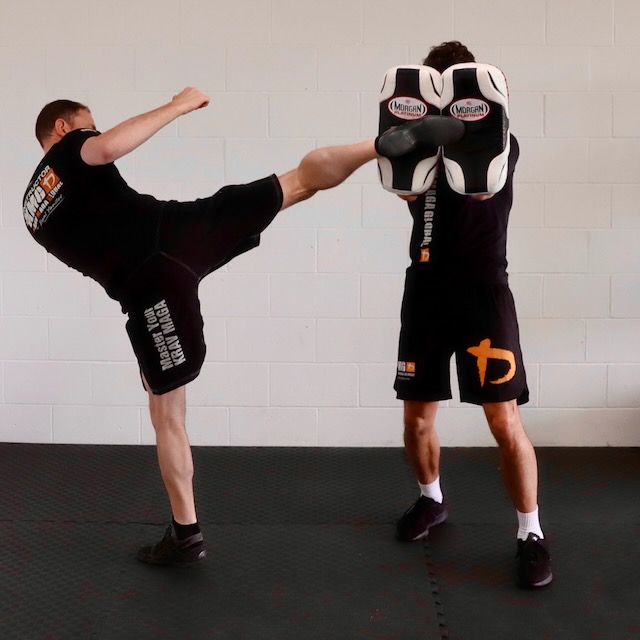
The core difference
Kickboxing is a combat sport. The training environment is controlled, the rules are fixed, and success means winning the match. Krav Maga is a self-defence system. The training environment is variable, there are no rules, and success means getting home safely.
Are they actually comparable?
Kickboxing and Krav Maga often get compared because both involve striking and both produce people who are physically capable under pressure. But that comparison can be misleading — they solve different problems.
Kickboxing trains you to be effective inside a sporting framework. Krav Maga trains you to be effective when there is no framework at all.
Neither makes the other irrelevant. Many experienced Krav Maga practitioners have a background in boxing, kickboxing, or Muay Thai — the striking mechanics carry across. What changes is the context in which that striking skill gets used.
What kickboxing genuinely does well
Kickboxing deserves credit here. It is one of the most effective ways to develop real striking ability, and the attributes it builds — timing, distance management, composure under pressure — are all genuinely useful in a self-defence context.
Striking mechanics
Punches and kicks are technically refined and thrown with real power. After months of training, they land correctly under pressure.
Conditioning
Kickboxing training is physically demanding. The fitness base it builds is real and applies well beyond the gym.
Distance management
Students learn to read range and control space — an underrated skill that carries directly into self-defence situations.
Pressure tolerance
Regular sparring produces people who stay functional when things become physical. That composure is hard to develop any other way.
Worth saying clearly
A kickboxer is not defenceless. The question is whether their training addresses the specific conditions that make real situations different from sport.
Where real-world self-defence diverges from sport
Sporting contexts are defined by what they exclude. There is a referee. There is one opponent. There are weight classes. You know the confrontation is coming and you are physically prepared for it.
Real situations remove almost all of that structure.
No warning
Most genuine attacks begin before you realise what is happening. Starting from a ready stance is rarely an option.
No rules
Real confrontations do not follow sporting rules or fairness. Sport trains you to exclude certain responses reflexively — responses that may matter when there is no referee.
The environment
Concrete, cars, crowds, confined spaces, uneven ground — the training mat is one of the least likely places a real situation occurs.
More than one person
Kickboxing structures one-on-one exchanges. Real situations frequently do not.
This is not a criticism of kickboxing — it is simply what sport frameworks are designed to control. The problem is that those exclusions become habits. Training shapes reflex, and sporting reflex does not always translate cleanly when the rules disappear.
Key takeaway: the most important difference is not technique — it is the conditions the training prepares you for.How the KMG training approach is different
Krav Maga Global's curriculum — the same system taught across 60+ countries — is built to operate without the safety structures sport provides. The KMG system was developed under Eyal Yanilov, who trained directly under Imi Lichtenfeld, the founder of Krav Maga. It is a system built for ordinary people, not an adaptation of a military or sport framework.
In practice, that means the scope of training is broader. Weapons threats are not an advanced topic reserved for experienced practitioners — they are integrated from the beginning because real situations do not wait for you to reach the right level.
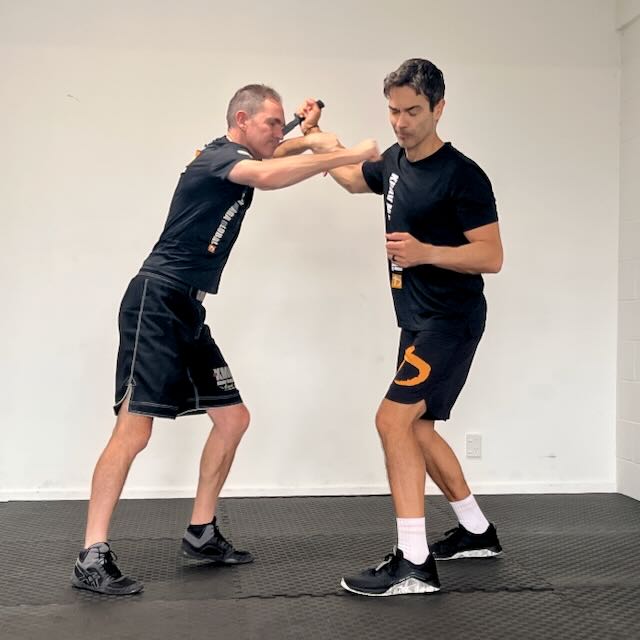
Knife defence in a KMG New Zealand class. Weapons threat scenarios are part of the curriculum from beginner level — not an advanced module.
Situational awareness
Training addresses what happens before any physical exchange — reading environments, avoiding confrontations, recognising risk earlier.
Scenario-based pressure
Scenarios replicate the unpredictability of real situations — starting position, verbal confrontation, confined space, multiple people.
Weapons awareness
Knife threats, stick defence, and threat management are integrated from beginner level — not reserved for advanced students.
Decision-making under stress
Students are trained to make fast judgements: when to act, when to disengage, when the threat has passed.
For a broader look at how the system is structured, see how Krav Maga works and whether it works in real-life situations.
Key takeaway: the KMG system trains for the full range of real situations — not just unarmed, one-on-one exchanges.Side-by-side: how the two systems compare
| Area | Kickboxing | Krav Maga (KMG) |
|---|---|---|
| Primary goal | Sport performance and competition | Self-defence in real-world conditions |
| Training environment | Controlled — mat, mouthguard, gloves, referee | Variable — scenarios, stress, multiple roles |
| Number of opponents | One | One or more |
| Awareness training | Not a focus | Central to the curriculum from the start |
| Weapons | Not covered | Knife, stick, and threat scenarios from beginner level |
| Kicking targets | Full range including head kicks | Practical focus — low and mid-level targets that work in street clothing |
| Rules | Fixed sporting rules | No rules — trains for unpredictable situations |
| Definition of success | Winning the match | Getting home safely |
A note on kicking
KMG does teach kicks — including roundhouse kicks. But the emphasis is deliberately practical. High kicks look impressive but they depend on flexibility, footwear, and a level floor. In real situations, you may be wearing jeans and shoes, on wet concrete, or in a confined space. KMG training favours low and mid-level kicks that work regardless of those variables — knee strikes, front kicks to the midsection, and low roundhouse kicks to the leg. The technique is there. The judgement of when and how to use it is trained in.
Is it an either / or decision?
Not necessarily. Many KMG practitioners have a striking background, and that foundation is useful. Kickboxing develops physical tools that transfer well — the difference is where those tools get applied and what else the training covers.
People who train both often describe kickboxing as sharpening their striking and Krav Maga as expanding the frame around it — who else is in the situation, what the environment looks like, whether a weapon is involved, whether the confrontation can be avoided entirely.
The real question
Both are effective disciplines. The question is whether your training addresses the full range of conditions a real situation might involve — not just the clean, one-on-one exchange a sporting context is built for.
Which is right for you?
If your goal is striking skill, fitness, and the experience of competing, kickboxing is excellent. It is one of the most honest ways to develop physical confidence under pressure.
If your primary goal is practical self-defence — the ability to handle a real situation, read environments, manage threats including armed ones, and act under pressure when necessary — Krav Maga covers a broader range of that problem.
The KMG system, as taught by Krav Maga Global New Zealand, is built for ordinary people who want to be less vulnerable and better equipped to manage the situations most people actually face.
For a wider view of how Krav Maga compares with other disciplines, see Krav Maga compared. If you want to understand the effectiveness question in a New Zealand context, this article covers it directly.
What people ask about Krav Maga vs kickboxing
For practical self-defence, Krav Maga covers a broader range of the problem. Kickboxing develops strong striking and composure under pressure, but it is built around sport rules and controlled, one-on-one exchanges. Krav Maga Global New Zealand trains for unpredictable real-world conditions: no rules, multiple attackers, weapons threats, and situational awareness. Both are valuable; the right choice depends on your goal.
Yes — and from beginner level. Weapons threat scenarios, including knife threats and stick defence, are integrated into the KMG curriculum from the start. Real situations do not wait until you reach a certain training level, so the system does not reserve this content for advanced students either.
Yes, and many KMG practitioners do. A kickboxing background provides solid striking mechanics that carry well into Krav Maga training. The KMG curriculum adds the self-defence context — situational awareness, scenario training, weapon defence, and decision-making under stress.
Yes. KMG includes kicks — including roundhouse kicks. The emphasis is on practical application: low and mid-level targets that work in street clothing, on uneven ground, and without the flexibility demands that high kicks require. Kicks are trained alongside punches, palm strikes, elbows, and knee strikes, all within the context of real situations rather than sporting exchanges.
Yes. KMG training is structured to build from fundamentals — no prior experience is required. Beginners learn awareness and positioning alongside physical techniques from the first session. A prior striking background is useful but not a prerequisite.
Krav Maga Global New Zealand has active clubs in Auckland and Hastings. Courses are building in Wellington, Hamilton, Christchurch, and other cities. The locations page at krav-maga-global.co.nz/locations has full details, including waitlist registration for cities where training is in development.
Find Training Near You
Active clubs in Auckland and Hastings. Courses building in Wellington, Hamilton, Christchurch, and beyond.