
Protecting Others in Self-Defence
Protecting another person — a partner, a child, a friend — is one of the most common reasons people start self-defence training, and one of the most demanding things that training can prepare you for. The tactical problems are genuinely different from protecting yourself: your positioning, your movement options, and your ability to stay calm under pressure all change when someone else depends on what you do next. Krav Maga Global integrates third-party protection into the curriculum from Practitioner Level 1 — because for most people, protecting others is the whole point.
Think about the moment that brought you here. For a lot of people, it's not a vague sense that they should be fitter or more capable. It's something more specific — a situation they imagined, or lived through, where someone they care about was vulnerable and they didn't know what to do.
That's a different motivation from training for yourself. And it should shape how you train. Protecting another person well — staying functional, making fast decisions, getting both of you out — is a skill. It's trainable. And the earlier you start building it properly, the more real it becomes.
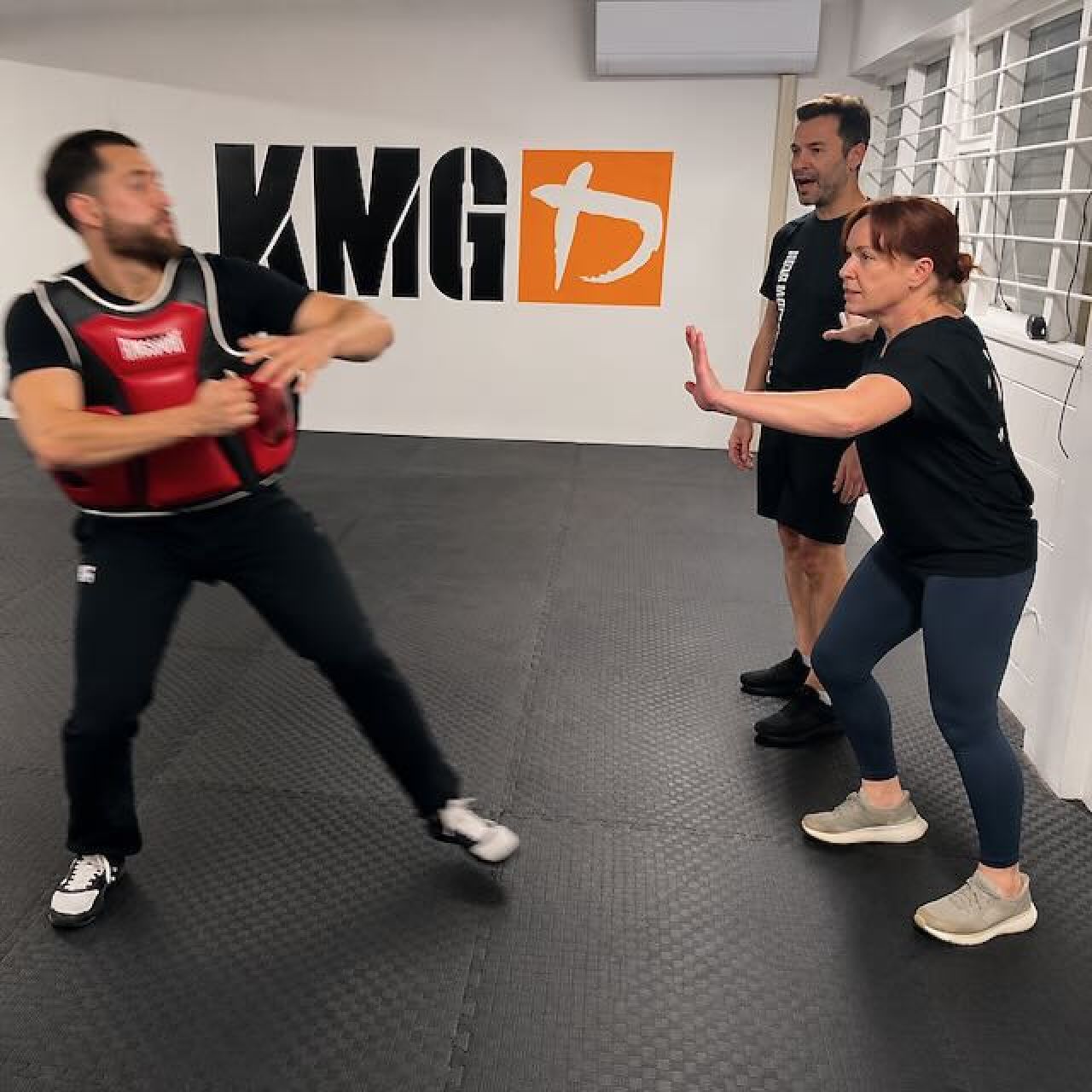
Third-party protection training at KMG New Zealand — positioning, movement, and escape under pressure.
Why protecting someone else is harder than protecting yourself
When you're responsible for another person in a dangerous situation, your options narrow in ways that solo training doesn't prepare you for. You can't position purely for your own advantage. You can't disengage freely. You have someone behind you who may freeze, move the wrong way, or grab onto you at exactly the moment you need to move — and their safety depends on decisions you're making under adrenaline, with incomplete information, in a compressed timeframe.
The person you're protecting introduces a second source of unpredictability. You're tracking the threat in front and managing someone behind you simultaneously. That cognitive load is real, and it compounds fast. The result is that people who train only for solo situations often find, when they walk through a third-party scenario for the first time, that it feels nothing like what they expected.
This is why the mental preparation dimension of self-defence matters so much here. The physical skills are part of it. But staying calm enough to communicate, to make a decision, to guide someone toward safety — that's the harder thing. Training that puts you in realistic third-party scenarios — with the unpredictability factored in — builds something genuinely different from drilling alone.
The sequence that gives you the best chance of getting everyone out safely
KMG training approaches third-party protection through a clear priority sequence — not a rigid script, but a framework that makes fast decision-making possible when the pressure is on. The goal is never to win a confrontation. It's to get everyone out. Every step in the sequence is oriented toward that outcome.
- Awareness — recognising what's developing early enough to still have options
- Positioning — placing yourself between the threat and the person you're protecting
- Movement — guiding the protected person toward safety, not just away from danger
- Escape — creating and using exit opportunities before the situation becomes physical
- Shielding — using your body, the environment, or objects to limit access
- Counter-attack — only when necessary, only to create the space needed to escape
The sequencing matters because each step is designed to make the next one unnecessary. Counter-attack sits at the end because everything before it is working to avoid it. Most third-party protection scenarios are resolved — or made survivable — at the awareness and positioning stage, before physical contact ever occurs. That's not theory. It's what realistic scenario training consistently shows.
How good positioning can change everything before anything physical happens
In third-party protection, positioning is the highest-leverage skill you can develop — and it's almost entirely a product of training, not instinct. When you position well before a situation escalates, you preserve options. When you don't, you eliminate them. The difference can be the whole outcome.
The general principles: threat in front, protected person behind or beside you, escape route available, barriers and obstacles working for you rather than against you. In a quiet room, that sounds simple. In a public space, under adrenaline, with someone beside you who doesn't understand what's happening — achieving it requires specific, repeated practice.
Physical movement with a second person — guiding someone behind you, stepping to redirect them, using your body to screen access — is a different motor skill from anything in solo training. It takes time to build, and it only gets built by practising it. KMG training introduces this from Practitioner Level 1, precisely because it's foundational, not advanced.
Situational awareness is what makes good positioning possible. The earlier you read what's developing, the more time you have to reposition before your options close. The two skills reinforce each other directly — and both are trainable from your first session.
What changes when you're protecting a child
Protecting a child introduces a set of tactical problems that don't apply to protecting an adult — and if you're a parent, these are probably the ones that matter most to you. Children move unpredictably. They panic differently. They can't follow complex instructions under stress. They may run toward danger rather than away from it. And they can't contribute to their own safety the way an adult can, even partially.
What this requires in practice: physical control of the child's movement, simple verbal commands that can actually be followed under stress, and positioning that accounts for their smaller size and the real possibility they're out of your sightline in a crowd or during the chaos of an incident.
"As a woman of a smaller build, I found that these classes strengthened me both physically and mentally."
Christine S. — KMG NZ memberThe confidence that comes from realistic training — the ability to move calmly under pressure, to stay clear-headed while managing another person, to make fast decisions when the stakes are highest — is exactly what protecting a child requires. It's not about being physically dominant. It never has been. It's about staying functional when the moment comes.
How the environment becomes your most underrated tool
Most people in a dangerous situation look for physical capability. The people who get out fastest look for exits, barriers, and objects — and they see them because they've trained to. A table between you and a threat, a door that limits access, a vehicle that provides cover, a wall that removes the risk of being flanked: these are not backup options. They're primary ones.
KMG training builds environmental awareness as a deliberate skill from early in the curriculum. Students practise reading spaces for exit routes, cover, barriers, and obstacles — not as a theoretical exercise, but in scenario-based drills where those decisions have to be made quickly under pressure. That's the only context in which the skill actually sticks.
When you're guiding someone out of a situation, the path matters. The fastest route and the safest route are often not the same. Knowing the difference — and being able to make that call in seconds — is something that exposure to realistic scenarios builds in a way that nothing else does.
Common objects used as barriers or shields are also covered in the KMG curriculum. The principle is consistent with the legal framework: using what's available in a genuine emergency is different from carrying something prepared for confrontation. Environmental awareness in KMG training is always oriented toward escape and protection — never toward escalation.
When there's more than one threat — and why escape matters even more
Public confrontations frequently involve more than one person, and this raises the cost of every mistake when you're also responsible for someone else. Tracking multiple potential threats while managing a protected person creates a cognitive load that compounds fast. The chance of missing something important rises sharply. And the consequences of being taken to the ground or trapped against a wall become far more serious when someone else's safety depends on your ability to stay mobile.
KMG training for multiple attacker scenarios — keeping threats in front, using space to avoid being flanked, prioritising escape over engagement — applies directly to third-party situations. The protected person makes these skills more important, not less. Staying mobile, creating space, and getting out fast is always the goal. With someone beside you, it's even more urgent.
The general principle: the longer a confrontation continues, the worse the odds. More people may become involved. Weapons may appear. Bystanders may interfere unpredictably. The escape-first orientation of KMG training isn't cautious — it's calculated. The cost of a prolonged confrontation rises faster when you're responsible for someone else. For a deeper look at what happens when situations go to the ground, see ground defence for self-defence.
Why being able to communicate under pressure is a physical skill
Calm, clear verbal communication is a functional part of third-party protection — and it's something most people lose access to under high stress, unless they've specifically trained it. Instructions to the person you're protecting. De-escalation directed at the threat. Commands that create hesitation or confusion. Recruiting attention from bystanders who don't yet understand what's happening.
These aren't additions to the physical curriculum — they're integrated into scenario training because real situations require both simultaneously. A student who can execute a technique cleanly but can't speak coherently under pressure has a gap that will show up exactly when it matters most.
Verbal performance under stress is a trained capability. It doesn't arrive with physical technique. It develops through repeated exposure to high-pressure scenarios where you're required to stay verbal — to give instructions, to stay clear, to communicate while everything else is also demanding your attention. That's the kind of training that actually transfers.
What New Zealand law says about protecting others — and why the KMG approach aligns with it
Under Section 48 of the Crimes Act 1961, New Zealand law permits the use of reasonable force to protect another person from an unlawful assault — not just yourself. The legal basis is the same as for self-defence, and so is the standard: force that is proportionate to the threat as you reasonably believe it to be, and that stops when the threat stops.
This means that stepping in to protect a partner, a child, or another person from genuine violence is legally grounded — provided the force used remains proportionate and you stop when the danger passes. Continuing to apply force after the threat has ended, or using more force than the situation warranted, can create legal exposure even when the initial intervention was fully justified.
KMG training reflects this directly — and it's one of the reasons the curriculum leads with avoidance, de-escalation, and escape rather than physical technique. That sequencing isn't only an ethical position. It aligns with what New Zealand law actually requires of you if a situation is ever examined afterwards. Training that teaches escalation, or that doesn't address where the legal lines are, is incomplete in a way that matters.
Frequently asked questions
Yes. Third-party protection is a specific part of the KMG curriculum, introduced from Practitioner Level 1 onward. Students learn positioning, shielding, movement with a protected person, and how to manage a violent situation when they're responsible for someone else's safety — not just their own. Krav Maga Global builds this in from the start because for most people, protecting others is the reason they're training.
Yes. Section 48 of the Crimes Act 1961 permits the use of reasonable force to defend another person from unlawful assault, not just yourself. The same standard applies as in self-defence: the force must be proportionate to the threat and must stop when the threat stops. KMG training is built around this legal framework — the emphasis on de-escalation and escape-first isn't only ethical, it's legally sound.
Panic under stress is a normal physiological response — and training is specifically designed to reduce its impact. Repeated exposure to high-pressure scenarios in a controlled environment builds familiarity with the stress response, which makes it less likely to overwhelm your decision-making when it matters. The goal isn't to eliminate fear. It's to stay functional despite it. That's a trainable outcome, and it's one of the core things KMG scenario training is built to develop.
Yes — and many parents find it one of the most directly applicable forms of training available. The KMG curriculum covers the specific challenges of protecting a child: movement control, clear verbal commands under stress, positioning with someone smaller and more unpredictable, and escape routes that account for a person who can't contribute to their own safety. No prior experience is required to begin, and the skills are practical from your first session.
Physical strength is far less important than awareness, positioning, and decision-making — and all three are trainable regardless of your starting point. A person who reads a situation early, positions well, and guides someone toward an exit is more capable than one who is physically strong but hasn't trained the tactical dimension. The KMG approach to third-party protection emphasises movement and escape over physical confrontation — which is both more effective and more accessible.
KMG New Zealand runs active clubs in Auckland (North Shore and West Auckland) and Hastings in Hawke's Bay. Third-party protection is part of the standard curriculum at all clubs from Practitioner Level 1. Courses are building in Wellington, Christchurch, Hamilton, Tauranga, and other cities — see the locations page for current options and to register your interest.
Find Training Near You
Active clubs in Auckland and Hawke's Bay. Courses building across New Zealand.
Find Training Near YouNo experience needed.