
Self-Defence for Nurses and Healthcare Workers in New Zealand
Krav Maga Global New Zealand trains a significant number of healthcare professionals — surgeons, doctors, nurses, paramedics, and physiotherapists — precisely because the system is built around controlled, proportionate response rather than fighting. In healthcare, the challenge is not just physical safety. It is protecting yourself while maintaining your duty of care to the person in front of you. KMG provides a framework for exactly that.
If you work in healthcare, you already know something most people do not: workplace violence is real, and it does not always look the way people expect.
Whether you are in an emergency department, on an ambulance callout, working a night shift in a mental health ward, or walking to your car at the end of a long shift, aggression can escalate quickly — and the person you are dealing with is often someone you are there to help.
That creates a tension that most self-defence training simply does not address. This article explains how Krav Maga does.
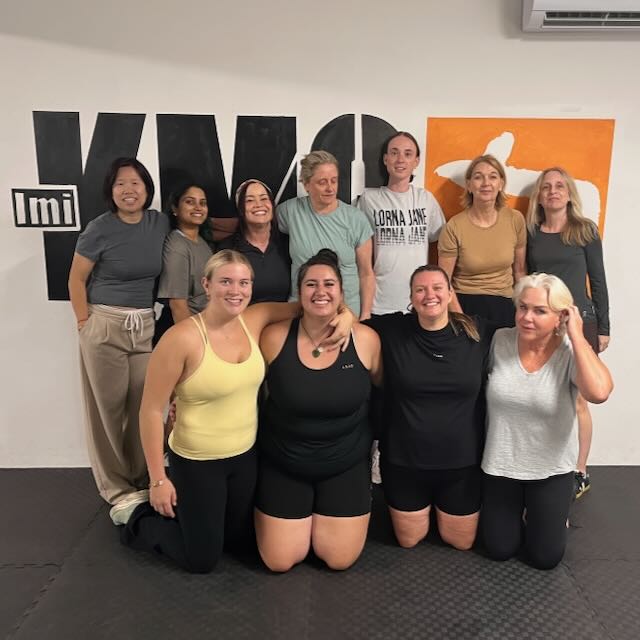
KMG New Zealand runs workplace seminars for healthcare teams — including a dedicated seminar with Takapuna Health — because the risk environment for clinical staff is genuinely different from street self-defence.
Why violence in healthcare is different
The person becoming aggressive in front of you is not a stranger in a car park. They may be a patient in severe pain, someone in a mental health crisis, a person affected by drugs or alcohol, or a distressed family member who has just received bad news.
You are not there to fight them. You are there to care for them — and in many cases, you have a professional and legal responsibility that continues even when your own safety is at risk.
That changes everything about how you can respond. A system that teaches you to hit first or to dominate a confrontation is worse than useless in a clinical environment. It can expose you professionally and legally, and it can make the situation significantly worse for everyone involved, including other patients and colleagues nearby.
Key takeaway: healthcare professionals need a self-defence approach that keeps them safe without compromising their duty of care or their professional standing.The risk environment most people miss
The aggression risk for healthcare workers is not limited to clinical settings. It extends into the parts of the job that people rarely discuss.
Shift work and lone travel
Nurses, paramedics, and support staff often finish late-night or early-morning shifts alone. Walking to a car park, waiting at a bus stop, or travelling between sites at unusual hours creates genuine personal safety exposure that is entirely separate from the clinical environment.
Hospital car parks and transition spaces
Multi-storey car parks, poorly lit walkways, and the areas between buildings are among the most common locations where healthcare workers feel vulnerable. Awareness and positioning matter enormously here — before anything physical is even a consideration.
In-situ clinical aggression
Grabs, pushes, and sudden aggression from patients or family members happen in corridors, wards, ambulances, and GP reception areas — often in confined spaces where movement is limited and colleagues may not be immediately nearby.
Verbal escalation before physical contact
Many incidents involve sustained verbal pressure, boundary violations, or intimidation that builds over time. Recognising and responding to that earlier — before it becomes physical — is often where the most important decisions are made.
Why most training does not fit healthcare environments
Most martial arts and combat sports are built around winning a physical confrontation. That creates real problems in clinical settings.
Escalating physically — even if technically effective — can create legal and professional exposure. Striking or throwing may not be appropriate given your duty of care. The environment is often confined and unpredictable, with other patients, equipment, and colleagues nearby. And you may be dealing with someone whose aggression is a symptom of their condition rather than a choice.
A self-defence system built around fighting harder is not what clinical staff need. They need something built around staying in control.
How Krav Maga approaches this differently
Krav Maga is not about fighting — it is about managing a situation and getting safe. In KMG New Zealand training, the emphasis begins before anything physical happens, and the objective at every stage is the most controlled and proportionate response available.
Awareness and early recognition
Reading behavioural cues early — changes in tone, body language shifts, proximity that feels wrong — is a core part of KMG training. In a clinical environment, this is particularly valuable because staff often have advance notice of escalation if they know what to watch for. Acting earlier, when the window is still open to de-escalate, is almost always the better outcome.
Verbal boundaries and de-escalation posture
Clear, calm communication, appropriate physical positioning, and confident non-threatening posture can often prevent a situation from becoming physical entirely. For healthcare workers who regularly manage difficult behaviour as part of their role, this is the layer of training with the most immediate practical value.
Controlled physical response — only when unavoidable
If physical action becomes genuinely unavoidable, the KMG approach focuses on three things: create space, break contact, and move to safety. Not sustained exchange. Not retaliation. Not domination. The objective is always to disengage and reach a position where the situation can be managed by others or where you are no longer in immediate danger.
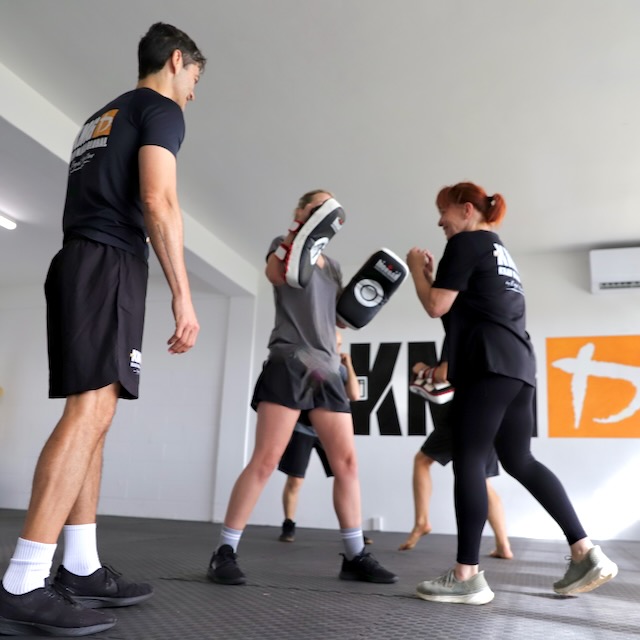
KMG New Zealand training introduces technique progressively — building from awareness and verbal skills through to controlled physical responses, matched to the student's role and environment.
What controlled self-defence looks like in practice
In healthcare-relevant scenarios, the focus is always on the minimum effective response — enough to create safety, nothing more.
| Scenario | KMG approach |
|---|---|
| Wrist or arm grab from a patient | Release the grip, step back, create distance — maintain calm verbal contact throughout if possible |
| Verbal escalation in a confined space | Hands in a non-threatening open position, clear verbal boundary, move to improve exit access without crowding the person |
| Shove or sudden push | Recover position, create distance, redirect toward exit — not counterattack |
| Close-range aggression in a ward or ambulance | Use body positioning and barriers, simple gross motor movement to disengage, prioritise exit |
| Lone worker, car park, night travel | Awareness, early recognition, voice and movement — physical response only if escape is blocked |
The constant goal
Create an opportunity to disengage safely. In a clinical environment, that also usually means getting to a position where colleagues can assist or where the aggressor can be managed through appropriate channels — not where you are still in the middle of a physical exchange.
Why simplicity matters under stress
In a high-stress situation, fine motor skills break down. Heart rate spikes. Decision-making narrows. The complexity that seemed manageable in a calm training environment becomes unreliable when the pressure is real.
This is one of the core design principles of Krav Maga — and it is directly relevant to healthcare workers, who are often managing their own stress response while simultaneously trying to manage a clinical situation and the people around them.
KMG training focuses on simple, gross motor actions that remain accessible under pressure. You are not relying on precision or physical strength. You are relying on responses that have been drilled enough to be available when composure is most difficult to maintain.
Key takeaway: under genuine stress, only the simplest responses remain reliably available. That is not a weakness of the training — it is the point of the training.Who trains in KMG New Zealand — and why
The KMG New Zealand instructor team regularly trains healthcare professionals in both regular classes and dedicated workplace seminars. Current and past participants have included surgeons, doctors, nurses, paramedics, and physiotherapists — people who deal with high-pressure human situations as a core part of their work.
What tends to draw healthcare professionals to KMG training is not intensity. It is structure and clarity. The progression is controlled. The scenarios are realistic without being reckless. And the system is built around principles — awareness, proportionate response, escape — that are compatible with professional environments rather than in conflict with them.
KMG New Zealand has also delivered dedicated workplace seminars for healthcare organisations, including a seminar with Takapuna Health. All-women workplace groups in particular have found the training directly relevant to the specific situations they face — including lone night-shift travel and car park safety — in a way that generic self-defence training rarely addresses.
Is this training legally safe for healthcare workers?
In New Zealand, self-defence is governed by the principle of reasonable force under Section 48 of the Crimes Act 1961. Your response must match the threat you honestly believed you were facing, and it must stop when that threat stops.
KMG training aligns with this directly. The system emphasises proportionate response, disengagement rather than retaliation, and stopping once safety has been created. That makes it far more compatible with the professional expectations of clinical staff than systems focused on sustained physical dominance.
For more detail on how New Zealand self-defence law works in practice, read Krav Maga, Self-Defence, Law and Ethics.
Key takeaway: KMG training is built around the same principles that govern lawful self-defence in New Zealand — proportionate, controlled, and stopping when the threat stops.So is Krav Maga suitable for healthcare workers?
Yes — because it is built around the same priorities healthcare professionals already operate under: control over chaos, awareness over reaction, safety over ego.
It does not require strength, prior martial arts experience, or a competitive mindset. What it requires is a willingness to think about personal safety more clearly — and to build a few practical skills that make the moments of real pressure more manageable.
For healthcare workers especially, that shift in awareness alone — noticing earlier, creating space sooner, having language and positioning ready before things escalate — can be the most valuable thing training provides.
What healthcare workers ask about self-defence training
Yes — and KMG training is particularly suitable because it is built around controlled, proportionate response rather than fighting. The emphasis is on awareness, de-escalation, and disengagement, which aligns with the professional expectations of clinical staff rather than conflicting with them.
KMG training is built around the principle of minimum effective response — creating space and disengaging safely, not dominating or retaliating. That approach is compatible with both New Zealand self-defence law (reasonable force under Section 48 of the Crimes Act) and with the professional expectations of clinical environments.
Yes. KMG New Zealand trains healthcare professionals including surgeons, doctors, nurses, paramedics, and physiotherapists, and has delivered dedicated workplace seminars for healthcare organisations. Training covers scenarios including confined-space incidents, wrist grabs and pushes from patients, verbal de-escalation, and lone-worker night travel safety.
Directly relevant. Car parks, poorly lit walkways, and late-night lone travel are genuine risk environments for healthcare workers — and they are separate from the clinical self-defence question. KMG training covers awareness, early recognition, positioning, and safe exit for exactly these everyday transition spaces.
No. Most healthcare professionals who train with KMG come with no martial arts background. The training is progressive, structured, and matched to realistic scenarios — not built around physical dominance or prior athletic ability.
Yes. KMG New Zealand has delivered dedicated workplace seminars for healthcare organisations. To enquire about a seminar for your team, the best starting point is the contact page or the national locations page to connect with the instructor network.
Find Training Near You
Whether you want to join a regular class or enquire about a workplace seminar for your team, the national locations page is the best place to start.