
Krav Maga vs Muay Thai: A Complete Guide for Self-Defence
Krav Maga Global New Zealand teaches a civilian self-defence system built for real-world unpredictability. Muay Thai is one of the most powerful striking systems in the world — and much of that striking mechanics carries directly into Krav Maga. What differs is the context: Muay Thai is designed for the ring, with rules, one opponent, and a controlled environment. Krav Maga is designed for everything else.
The core difference
Muay Thai is a combat sport refined over centuries for ring competition. Krav Maga is a civilian self-defence system designed for situations where there are no rules, no referee, and no guarantee of a single opponent — and where the goal is not to win, but to get home safely.
Is Muay Thai effective for self-defence?
Yes — genuinely. Muay Thai develops striking ability that few other disciplines match. The mechanics of elbows, knees, clinch control, and powerful kicks are technically refined and tested under real pressure. Anyone who has trained Muay Thai seriously brings something real into a self-defence context.
But what Muay Thai prepares you for is a specific kind of confrontation: one opponent, standing, in open space, with agreed rules and a referee in place. That is a very particular set of conditions — and real situations rarely honour any of them.
Striking power
The eight-limb system — fists, elbows, knees, kicks — produces some of the most effective striking in any discipline. These mechanics transfer well.
Clinch control
Muay Thai's clinch work is sophisticated: controlling the head, landing short strikes, managing distance. All directly applicable at close range.
Conditioning
Muay Thai training builds fitness, toughness, and genuine composure under physical pressure. That foundation carries across into any high-stress situation.
Pressure testing
Sparring regularly against resisting opponents develops the ability to think and act under stress — a quality that is rare and genuinely valuable.
Where the ring and the street diverge
The rules that make Muay Thai a sport also define its limits as self-defence preparation. A referee stops the fight when someone goes down. Weight classes ensure rough physical parity. Real situations operate without any of that structure.
No warning
Genuine attacks typically begin without a square-up or ready position. The moment of surprise is where sport preparation has the least to offer.
Multiple people
Ring competition is one-on-one by design. Real situations have no such constraint — and managing more than one attacker requires entirely different thinking.
Weapons
Muay Thai does not address armed threats. Real self-defence situations sometimes involve weapons, and training that ignores this leaves a significant gap.
Sporting reflex
Years of training within rules creates deeply embedded habits. Those habits can work against you when the rules disappear — particularly around targets and responses that sport forbids.
Side-by-side: how the two systems compareSelf-Defence Advantage: Krav Maga
| Area | Krav Maga (KMG) | Muay Thai |
|---|---|---|
| Primary goal | ✓ Designed for thisSelf-defence in real-world conditions — no rules, no referee. | Sport focusRing competition and striking excellence. |
| Training environment | ✓ Variable and realisticScenarios, stress, confined spaces, multiple roles. | ControlledRing, referee, weight class, agreed rules. |
| Number of opponents | ✓ Trained for thisMultiple-attacker awareness from beginner level. | OneSport format assumes single opponent. |
| Weapons | ✓ Core curriculumKnife, stick, and threat scenarios from beginner level. | Not coveredOutside the sport entirely. |
| Surprise & ambush | ✓ Trained for thisScenario training from non-ready positions. | Not addressedFights begin from mutual ready stance. |
| Striking mechanics | Elbows, knees, kicks — adapted for civilian context. | ✓ Strongest hereEight-limb system, deep technical refinement, high sparring volume. |
| Awareness training | ✓ Central curriculumThreat recognition, situational awareness from the start. | Not a focusNot relevant inside a sport context. |
| Legal context | ✓ Built inProportionate force, de-escalation, NZ legal framework. | Not addressedSport rules govern what's permitted. |
| Definition of success | Getting home safelyEscape-first, proportionate, decisive when necessary. | Winning the matchPoints, stoppage, or decision in a refereed contest. |
The problem with training for a fight you can see coming
Most people imagine self-defence as a confrontation they can see developing.
Two people facing each other. Space to move. Time to react.
Real violence often begins much earlier than that.
It may start with someone crowding your space, grabbing clothing, blocking your exit, or becoming aggressive before you have fully realised what is happening. There is no stance. No squared-up opponent. No moment where both sides acknowledge something is about to happen.
That is where self-defence starts becoming a different skill from fighting — and where Muay Thai's preparation, however excellent inside the ring, starts to reach its limits.
That realisation is often the moment people decide to start training. Not because they expect violence, but because they recognise that if something does happen, they would rather have options than assumptions.
Why striking skill is only part of the self-defence picture
Muay Thai gives people powerful tools.
The challenge is that many real situations are not solved by striking alone.
You may need to recognise danger early, create distance, protect another person, de-escalate an argument, or leave before anything physical happens. A person who is very good at throwing elbows is still potentially in trouble if they did not see the confrontation developing, could not communicate clearly enough to avoid it, or had no plan for what happens when a second person joins in.
Those skills sit outside the ring, but they are central to civilian self-defence.
How KMG adapts Muay Thai mechanics
Krav Maga Global's curriculum does not reject Muay Thai. It incorporates it. Elbows, knees, clinch control, and low kicks all appear in the KMG curriculum — developed under Eyal Yanilov who trained directly under Imi Lichtenfeld, the founder of Krav Maga. What changes is how they are applied and what they are applied within.
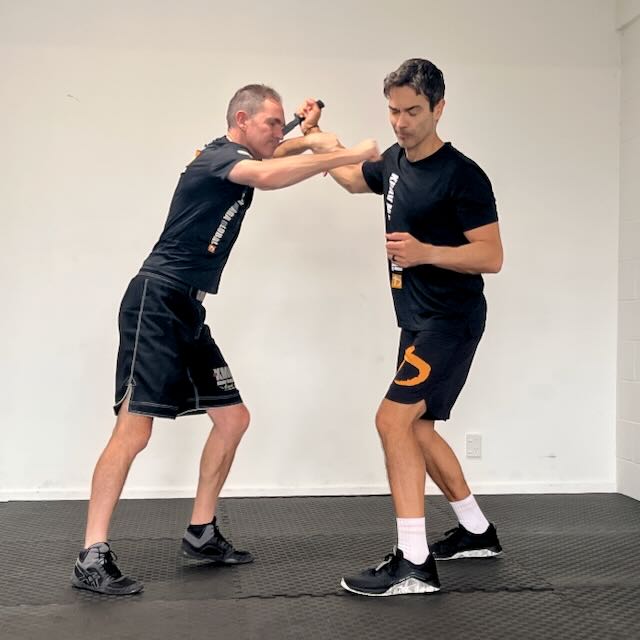
Knife defence in a KMG New Zealand class. Armed threat scenarios are part of the curriculum from beginner level — a dimension Muay Thai training does not address.
Stance and posture
A Muay Thai guard signals readiness to fight. KMG uses a passive, non-aggressive posture that avoids escalation — while keeping the same capacity to act immediately.
Clinch — survival first
In Muay Thai the clinch is a striking platform. In KMG it becomes a control tool: protecting against takedowns, checking for weapons, managing distance to create escape.
Target selection
Sport rules restrict targeting to create a fair contest. KMG has no such restriction — the goal is to end a genuine threat quickly and safely, not to win on points.
The wider frame
Striking skill operates inside a larger system: situational awareness, de-escalation, reading threats, managing multiple people, and knowing when to disengage.
For a fuller picture of how the KMG system is structured, see how Krav Maga works and the Krav Maga self-defence timeline.
Does a Muay Thai background help in Krav Maga?
Significantly. A Muay Thai background is one of the most transferable foundations a KMG student can bring. The striking mechanics, physical conditioning, and composure under pressure are all immediately useful — and the transition period is shorter than for people coming from grappling-only backgrounds or no martial arts experience at all.
What transfers from Muay Thai
- Elbow and knee mechanics
- Clinch awareness and control
- Striking power and timing
- Conditioning and pressure tolerance
- Comfort with close-range exchanges
What KMG adds
- Situational awareness and threat recognition
- Weapon defence from beginner level
- Multiple-attacker scenarios
- De-escalation and verbal management
- Decision-making under real-world stress
The transition
For a Muay Thai practitioner, Krav Maga training is not starting again. It is expanding the frame around physical skills that are already well-developed — and learning to apply them in conditions sport does not prepare you for.
Which should you choose?
If your goal is striking excellence, ring competition, or becoming a technically refined fighter, Muay Thai is one of the best choices available anywhere in the world. If your goal is practical self-defence — managing real situations including weapons, multiple people, and conditions you cannot predict — Krav Maga addresses a broader range of that problem.
Many people train both, and there is real value in that combination. Muay Thai sharpens the striking; Krav Maga provides the frame within which that striking gets used when it matters outside the ring.
For a wider view of how Krav Maga compares with other systems, see best martial art for self-defence and Krav Maga compared.
What people ask about Krav Maga vs Muay Thai
Yes, to a point. Muay Thai develops powerful striking ability that would give most people a meaningful advantage in a one-on-one physical confrontation. The limitation is that it is built around sport conditions — one opponent, rules, open space — and real situations frequently do not provide those conditions. Weapons, multiple attackers, and confined environments are not things Muay Thai training addresses.
Yes. Elbows, knees, clinch control, and kicks all feature in the KMG curriculum. What differs is how they are applied: in KMG, they operate inside a broader system that includes awareness, de-escalation, weapon defence, and multiple-attacker management.
Significantly so. Muay Thai practitioners bring striking mechanics, conditioning, and composure under pressure that transfer directly into KMG training. The transition is typically faster than for people with no striking background.
Situational awareness, threat recognition, de-escalation, weapon defence (knife, stick, threat scenarios), multiple-attacker management, and decision-making under real-world stress. These are not part of Muay Thai training because they are not relevant to ring competition — but they are central to what practical self-defence requires.
Yes, and the combination is a strong one. Muay Thai continues to develop striking mechanics and conditioning; Krav Maga provides the self-defence frame around those physical tools.
Krav Maga Global New Zealand has active clubs in Auckland and Hastings. Courses are building in Wellington, Hamilton, Christchurch, and other cities. The locations page at krav-maga-global.co.nz/locations has full details.
Find Training Near You
Most people do not need to become fighters. They need to become harder to overwhelm. That is the problem Krav Maga was designed to solve.
Active clubs in Auckland and Hastings. Courses building in Wellington, Hamilton, Christchurch, and beyond.